


Dykning med Draadvinnige brasems
Onderwaterleven Lanta | Nemipteridae
Er zijn ongeveer 70 soorten draadvinbrassen, ook wel valse snappers genoemd. Ze hebben een lang, ovaalvormig lichaam met grote schubben en worden vaak gezien tijdens duikexcursies naar Koh Lanta. Ze hebben een kleine bek en sommige soorten hebben een stekel onder de ogen.
Draadvinbrassen hebben meestal heldere kleuren, variërend van zilver en zwart tot licht- en donkerbruin, soms met een gele streep. Sommige soorten kunnen ook een verlengd filament op de bovenste staartvinlob hebben.
Deze familie wordt vaak aangetroffen boven zand, puin, anemonenbedden en in de buurt van koraal. De meeste soorten jagen op kleinere vissen, koppotigen, schaaldieren en borstelwormen; enkele soorten eten echter plankton.
Draadvinnige brasems worden in veel gebieden commercieel bevist en zijn gastheer voor grote aantallen parasieten, maar geen enkele is gevaarlijk voor de mens.
5 soorten gevonden op deze pagina:
Two-Lined Monocle Bream
(Scolopsis bilineata)
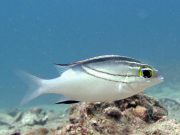
Scolopsis bilineata @ Koh Bida
The two-lined monocle bream is commonly encountered over sandy and rubble areas at the edge of the reef.
The body is mostly white, with a dark grey streak running from the snout nearly to the rear of the dorsal fin. There are three whitish/yellowish stripes on the head and a white band with black edges runs from below the eye to the rear of the dorsal fin.
This bream grows to 25 cm, but is often observed smaller than this, either singly or in pairs.
The two-lined monocle bream diet includes small fishes and bottom-dwelling invertebrates.
Monogram Monocle Bream
(Scolopsis monogramma)

Scolopsis monogramma @ Koh Haa
The monogram monocle bream has a pale body, whitish or grey, with a sky blue and yellow band which runs above and between the eyes.
The dorsal fin is yellow, with a sky blue tinge on the body running alongside the dorsal fin.
The tail fin is yellow and there is a dusky stripe along the middle part of the body.
The monogram monocle bream is usually found along the reef edge, on sandy or rubble bottoms and can grow to 26 cm, but is usually observed much smaller than this, typically 10 - 15 cm.
The diet of this species includes small fish, crustaceans, molluscs and bristle-worms.
Pearly Monocle Bream
(Scolopsis margaritifer)

Scolopsis margaritifer @ Koh Bida
The pearly monocle bream has a pearly/olive upper body colour, and a generally whitish lower body colour.
The upper lobe of the tail fin is yellowish, and the lower lobe is reddish. The pelvic fins base is yellow, as is the pectoral and anal fins. The Indian variation has different colouration from the Pacific variation.
The dorsal fin has 10 spines and 9 soft rays and grows to 25 cm, though is usually observed smaller than this, often 10 - 15 cm.
As with the other breams, this species frequents the sandy and rubble areas around the edge of the reef.
Whitecheek Monocle Bream
(Scolopsis torquatus)
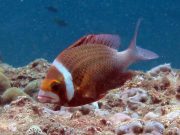
Scolopsis torquatus @ Koh Bida
The whitecheek monocle bream has a deeper body than many of the other species in this family (less compressed, wider). The body is a deep reddish to purple/brownish colour and the scales have slightly darker centers.
This species has a broad white bar on the head, behind the eye. The snout may be more lightly coloured, with lighter/pale lips.
This species grows to 25 cm, and as with other monocle breams, the whitecheek monocle bream is also usually found over sand and rubble, solitary or in small groups.
Whitestreak Monocle Bream
(Scolopsis ciliatus)
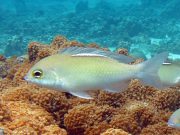
Scolopsis ciliatus @ Koh Haa
The whitestreak monocle bream has a pale grey body with between two and four rows of yellowish or slightly orange spots running length-ways along the side.
The name of this species derives from the bright white streak below the dorsal fin.
The whitestreak monocle bream grows to 25 cm, but usually observed smaller than this.
Can be found singly, or in small groups over soft coral and anemone beds, sandy and rubble areas close to the reef.
Duiken met Draadvinnige brasems rond Koh Lanta
Duiken & Snorkeltrips
Als je graag een kans hebt om Draadvinnige brasems te spotten op een van onze dagelijkse hoogseizoen duiktrips vanuit Koh Lanta, stuur ons dan een email naar info@diveandrelax.com.
Ga mee met onze speedboot duiktrips in het hoogseizoen naar enkele van Thailand's beste duiklocaties en geniet van kleine groepen, korte reistijden, met een focus op goede persoonlijke service, veiligheid en plezier.
Not yet a certified diver? Learn to Scuba Dive on Koh Lanta with the 3 day SSI Open Water Diver course.
Boek online en bespaar 10% op duiktrips en duikcursussen op Koh Lanta.
Meer informatie
Indo-Stille Oceaan gidsen
- Allen, G., Steene, R., Humann, P., DeLoach, N. (2003) Reef Fish Identification, Tropical Pacific. Jacksonville, FL., USA: New World Publications, Inc., ISBN 1-878348-36-1.
- Humann, P., DeLoach, N., (2010) Reef Creature Identification, Tropical Pacific. Jacksonville, FL., USA: New World Publications Inc., ISBN 978-1-878348-44-9
- Debelius, H. (2013) Indian Ocean Reef Guide. Frankfurt, Germany: IKAN - Unterwasserarchiv, ISBN 978-3-939767-52-7.
- Debelius, H. (2004) Nudibranchs and Sea Snails, Indo-Pacific Field Guide. Frankfurt, Germany: IKAN - Unterwasserarchiv, ISBN 3-925919-51-1
- Erhardt, H., Knop, D. (2015) Corals Indo-Pacific Field Guide. Frankfurt, Germany: IKAN - Unterwasserarchiv, ISBN 3-925919-69-4.
- Veron J.E.N., Stafford-Smith M.G., Turak E. and DeVantier L.M. (2016). Corals of the World