


Dykning med Geitvissen
Onderwaterleven Lanta | Mullidae
Er zijn ongeveer 40 soorten geitvissen, die allemaal worden gekenmerkt door twee lange baarddraden op de kin, waarmee ze in het sediment naar voedsel zoeken. Zodra ze hun prooi hebben gevonden, zie je ze met hun baarddraden en snuit in het sediment wroeten op zoek naar kleine kreeftachtigen en wormen. Hun laag geplaatste mond en korte onderkaak zijn perfect voor deze taak. De lange sensorische baarddraden kunnen in een groef op de keel worden opgeborgen, en deze vissen zijn een veelvoorkomend verschijnsel tijdens duiken bij Koh Lanta.
Geitvissen hebben twee duidelijk gescheiden rugvinnen en een gevorkte staartvin. De kop en het lichaam zijn bedekt met schubben en de meeste soorten hebben opvallende zwarte, bruine, rode of gele vlekken. De meeste soorten zijn ook in staat om snel van kleur te veranderen.
Ze zijn meestal te vinden op open zand- of modderbodems, in ieder geval om te eten, en trekken naar koraalgebieden voor reinigingsstations en de kleine reinigingslipvissen die dode schubben en parasieten van het lichaam en de kieuwen verwijderen.
6 soorten gevonden op deze pagina:
Freckled Goatfish
(Upeneus tragula)
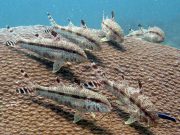
Upeneus tragula @ Koh Haa
The freckled goatfish, also known as the bar-tail goatfish, has a whitish or tan body with a heavy mottling of brown blotches, spots and lines.
This species has a dark yellowish to brown stripe from snout to tail, and all fins have red, brown or black stripes, bars or blotches. The first dorsal fin has a large dark blotch around the tip and there are dark bars on the tail fin lobes. The barbells are yellow.
The freckled goatfish may rapidly change to tan or red with a dark red stripe from the snout to the tail.This phase change may occur during cleaning or when sleeping at night.
This species grows to a maximum of 30 cm, but is usually observed much smaller, in the 15 - 20 cm range in small groups or solitary. The freckled goatfish is found on the reef edge, foraging for food in the sand and rubble areas.
Dash-Dot Goatfish
(Parupeneus barberinus)
The dash-dot goatfish grows to 50 cm and has a usually white body. The upper back may be yellowish or dark reddish, with a darker stripe running from the snout to below the second dorsal fin. The dark stripe has a much lighter silvery-bluish stripe below this. There is a large dark blotch on the tail base.
This species is capable of changing colour very quickly. The dash-dot goatfish may also display thick vertical banding on its sides which highlights the lighter stripe running from the snout to tail base. The lighter silvery-bluish stripe is much more obvious during the dark colouration phase.
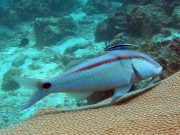
Parupeneus barberinus @ Koh Haa
In some texts this colour change is claimed as a red-variation existing in species from deeper water. The photos here were taken at 15 m and show an obvious rapid colour change from the 'light variation' to the 'red variation'. Rather than two distinct 'variations' depending on depth, it is much more likely that this species exhibits a reddish colour phase during cleaning and sleeping at night, as has already been documented with the freckled goatfish (Upeneus tragula).

Dash-Dot Goatfish rapid colour change
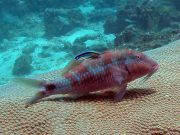
Dash-Dot Goatfish rapid colour change
The dash-dot goatfish is usually solitary but may form small groups. This species is often found over sandy or coral rubble areas close to the reef edge. Photos here show this goatfish species at a cleaning station on the reef edge at Koh Haa, along with rapid colour change.
Cinnabar Goatfish
(Parupeneus heptacanthus)
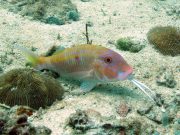
Parupeneus heptacanthus @ Koh Bida
The Cinnabar Goatfish is a brownish yellow to light red fish, capable of very rapid changes in body colour and pattern.
There are iridescent blue stripes and markings around the eyes and along the upper body. There is a small reddish brown spot on the mid-side.
The Cinnabar Goatfish grows to 36 cm and is usually seen solitary or in small groups over sand and coral rubble areas searching for food.
Goldsaddle Goatfish
(Parupeneus cyclostomus)

Parupeneus cyclostomus @ Koh Haa
The Goldsaddle Goatfish has a highly variable colour, including purple, blue, green, yellow and brown.
Often there is a yellow saddle just forward of the tail base, below the second dorsal fin.
All colour variations have several small blue lines and streaks around the eyes.
The Goldsaddle Goatfish is capable of rapid colour change to a bright yellow, or deep gold colour, except for the blue lines and streaks around the eyes.
The Goldsaddle Goatfish grows to 50 cm and feeds during the day.
The diet includes small fishes, crustaceans, worms, shrimps, crabs, octopi, and small gastropods.
Yellowfin Goatfish
(Mulloidichthys vanicolensis)
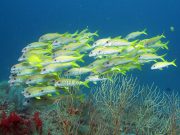
Mulloidichthys vanicolensis @ Koh Haa
The yellowfin goatfish grows to 38 cm and has a whitish to pinkish body with a yellow back, and a yellow stripe running from the eye to the base of the tail fin. The fins are yellow.
During the day the yellowfin goatfish forms large groups which are relatively inactive/stationary. These groups then disperse to feed on sand-dwelling worms and crustaceans, normally at night.
Occasionally individuals are seen feeding on the sandy bottom during the day.
Yellowstripe Goatfish
(Mulloidichthys flavolineatus)

Mulloidichthys flavolineatus @ Koh Haa
The Yellowstripe Goatfish has a silvery white body with a yellow stripe on the side which is bordered by two very faint pale bluish stripes.
There is a black rectangular or oval mid-body spot on the the yellow stripe which can be rapidly darkened or faded.
The fins are partially translucent, and the barbels are white.
The Yellowstripe Goatfish grows to 40 cm and is usually seen in small groups during the day over sandy reef areas.
Feeds on crustaceans, molluscs, worms and small urchins.
Duiken met Geitvissen rond Koh Lanta
Duiken & Snorkeltrips
Als je graag een kans hebt om Geitvissen te spotten op een van onze dagelijkse hoogseizoen duiktrips vanuit Koh Lanta, stuur ons dan een email naar info@diveandrelax.com.
Ga mee met onze speedboot duiktrips in het hoogseizoen naar enkele van Thailand's beste duiklocaties en geniet van kleine groepen, korte reistijden, met een focus op goede persoonlijke service, veiligheid en plezier.
Not yet a certified diver? Learn to Scuba Dive on Koh Lanta with the 3 day SSI Open Water Diver course.
Boek online en bespaar 10% op duiktrips en duikcursussen op Koh Lanta.
Meer informatie
Indo-Stille Oceaan gidsen
- Allen, G., Steene, R., Humann, P., DeLoach, N. (2003) Reef Fish Identification, Tropical Pacific. Jacksonville, FL., USA: New World Publications, Inc., ISBN 1-878348-36-1.
- Humann, P., DeLoach, N., (2010) Reef Creature Identification, Tropical Pacific. Jacksonville, FL., USA: New World Publications Inc., ISBN 978-1-878348-44-9
- Debelius, H. (2013) Indian Ocean Reef Guide. Frankfurt, Germany: IKAN - Unterwasserarchiv, ISBN 978-3-939767-52-7.
- Debelius, H. (2004) Nudibranchs and Sea Snails, Indo-Pacific Field Guide. Frankfurt, Germany: IKAN - Unterwasserarchiv, ISBN 3-925919-51-1
- Erhardt, H., Knop, D. (2015) Corals Indo-Pacific Field Guide. Frankfurt, Germany: IKAN - Unterwasserarchiv, ISBN 3-925919-69-4.
- Veron J.E.N., Stafford-Smith M.G., Turak E. and DeVantier L.M. (2016). Corals of the World