


Dykking med Trådfinnebrasen
Lantas marine liv | Nemipteridae
Det finnes rundt 70 arter av trådfinnebrasen, også kjent som falske snappere. De har lange, ovale kropper med store skjell og sees ofte under dykkereiser til Koh Lanta. De har små munner, og noen arter har en pigg under øynene.
Trådfinnebrasen har vanligvis lyse farger, som varierer fra sølv og svart til lys og mørk brun, noen ganger med en gul stripe. Noen arter kan også ha en utstrekning på den øvre halen.
Denne familien finnes ofte over sand, stein, anemoner og i nærheten av koraller. De fleste artene jakter på mindre fisker, blæksprutter, krepsdyr og børsteormer; noen få arter spiser imidlertid plankton.
Trådfinnebrasen fiskes kommersielt i mange områder og er vert for et stort antall parasitter, men ingen av disse er farlige for mennesker.
5 arter funnet på denne siden:
Two-Lined Monocle Bream
(Scolopsis bilineata)
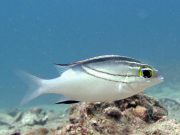
Scolopsis bilineata @ Koh Bida
The two-lined monocle bream is commonly encountered over sandy and rubble areas at the edge of the reef.
The body is mostly white, with a dark grey streak running from the snout nearly to the rear of the dorsal fin. There are three whitish/yellowish stripes on the head and a white band with black edges runs from below the eye to the rear of the dorsal fin.
This bream grows to 25 cm, but is often observed smaller than this, either singly or in pairs.
The two-lined monocle bream diet includes small fishes and bottom-dwelling invertebrates.
Monogram Monocle Bream
(Scolopsis monogramma)

Scolopsis monogramma @ Koh Haa
The monogram monocle bream has a pale body, whitish or grey, with a sky blue and yellow band which runs above and between the eyes.
The dorsal fin is yellow, with a sky blue tinge on the body running alongside the dorsal fin.
The tail fin is yellow and there is a dusky stripe along the middle part of the body.
The monogram monocle bream is usually found along the reef edge, on sandy or rubble bottoms and can grow to 26 cm, but is usually observed much smaller than this, typically 10 - 15 cm.
The diet of this species includes small fish, crustaceans, molluscs and bristle-worms.
Pearly Monocle Bream
(Scolopsis margaritifer)

Scolopsis margaritifer @ Koh Bida
The pearly monocle bream has a pearly/olive upper body colour, and a generally whitish lower body colour.
The upper lobe of the tail fin is yellowish, and the lower lobe is reddish. The pelvic fins base is yellow, as is the pectoral and anal fins. The Indian variation has different colouration from the Pacific variation.
The dorsal fin has 10 spines and 9 soft rays and grows to 25 cm, though is usually observed smaller than this, often 10 - 15 cm.
As with the other breams, this species frequents the sandy and rubble areas around the edge of the reef.
Whitecheek Monocle Bream
(Scolopsis torquatus)
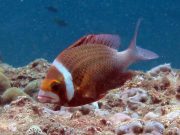
Scolopsis torquatus @ Koh Bida
The whitecheek monocle bream has a deeper body than many of the other species in this family (less compressed, wider). The body is a deep reddish to purple/brownish colour and the scales have slightly darker centers.
This species has a broad white bar on the head, behind the eye. The snout may be more lightly coloured, with lighter/pale lips.
This species grows to 25 cm, and as with other monocle breams, the whitecheek monocle bream is also usually found over sand and rubble, solitary or in small groups.
Whitestreak Monocle Bream
(Scolopsis ciliatus)
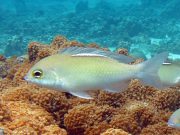
Scolopsis ciliatus @ Koh Haa
The whitestreak monocle bream has a pale grey body with between two and four rows of yellowish or slightly orange spots running length-ways along the side.
The name of this species derives from the bright white streak below the dorsal fin.
The whitestreak monocle bream grows to 25 cm, but usually observed smaller than this.
Can be found singly, or in small groups over soft coral and anemone beds, sandy and rubble areas close to the reef.
Dykking med Trådfinnebrasen rundt Koh Lanta
Dykking og snorkleturer
Hvis du vil ha sjansen til å se Trådfinnebrasen på en av våre daglige dykkerturer fra Koh Lanta i høysesongen, kan du sende oss en e-post til info@diveandrelax.com.
Bli med på våre dykkerturer med hurtigbåt i høysesongen til noen av Thailands beste dykkesteder, og nyt små grupper, kort reisetid og fokus på god personlig service, sikkerhet og moro.
Not yet a certified diver? Learn to Scuba Dive on Koh Lanta with the 3 day SSI Open Water Diver course.
Bestill på nettet og spar 10 % på dykkerturer og dykkerkurs på Koh Lanta.
Finn ut mer
Guider om livet i havet i Indo-Stillehavet
- Allen, G., Steene, R., Humann, P., DeLoach, N. (2003) Reef Fish Identification, Tropical Pacific. Jacksonville, FL., USA: New World Publications, Inc., ISBN 1-878348-36-1.
- Humann, P., DeLoach, N., (2010) Reef Creature Identification, Tropical Pacific. Jacksonville, FL., USA: New World Publications Inc., ISBN 978-1-878348-44-9
- Debelius, H. (2013) Indian Ocean Reef Guide. Frankfurt, Germany: IKAN - Unterwasserarchiv, ISBN 978-3-939767-52-7.
- Debelius, H. (2004) Nudibranchs and Sea Snails, Indo-Pacific Field Guide. Frankfurt, Germany: IKAN - Unterwasserarchiv, ISBN 3-925919-51-1
- Erhardt, H., Knop, D. (2015) Corals Indo-Pacific Field Guide. Frankfurt, Germany: IKAN - Unterwasserarchiv, ISBN 3-925919-69-4.
- Veron J.E.N., Stafford-Smith M.G., Turak E. and DeVantier L.M. (2016). Corals of the World