


Dykking med Steinfisker
Lantas marine liv | Synanceiidae
Steinfiskfamilien Synanceiidae er langsomme, bunnlevende fisker som lever i de grunnere delene av revet blant steiner og koraller. På våre dykkerturer til Koh Lanta er det mest sannsynlig at vi finner steinfisker rundt lagunen ved Koh Haa.
Medlemmene av denne familien er for det meste tykke fisker med store hoder og munner og små øyne. Kroppen er dekket av ujevne vorteaktige hudkjertler og kjøttfulle fliker som kan bidra til kamuflasje. Noen ganger kan man se alger vokse på kroppen, noe som forbedrer kamuflasjen ytterligere.
Vanligvis finner man steinfisker på bunnen, begravd i sand eller klamrende seg fast til et stykke dødt korall. De er mestre i kamuflasje og forkler seg som steiner og klipper, og smelter nesten helt sammen med omgivelsene i farge og form.
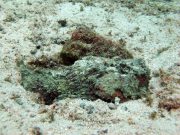



I likhet med sine slektninger, skorpionfiskene, har steinfisker svært skarpe, hule ryggfinner, som ligner på en injeksjonsnål, hver med en giftkjertel i bunnen.
Steinfiskens gift brukes til selvforsvar, og giften injiseres vanligvis når et intetanende offer ved et uhell lener seg mot eller tråkker på en av disse fiskene. Nevrotoksinen i giften er ekstremt smertefull.
Den gråaktige, brunaktige, rødaktige revesteinfisken (Synanceia verrucosa) er den giftigste fisken som er kjent, og finnes på noen av dykkestedene rundt Koh Lanta, spesielt i og rundt Koh Haa-lagunen. Giftet fra revesteinfisken er dødelig for mennesker.
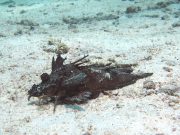
Den mørke Indian Ocean Walkman (Inimicus didactylus) finnes også i og rundt Koh Haa Lagoon, og er vanskeligere å få øye på enn Reef Stonefish. Den ligger vanligvis dypt begravd i sanden, men det kan hende man får sjeldne glimt av den når den vandrer langs havbunnen for å skifte sted.
Walkmans i Det indiske hav er også kjent som ghoulfish, goblinfish, sea goblins, spiny devilfish, stinger og stingfish, og er også farlig giftige.
Vi oppfordrer ikke folk til å sitte, knele, gå eller hvile på den ømfintlige havbunnen rundt korallrevene, ikke bare på grunn av de mange små og ømfintlige dyrene som lever på havbunnen, men også på grunn av den reelle faren for å bli stukket av en av naturens giftigste fisker.
Steinfisk er vanligvis solitære og lever av småfisk og krepsdyr.
2 arter funnet på denne siden:
Reef Stonefish
(Synanceia verrucosa)
The Reef Stonefish, Synanceia verrucosa, is one of 36 members of the Synanceiidae family and is one of the most venomous fish in the world. This fish has a large head and tapering body, with its mouth on top of the face, and a deep depression between its eyes.

Synanceia verrucosa @ Koh Haa
Typically the Reef Stonefish reaches lengths of up to 30 - 40 centimeters and is generally grey or brown in colour, though it may also have small areas of yellow, red or orange.
The key difference between males and females is the size. The female stonefish is larger and broader around the abdomen than the male and can weigh as much as 50% more.
A carnivorous fish, the Reef Stonefish may settle around rocks and plants, or rest on the seabed and is extremely well camouflaged as rock or coral. They are difficult to find and are also known to use their large pectoral fins to bury themselves in the sand, with only the eyes and mouth visible.
The Reef Stonefish eats mostly small fish, shrimp, and other crustaceans. It usually waits for its prey to swim past, and then strikes with incredible speed. Waiting for hours at a time, stonefish strike when their potential prey is less than their body length away. Their powerful jaws and large, rapidly expanding mouths create so much pressure that they are easily able to suck down their unsuspecting prey and swallow it whole. The attack can last as little as 0.01 seconds and requires high-speed video equipment to capture.

Reef Stonefish @ Koh Haa
As a purely defensive measure, the dorsal fin comprises 13 sharp, stiff, hollow spines, each with a venom sac. When disturbed, the Reef Stonefish will typically not swim away, and will instead erect it's poisonous dorsal fin spines.
The venom is usually released when pressure is applied to the stonefish's spine, which means the poison is most often emitted when the stonefish is being attacked by a predator or stepped on by a human. Effects of the venom include severe pain, shock, paralysis and tissue death. A large dose can be fatal to humans. Predators of the Reef Stonefish include sharks and rays.
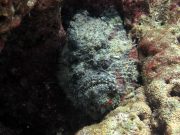
Reef Stonefish @ Koh Haa
The stonefish can survive out of water for up to 24 hours. This may be an adaptation to its shallow water existence where it may get trapped in drying out rock-pools during low tide.
In addition to the dorsal spines and venom, stonefish also possess a 'lachrymal sabre', a very sharp spine embedded in each side of the face, beneath each eye. This sharp blade can be deployed by squeezing its cheeks, which pull on the upper jaw and rotate the spines. This built-in weapon is non-venomous, however, they are extremely sharp.
The stonefish is a solitary animal. The only time it will actively seek out another is during mating season. The female stonefish releases a layer of eggs on the seafloor, with the male then releasing sperm over them.
Indian Ocean Walkman
(Inimicus didactylus)
The Indian Ocean Walkman, also known as the Spiny Devilfish, has a flattened head, large bulbous eyes and an upturned shout. The dorsal spines are highly venomous, with the first three being connected by a thin membrane. Dorsal spines may cause very painful and deep wounds, and can be fatal.

Inimicus didactylus @ Koh Haa
The Indian Ocean Walkman can quickly change colour to aid camouflage, and likes to partially bury itself in sand during the day. The fan-like pectoral fins are very colourful when opened, usually when disturbed or during courtship.

Inimicus didactylus @ Koh Haa
This species can sometimes be seen 'walking' on the seafloor using the forward pelvic fin spines which are not connected via fin membrane, and have adapted as forward 'legs'.

Inimicus didactylus @ Koh Haa
The Indian Ocean Walkman grows to 25 cm and is found in sand and rubble areas close to coral reefs. The diet includes small fishes and crustaceans.
Dykking med Steinfisker rundt Koh Lanta
Dykking og snorkleturer
Hvis du vil ha sjansen til å se Steinfisker på en av våre daglige dykkerturer fra Koh Lanta i høysesongen, kan du sende oss en e-post til info@diveandrelax.com.
Bli med på våre dykkerturer med hurtigbåt i høysesongen til noen av Thailands beste dykkesteder, og nyt små grupper, kort reisetid og fokus på god personlig service, sikkerhet og moro.
Not yet a certified diver? Learn to Scuba Dive on Koh Lanta with the 3 day SSI Open Water Diver course.
Bestill på nettet og spar 10 % på dykkerturer og dykkerkurs på Koh Lanta.
Finn ut mer
Guider om livet i havet i Indo-Stillehavet
- Allen, G., Steene, R., Humann, P., DeLoach, N. (2003) Reef Fish Identification, Tropical Pacific. Jacksonville, FL., USA: New World Publications, Inc., ISBN 1-878348-36-1.
- Humann, P., DeLoach, N., (2010) Reef Creature Identification, Tropical Pacific. Jacksonville, FL., USA: New World Publications Inc., ISBN 978-1-878348-44-9
- Debelius, H. (2013) Indian Ocean Reef Guide. Frankfurt, Germany: IKAN - Unterwasserarchiv, ISBN 978-3-939767-52-7.
- Debelius, H. (2004) Nudibranchs and Sea Snails, Indo-Pacific Field Guide. Frankfurt, Germany: IKAN - Unterwasserarchiv, ISBN 3-925919-51-1
- Erhardt, H., Knop, D. (2015) Corals Indo-Pacific Field Guide. Frankfurt, Germany: IKAN - Unterwasserarchiv, ISBN 3-925919-69-4.
- Veron J.E.N., Stafford-Smith M.G., Turak E. and DeVantier L.M. (2016). Corals of the World