


Dykning med Steenvissen
Onderwaterleven Lanta | Synanceiidae
De steenvisfamilie Synanceiidae bestaat uit langzaam bewegende, op de bodem levende vissen die in ondiepe delen van het rif tussen rotsen en koralen leven. Tijdens onze duiktrips op Koh Lanta vinden we steenvissen het vaakst rond de lagune bij Koh Haa.
Leden van deze familie zijn meestal gedrongen vissen, met grote koppen en monden, en kleine ogen. Het lichaam is bedekt met bobbelige, wratachtige huidklieren en vlezige flappen die kunnen helpen bij camouflage. Soms groeien er algen op het lichaam, wat de camouflage nog verder verbetert.
Steenvissen worden meestal op de bodem aangetroffen, begraven in het zand of vastgeklampt aan een stuk dood koraal. Het zijn meesters in camouflage: ze vermommen zich als rotsen en stenen en gaan qua kleur en vorm bijna volledig op in hun omgeving.
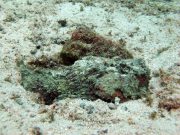



Net als hun verwanten, de schorpioenvissen, hebben steenvissen zeer scherpe, holle rugvinnen, die veel weg hebben van een injectienaald, met aan de basis een gifklier.
Het gif van de steenvis wordt gebruikt voor zelfverdediging. Het gif wordt meestal geïnjecteerd wanneer een nietsvermoedend slachtoffer per ongeluk op een van deze vissen leunt of gaat staan. Het neurotoxine gif is uiterst pijnlijk.
De grijzige, bruinachtige, roodachtige rifsteenvis (Synanceia verrucosa) is de giftigste vis die bekend is en komt voor op sommige duiklocaties rond Koh Lanta, vooral in en rond de Koh Haa-lagune. Het gif van de rifsteenvis is dodelijk voor mensen.
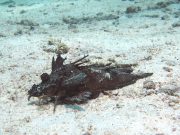
De donkergekleurde Indische Oceaan Walkman (Inimicus didactylus) komt ook voor in en rond de Koh Haa-lagune en is moeilijker te spotten dan de rifsteenvis. Normaal gesproken zit hij diep begraven in het zand, maar soms kun je hem zien als hij over de zeebodem loopt om van plek te veranderen.
Walkmans uit de Indische Oceaan staan ook bekend als ghoulfish, goblinfish, sea goblins, spiny devilfish, stinger en stingfish, en zijn ook gevaarlijk giftig.
We raden mensen af om te gaan zitten, knielen, lopen of rusten op de kwetsbare zeebodem rond koraalriffen, niet alleen vanwege de vele kleine en kwetsbare dieren die op de zeebodem leven, maar ook vanwege het reële gevaar om gestoken te worden door een van de meest giftige vissen in de natuur.
Steenvissen zijn over het algemeen solitair en voeden zich met kleine vissen en schaaldieren.
2 soorten gevonden op deze pagina:
Reef Stonefish
(Synanceia verrucosa)
The Reef Stonefish, Synanceia verrucosa, is one of 36 members of the Synanceiidae family and is one of the most venomous fish in the world. This fish has a large head and tapering body, with its mouth on top of the face, and a deep depression between its eyes.

Synanceia verrucosa @ Koh Haa
Typically the Reef Stonefish reaches lengths of up to 30 - 40 centimeters and is generally grey or brown in colour, though it may also have small areas of yellow, red or orange.
The key difference between males and females is the size. The female stonefish is larger and broader around the abdomen than the male and can weigh as much as 50% more.
A carnivorous fish, the Reef Stonefish may settle around rocks and plants, or rest on the seabed and is extremely well camouflaged as rock or coral. They are difficult to find and are also known to use their large pectoral fins to bury themselves in the sand, with only the eyes and mouth visible.
The Reef Stonefish eats mostly small fish, shrimp, and other crustaceans. It usually waits for its prey to swim past, and then strikes with incredible speed. Waiting for hours at a time, stonefish strike when their potential prey is less than their body length away. Their powerful jaws and large, rapidly expanding mouths create so much pressure that they are easily able to suck down their unsuspecting prey and swallow it whole. The attack can last as little as 0.01 seconds and requires high-speed video equipment to capture.

Reef Stonefish @ Koh Haa
As a purely defensive measure, the dorsal fin comprises 13 sharp, stiff, hollow spines, each with a venom sac. When disturbed, the Reef Stonefish will typically not swim away, and will instead erect it's poisonous dorsal fin spines.
The venom is usually released when pressure is applied to the stonefish's spine, which means the poison is most often emitted when the stonefish is being attacked by a predator or stepped on by a human. Effects of the venom include severe pain, shock, paralysis and tissue death. A large dose can be fatal to humans. Predators of the Reef Stonefish include sharks and rays.
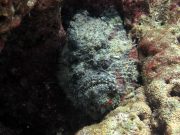
Reef Stonefish @ Koh Haa
The stonefish can survive out of water for up to 24 hours. This may be an adaptation to its shallow water existence where it may get trapped in drying out rock-pools during low tide.
In addition to the dorsal spines and venom, stonefish also possess a 'lachrymal sabre', a very sharp spine embedded in each side of the face, beneath each eye. This sharp blade can be deployed by squeezing its cheeks, which pull on the upper jaw and rotate the spines. This built-in weapon is non-venomous, however, they are extremely sharp.
The stonefish is a solitary animal. The only time it will actively seek out another is during mating season. The female stonefish releases a layer of eggs on the seafloor, with the male then releasing sperm over them.
Indian Ocean Walkman
(Inimicus didactylus)
The Indian Ocean Walkman, also known as the Spiny Devilfish, has a flattened head, large bulbous eyes and an upturned shout. The dorsal spines are highly venomous, with the first three being connected by a thin membrane. Dorsal spines may cause very painful and deep wounds, and can be fatal.

Inimicus didactylus @ Koh Haa
The Indian Ocean Walkman can quickly change colour to aid camouflage, and likes to partially bury itself in sand during the day. The fan-like pectoral fins are very colourful when opened, usually when disturbed or during courtship.

Inimicus didactylus @ Koh Haa
This species can sometimes be seen 'walking' on the seafloor using the forward pelvic fin spines which are not connected via fin membrane, and have adapted as forward 'legs'.

Inimicus didactylus @ Koh Haa
The Indian Ocean Walkman grows to 25 cm and is found in sand and rubble areas close to coral reefs. The diet includes small fishes and crustaceans.
Duiken met Steenvissen rond Koh Lanta
Duiken & Snorkeltrips
Als je graag een kans hebt om Steenvissen te spotten op een van onze dagelijkse hoogseizoen duiktrips vanuit Koh Lanta, stuur ons dan een email naar info@diveandrelax.com.
Ga mee met onze speedboot duiktrips in het hoogseizoen naar enkele van Thailand's beste duiklocaties en geniet van kleine groepen, korte reistijden, met een focus op goede persoonlijke service, veiligheid en plezier.
Not yet a certified diver? Learn to Scuba Dive on Koh Lanta with the 3 day SSI Open Water Diver course.
Boek online en bespaar 10% op duiktrips en duikcursussen op Koh Lanta.
Meer informatie
Indo-Stille Oceaan gidsen
- Allen, G., Steene, R., Humann, P., DeLoach, N. (2003) Reef Fish Identification, Tropical Pacific. Jacksonville, FL., USA: New World Publications, Inc., ISBN 1-878348-36-1.
- Humann, P., DeLoach, N., (2010) Reef Creature Identification, Tropical Pacific. Jacksonville, FL., USA: New World Publications Inc., ISBN 978-1-878348-44-9
- Debelius, H. (2013) Indian Ocean Reef Guide. Frankfurt, Germany: IKAN - Unterwasserarchiv, ISBN 978-3-939767-52-7.
- Debelius, H. (2004) Nudibranchs and Sea Snails, Indo-Pacific Field Guide. Frankfurt, Germany: IKAN - Unterwasserarchiv, ISBN 3-925919-51-1
- Erhardt, H., Knop, D. (2015) Corals Indo-Pacific Field Guide. Frankfurt, Germany: IKAN - Unterwasserarchiv, ISBN 3-925919-69-4.
- Veron J.E.N., Stafford-Smith M.G., Turak E. and DeVantier L.M. (2016). Corals of the World