


Dykking med Skorpionfisk og løvefisk
Lantas marine liv | Scorpaenidae
Skorpionfiskene er en stor superfamilie av giftige fisker, som inkluderer dragefisk, steinfisk, vepsfisk og fløyelfisk, og kan finnes på alle dykkesteder på Koh Lanta dykkerturer.
Blant dykkere refererer ordet skorpionfisk vanligvis til slekten Scorpaenopsis, og her inkluderer vi også underfamilien Pteroinae, som omfatter dragefisken. Medlemmer av denne gruppen har kammer og/eller pigger på hodet, en eller to pigger på gjelledekselet, pigger på den nedre kinnpartiet og 11 til 17 pigger på ryggfinnen.
Som navnet antyder, har skorpionfisk en type 'brodd' i form av skarpe pigger belagt med giftig slim. Brystfinnene er godt utviklet, og piggene på rygg-, bekken- og analfinnene har alle giftkjertler ved basen. Disse piggene kan gi et giftig stikk som kan vare i flere dager og forårsake ekstrem smerte, svette, pustevansker og til og med lammelse.
De fleste artene lever på havbunnen, hvor de spiser krepsdyr og mindre fisk, og antas å være nattaktive jegere som fanger byttet sitt ved å ligge på lur og svelge det hele når det svømmer forbi. Dragefisk har spesialiserte svømmeblæremuskler som gir dem utmerket kontroll, slik at de kan endre tyngdepunktet for å angripe bedre.
6 arter funnet på denne siden:
Mombasa Lionfish
(Pterois mombasae)
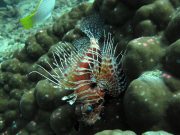
Pterois mombasae @ Koh Haa
The mombasa lionfish, or african lionfish, grows to 16 cm. The body comprises reddish brown stripes with alternating broad and thin dark bars separated with white stripes. This species has a dark spot on the cheek and whitish fan-like pectoral fins with semicircular bands formed of large spots and long filamentous rays.
The mombasa lionfish is solitary and can normally be found in areas with soft corals, sponges, rubble and soft-bottomed areas of sheltered reefs.
Indian Lionfish
(Pterois miles)

Pterois miles @ Koh Bida
The Indian Lionfish has a white body, with numerous creamy-red or reddish-brown vertical stripes. The vertical stripes alternate from wide to very thin and sometimes merge to form a V-shape. The head has fleshy antenna and numerous fleshy appendages.
The dorsal fin spines are highly venomous and can inflict excruciatingly painful puncture wounds. The pectoral fins are wing-like with separate broad, smooth rays.
This species grows to 35 cm and is very similar to, and often confused with the red lionfish (Pterois volitans). The Red Lionfish is native to the Gulf of Thailand, and the Indian Lionfish is native to the Andaman Sea. The Red Lionfish (Gulf of Thailand) has more dorsal and tail fin rays than the Indian Lionfish.
Juveniles have black stripes and bars.
Clearfin Lionfish
(Pterois radiata)

Pterois radiata @ Koh Haa
The Clearfin Lionfish body has wide brown to reddish brown bars with white bars between them. Two white lines make a horizontal band on the tail base.
The thin white pectoral fin spines are quite long compared to other species and have no markings. The pectoral fin rays are thin and reddish brown.
The Clearfin Lionfish grows to 24 cm and is nocturnal, emerging at night to feed on invertebrates such as crabs and shrimps.
This species is not commonly seen around the Lanta dive sites.
Zebra Lionfish
(Dendrochirus zebra)
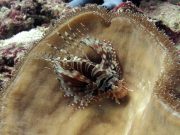
Dendrochirus zebra @ Koh Haa
The zebra lionfish has a reddish body with 5 vertical stripes, usually orangish/black, with white spacing and grows to a maximum size of around 25 cm.
There may be alternating thin dark bars in larger individuals. The pectoral fins are large, fan-like and flare out on either side of the fish. The pectoral fins are banded dark reddish/orange and white.
This species also has a dark brown band through the eye, a large black spot on the cheek, and pale and dark bands on the dorsal-fin spines. The dorsal fin has thirteen venomous spines along its back, connected with a clear film-like membrane.
The zebra lionfish live near the sea bed, found on coral, rubble, and rock bottoms on reef flats and lagoons. This species may also be found in caves, or other dark areas under corals or inside a shipwreck, sometimes in small groups. These fish are generally slow-moving and peaceful, but can be dangerous when disturbed or attacked. The zebra lionfish feeds on small crustaceans, and is in turn preyed upon by groupers.
Bearded Scorpionfish
(Scorpaenopsis barbata)
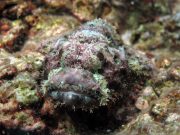
Scorpaenopsis barbata @ Koh Bida
The bearded scorpionfish grows to 25 cm in length and is usually brightly coloured and heavily camouflaged. The body is normally dark brown or reddish in colour, with many blackish and whitish blotches. Often the bearded scorpionfish will have darker area starting behind the lower part of the eye and extending down toward the lower cheek.
This species has many fleshy outgrowths of skin protruding from the chin, giving a beard-like appearance. The space between the eyes has several ridges created by spines, and these are separated by a channel which is more than double the width of a ridge. This fish also has a moderately deep cavity in the rear portion of the upper surface of the skull, known as the occipital pit.
Often confused with the tassled scorpionfish (Scorpaenopsis oxycephala) which has a much longer snout that the bearded scorpionfish, these ambush predators usually rest during the day, feeding at night on crustaceans and other small fishes.
Devil Scorpionfish
(Scorpaenopsis diabolus)

Scorpaenopsis diabolus @ Koh Bida
The devil scorpionfish can usually be found on the seabed, on sand or gravel areas. This fish has a broad head with a wide mouth, a noticeably humped back, and a tapering body, and can reach 30 cm.
The snout length is around 1.3 to 1.5 times the diameter of the eye and this measurement can help to distinguish this species from other, similar species.
Devil scorpionfish have rough skin and numerous projections, spines, and tassels which aid with camouflage.
Colouring can be changed quickly to aid camouflage, but is typically a combination of grey and white with reddish-brown blotches. The inside of the pectoral fins are banded orange and white, with black blotches.
Dykking med Skorpionfisk og løvefisk rundt Koh Lanta
Dykking og snorkleturer
Hvis du vil ha sjansen til å se Skorpionfisk og løvefisk på en av våre daglige dykkerturer fra Koh Lanta i høysesongen, kan du sende oss en e-post til info@diveandrelax.com.
Bli med på våre dykkerturer med hurtigbåt i høysesongen til noen av Thailands beste dykkesteder, og nyt små grupper, kort reisetid og fokus på god personlig service, sikkerhet og moro.
Not yet a certified diver? Learn to Scuba Dive on Koh Lanta with the 3 day SSI Open Water Diver course.
Bestill på nettet og spar 10 % på dykkerturer og dykkerkurs på Koh Lanta.
Finn ut mer
Guider om livet i havet i Indo-Stillehavet
- Allen, G., Steene, R., Humann, P., DeLoach, N. (2003) Reef Fish Identification, Tropical Pacific. Jacksonville, FL., USA: New World Publications, Inc., ISBN 1-878348-36-1.
- Humann, P., DeLoach, N., (2010) Reef Creature Identification, Tropical Pacific. Jacksonville, FL., USA: New World Publications Inc., ISBN 978-1-878348-44-9
- Debelius, H. (2013) Indian Ocean Reef Guide. Frankfurt, Germany: IKAN - Unterwasserarchiv, ISBN 978-3-939767-52-7.
- Debelius, H. (2004) Nudibranchs and Sea Snails, Indo-Pacific Field Guide. Frankfurt, Germany: IKAN - Unterwasserarchiv, ISBN 3-925919-51-1
- Erhardt, H., Knop, D. (2015) Corals Indo-Pacific Field Guide. Frankfurt, Germany: IKAN - Unterwasserarchiv, ISBN 3-925919-69-4.
- Veron J.E.N., Stafford-Smith M.G., Turak E. and DeVantier L.M. (2016). Corals of the World