


Dykning med Schorpioenvis & Koraalduivel
Onderwaterleven Lanta | Scorpaenidae
De schorpioenvissen zijn een grote superfamilie van giftige vissen, waaronder de koraalduivel, steenvis, wespvis en fluweelvis, en zijn te vinden op elke duiklocatie tijdens duiktrips op Koh Lanta.
Onder duikers verwijst het woord schorpioenvis meestal naar het geslacht Scorpaenopsis, en hier rekenen we ook de onderfamilie Pteroinae toe, waartoe de koraalduivel behoort. Leden van deze groep hebben richels en/of stekels op de kop, één of twee stekels op de kieuwdeksel, stekels op de onderkaak en 11 tot 17 stekels op de rugvin.
Zoals de naam al doet vermoeden, hebben schorpioenvissen een soort 'steek' in de vorm van scherpe stekels die bedekt zijn met giftig slijm. De borstvinnen zijn goed ontwikkeld en de stekels van de rug-, buik- en anaalvinnen hebben allemaal gifklieren aan de basis. Deze stekels kunnen een giftige steek toebrengen die dagenlang kan aanhouden en extreme pijn, zweten, ademhalingsmoeilijkheden en zelfs verlamming kan veroorzaken.
De meeste soorten leven op de bodem, voeden zich met schaaldieren en kleinere vissen en worden beschouwd als nachtelijke jagers, die hun prooi vangen door deze in een hinderlaag te lokken wanneer deze voorbij zwemt, en deze vervolgens in zijn geheel op te slokken. Koraalduivels hebben gespecialiseerde zwemblaas-spieren die hen een uitstekende controle geven, waardoor ze hun zwaartepunt kunnen veranderen om beter aan te vallen.
6 soorten gevonden op deze pagina:
Mombasa Lionfish
(Pterois mombasae)
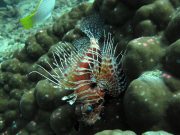
Pterois mombasae @ Koh Haa
The mombasa lionfish, or african lionfish, grows to 16 cm. The body comprises reddish brown stripes with alternating broad and thin dark bars separated with white stripes. This species has a dark spot on the cheek and whitish fan-like pectoral fins with semicircular bands formed of large spots and long filamentous rays.
The mombasa lionfish is solitary and can normally be found in areas with soft corals, sponges, rubble and soft-bottomed areas of sheltered reefs.
Indian Lionfish
(Pterois miles)

Pterois miles @ Koh Bida
The Indian Lionfish has a white body, with numerous creamy-red or reddish-brown vertical stripes. The vertical stripes alternate from wide to very thin and sometimes merge to form a V-shape. The head has fleshy antenna and numerous fleshy appendages.
The dorsal fin spines are highly venomous and can inflict excruciatingly painful puncture wounds. The pectoral fins are wing-like with separate broad, smooth rays.
This species grows to 35 cm and is very similar to, and often confused with the red lionfish (Pterois volitans). The Red Lionfish is native to the Gulf of Thailand, and the Indian Lionfish is native to the Andaman Sea. The Red Lionfish (Gulf of Thailand) has more dorsal and tail fin rays than the Indian Lionfish.
Juveniles have black stripes and bars.
Clearfin Lionfish
(Pterois radiata)

Pterois radiata @ Koh Haa
The Clearfin Lionfish body has wide brown to reddish brown bars with white bars between them. Two white lines make a horizontal band on the tail base.
The thin white pectoral fin spines are quite long compared to other species and have no markings. The pectoral fin rays are thin and reddish brown.
The Clearfin Lionfish grows to 24 cm and is nocturnal, emerging at night to feed on invertebrates such as crabs and shrimps.
This species is not commonly seen around the Lanta dive sites.
Zebra Lionfish
(Dendrochirus zebra)
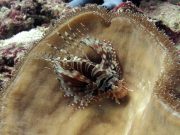
Dendrochirus zebra @ Koh Haa
The zebra lionfish has a reddish body with 5 vertical stripes, usually orangish/black, with white spacing and grows to a maximum size of around 25 cm.
There may be alternating thin dark bars in larger individuals. The pectoral fins are large, fan-like and flare out on either side of the fish. The pectoral fins are banded dark reddish/orange and white.
This species also has a dark brown band through the eye, a large black spot on the cheek, and pale and dark bands on the dorsal-fin spines. The dorsal fin has thirteen venomous spines along its back, connected with a clear film-like membrane.
The zebra lionfish live near the sea bed, found on coral, rubble, and rock bottoms on reef flats and lagoons. This species may also be found in caves, or other dark areas under corals or inside a shipwreck, sometimes in small groups. These fish are generally slow-moving and peaceful, but can be dangerous when disturbed or attacked. The zebra lionfish feeds on small crustaceans, and is in turn preyed upon by groupers.
Bearded Scorpionfish
(Scorpaenopsis barbata)
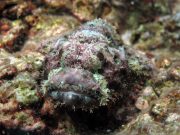
Scorpaenopsis barbata @ Koh Bida
The bearded scorpionfish grows to 25 cm in length and is usually brightly coloured and heavily camouflaged. The body is normally dark brown or reddish in colour, with many blackish and whitish blotches. Often the bearded scorpionfish will have darker area starting behind the lower part of the eye and extending down toward the lower cheek.
This species has many fleshy outgrowths of skin protruding from the chin, giving a beard-like appearance. The space between the eyes has several ridges created by spines, and these are separated by a channel which is more than double the width of a ridge. This fish also has a moderately deep cavity in the rear portion of the upper surface of the skull, known as the occipital pit.
Often confused with the tassled scorpionfish (Scorpaenopsis oxycephala) which has a much longer snout that the bearded scorpionfish, these ambush predators usually rest during the day, feeding at night on crustaceans and other small fishes.
Devil Scorpionfish
(Scorpaenopsis diabolus)

Scorpaenopsis diabolus @ Koh Bida
The devil scorpionfish can usually be found on the seabed, on sand or gravel areas. This fish has a broad head with a wide mouth, a noticeably humped back, and a tapering body, and can reach 30 cm.
The snout length is around 1.3 to 1.5 times the diameter of the eye and this measurement can help to distinguish this species from other, similar species.
Devil scorpionfish have rough skin and numerous projections, spines, and tassels which aid with camouflage.
Colouring can be changed quickly to aid camouflage, but is typically a combination of grey and white with reddish-brown blotches. The inside of the pectoral fins are banded orange and white, with black blotches.
Duiken met Schorpioenvis & Koraalduivel rond Koh Lanta
Duiken & Snorkeltrips
Als je graag een kans hebt om Schorpioenvis & Koraalduivel te spotten op een van onze dagelijkse hoogseizoen duiktrips vanuit Koh Lanta, stuur ons dan een email naar info@diveandrelax.com.
Ga mee met onze speedboot duiktrips in het hoogseizoen naar enkele van Thailand's beste duiklocaties en geniet van kleine groepen, korte reistijden, met een focus op goede persoonlijke service, veiligheid en plezier.
Not yet a certified diver? Learn to Scuba Dive on Koh Lanta with the 3 day SSI Open Water Diver course.
Boek online en bespaar 10% op duiktrips en duikcursussen op Koh Lanta.
Meer informatie
Indo-Stille Oceaan gidsen
- Allen, G., Steene, R., Humann, P., DeLoach, N. (2003) Reef Fish Identification, Tropical Pacific. Jacksonville, FL., USA: New World Publications, Inc., ISBN 1-878348-36-1.
- Humann, P., DeLoach, N., (2010) Reef Creature Identification, Tropical Pacific. Jacksonville, FL., USA: New World Publications Inc., ISBN 978-1-878348-44-9
- Debelius, H. (2013) Indian Ocean Reef Guide. Frankfurt, Germany: IKAN - Unterwasserarchiv, ISBN 978-3-939767-52-7.
- Debelius, H. (2004) Nudibranchs and Sea Snails, Indo-Pacific Field Guide. Frankfurt, Germany: IKAN - Unterwasserarchiv, ISBN 3-925919-51-1
- Erhardt, H., Knop, D. (2015) Corals Indo-Pacific Field Guide. Frankfurt, Germany: IKAN - Unterwasserarchiv, ISBN 3-925919-69-4.
- Veron J.E.N., Stafford-Smith M.G., Turak E. and DeVantier L.M. (2016). Corals of the World