


Dykking med Chromodorid-nakensnegler
Lantas marine liv | Chromodorididae
Chromodorid-naken sneglene omfatter rundt 600 arter og er blant de mest fargerike og mønsterrike dyrene som finnes. Mange arter kan oppleves under dykking ved Koh Lanta.
Chromodorid-nakensnegler er uappetittlige for rovdyr eller til og med giftige å spise, noe som gjør at mange arter kan vandre fritt rundt i korallrevene om dagen.
Kostholdet til alle Chromodorider inkluderer svamper, og noen arter av snegler er svært spesifikke i sitt matvalg og spiser kun én enkelt svampart. Kjemikalier fra fordøyelsen av disse svampene brukes deretter til å produsere kraftige giftstoffer.
De ovale mantlene har en glatt overflate og dekker foten helt. Hos de fleste artene danner gjellene en bue rundt anus, åpen mot baksiden, og i noen tilfeller nesten en fullstendig sirkel.
Når den trues, kan en Chromodorid også trekke gjellene inn i en lomme for beskyttelse.
7 arter funnet på denne siden:
- Gem Sea Slug (Goniobranchus geminus)
- White-margin Sea Slug (Glossodoris rufomarginata)
- Girdled Glossodoris (Glossodoris cincta)
- Beautiful Risbecia (Risbecia pulchella)
- Cheesecake Nudibranch (Doriprismatica atromarginata)
- Ringed Chromodoris (Chromodoris annulata)
- Three-Lobed Ceratosoma (Ceratosoma trilobatum)
Gem Sea Slug
(Goniobranchus geminus)
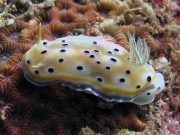
Goniobranchus geminus @ Koh Haa
The Gem Sea Slug has four coloured lines around the edge of the mantle, first a thin white line at the edge, followed by a greyish or bluish-purple line, thirdly another white line and finally a strong yellow line. The main body is pale yellowish to beige to tan with numerous white-edged purple to purple-brown spots. The rhinophores (tentacles on top of the head) are purple or yellow, the gills are whitish with brownish edges.
The Gem Sea Slug grows to 5 cm. The foot extends beyond the rear of the mantle and the upper foot is similarly patterned to the mantle.
White-margin Sea Slug
(Glossodoris rufomarginata)
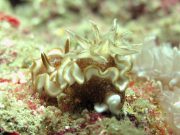
Glossodoris rufomarginata @ Koh Haa
The White-margin Sea Slug has a reddish speckled body, surrounded by a wide, wavy mantle with a fine reddish-orange border surrounding a wide white band.
The rhinophores (tentacles on top of the head) and gills are reddish-orange and white. The foot also has a white margin.
The White-margin Sea Slug grows to 5 cm, but usually observed around 3 cm.
Girdled Glossodoris
(Glossodoris cincta)
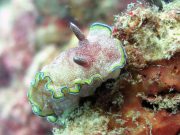
Glossodoris cincta @ Koh Haa
The Girdled Glossodoris has a dark to pale reddish brownish body and rhinophores with scattered white spots of varying sizes. The body is often darker around the base of the rhinophores.
The wavy mantle has a three-part marginal band which is variably coloured from whitish-blue to dark blue/black to yellow. This species has different colour forms depending on location.
The Girdled Glossodoris grows to 5 cm.
Beautiful Risbecia
(Risbecia pulchella)
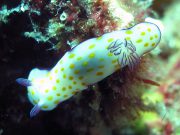
Risbecia pulchella @ Koh Haa
The Beautiful Risbecia has a creamy-whitish upper body, lower body and foot. The slightly wavy mantle margin is purple and the body is covered in many yellow-orange spots. The rhinophores have a white stem and purple leaves, and the gills are whitish with purple or orange margins.
The Beautiful Risbecia is a large nudibranch, growing to 11 cm, often found in pairs, feeds on sponges.
Cheesecake Nudibranch
(Doriprismatica atromarginata)
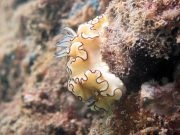
Doriprismatica atromarginata @ Koh Talabeng
The Cheesecake Nudibranch has a creamy-white to lemon-yellow body with a deep purple to black-edged wavy mantle. The rhinophores have a whitish stem and dark grey to black leaves, and the gills are creamy whitish with dark grey margins. There are dark rings at the base of the rhinophores.
The Cheesecake Nudibranch grows to 9 cm and raises its ruffled margin up from the seafloor. This nudibranch can be found close to sponges of the Fasciospongia, Spongia and Luffariella genera.
Ringed Chromodoris
(Chromodoris annulata)
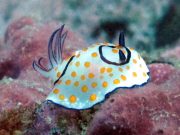
Chromodoris annulata @ Koh Phi Phi
The Ringed Chromodoris has a whitish body colour, often with many yellow spots. There is a distinct purple ring around both the gills and rhinophores.
The mantle has a bluish to purple margin.
A variation of the Ringed Chromodoris has a line joining both rings together. The Ringed Chromodoris grows to 10 cm. The diet includes sponges.
Three-Lobed Ceratosoma
(Ceratosoma trilobatum)
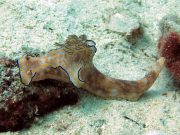
Ceratosoma trilobatum @ Koh Rok
The Three-Lobed Ceratosoma is unusually shaped, with three mantle lobes, one at the front, and two at the side of the body, just forward of the gills. These lobes give the appearance of a flattened mantle.
Around the edge of each lobe is a concentration of 'repugnatorial glands' containing a toxic substance which is excreted as a defensive measure when attacked. This toxic substance is derived from chemicals extracted from the diet.
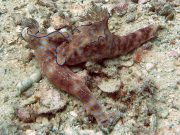
Ceratosoma trilobatum @ Koh Rok
The Three-Lobed Ceratosoma has a long, tapering foot and is variabled coloured, from pale shades, through to an orange-brown or red colour.
The body is often mottled and spotted with lighter colours (not always), and there is often a characteristic thin purple band along most of the mantle edge.
The Three-Lobed Ceratosoma grows to 10 cm and is usually found over sand and rubble areas close to the reef edge.
Dykking med Chromodorid-nakensnegler rundt Koh Lanta
Dykking og snorkleturer
Hvis du vil ha sjansen til å se Chromodorid-nakensnegler på en av våre daglige dykkerturer fra Koh Lanta i høysesongen, kan du sende oss en e-post til info@diveandrelax.com.
Bli med på våre dykkerturer med hurtigbåt i høysesongen til noen av Thailands beste dykkesteder, og nyt små grupper, kort reisetid og fokus på god personlig service, sikkerhet og moro.
Not yet a certified diver? Learn to Scuba Dive on Koh Lanta with the 3 day SSI Open Water Diver course.
Bestill på nettet og spar 10 % på dykkerturer og dykkerkurs på Koh Lanta.
Finn ut mer
Guider om livet i havet i Indo-Stillehavet
- Allen, G., Steene, R., Humann, P., DeLoach, N. (2003) Reef Fish Identification, Tropical Pacific. Jacksonville, FL., USA: New World Publications, Inc., ISBN 1-878348-36-1.
- Humann, P., DeLoach, N., (2010) Reef Creature Identification, Tropical Pacific. Jacksonville, FL., USA: New World Publications Inc., ISBN 978-1-878348-44-9
- Debelius, H. (2013) Indian Ocean Reef Guide. Frankfurt, Germany: IKAN - Unterwasserarchiv, ISBN 978-3-939767-52-7.
- Debelius, H. (2004) Nudibranchs and Sea Snails, Indo-Pacific Field Guide. Frankfurt, Germany: IKAN - Unterwasserarchiv, ISBN 3-925919-51-1
- Erhardt, H., Knop, D. (2015) Corals Indo-Pacific Field Guide. Frankfurt, Germany: IKAN - Unterwasserarchiv, ISBN 3-925919-69-4.
- Veron J.E.N., Stafford-Smith M.G., Turak E. and DeVantier L.M. (2016). Corals of the World