


Dykning med Chromodorid-naaktslakken
Onderwaterleven Lanta | Chromodorididae
De Chromodoridae-naaktslakken omvatten ongeveer 600 soorten en behoren tot de meest opvallend gekleurde en rijkelijk gedecoreerde dieren die er zijn. Veel soorten zijn te zien tijdens duiken bij Koh Lanta.
Chromodoride naaktslakken smaken niet lekker voor roofdieren of zijn zelfs giftig om te eten, waardoor veel soorten overdag openlijk rond de koraalriffen kunnen zwemmen.
Het dieet van alle Chromodoriden bestaat uit sponzen, waarbij sommige soorten naaktslakken zeer specifiek zijn in hun voedselkeuze en slechts één enkele soort spons eten. Stoffen die vrijkomen bij de vertering van deze sponzen worden vervolgens gebruikt voor de aanmaak van krachtige gifstoffen.
De ovale mantels hebben een glad oppervlak en bedekken de voet volledig. Bij de meeste soorten vormen de kieuwen een boog rond de anus, open naar achteren, en in sommige gevallen bijna een volledige cirkel.
Wanneer bedreigd, kan een Chromodorid de kieuwen ook in een zakje terugtrekken ter bescherming.
7 soorten gevonden op deze pagina:
- Gem Sea Slug (Goniobranchus geminus)
- White-margin Sea Slug (Glossodoris rufomarginata)
- Girdled Glossodoris (Glossodoris cincta)
- Beautiful Risbecia (Risbecia pulchella)
- Cheesecake Nudibranch (Doriprismatica atromarginata)
- Ringed Chromodoris (Chromodoris annulata)
- Three-Lobed Ceratosoma (Ceratosoma trilobatum)
Gem Sea Slug
(Goniobranchus geminus)
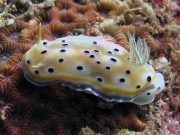
Goniobranchus geminus @ Koh Haa
The Gem Sea Slug has four coloured lines around the edge of the mantle, first a thin white line at the edge, followed by a greyish or bluish-purple line, thirdly another white line and finally a strong yellow line. The main body is pale yellowish to beige to tan with numerous white-edged purple to purple-brown spots. The rhinophores (tentacles on top of the head) are purple or yellow, the gills are whitish with brownish edges.
The Gem Sea Slug grows to 5 cm. The foot extends beyond the rear of the mantle and the upper foot is similarly patterned to the mantle.
White-margin Sea Slug
(Glossodoris rufomarginata)
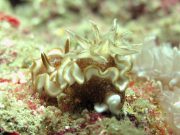
Glossodoris rufomarginata @ Koh Haa
The White-margin Sea Slug has a reddish speckled body, surrounded by a wide, wavy mantle with a fine reddish-orange border surrounding a wide white band.
The rhinophores (tentacles on top of the head) and gills are reddish-orange and white. The foot also has a white margin.
The White-margin Sea Slug grows to 5 cm, but usually observed around 3 cm.
Girdled Glossodoris
(Glossodoris cincta)
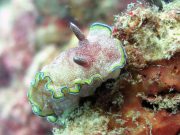
Glossodoris cincta @ Koh Haa
The Girdled Glossodoris has a dark to pale reddish brownish body and rhinophores with scattered white spots of varying sizes. The body is often darker around the base of the rhinophores.
The wavy mantle has a three-part marginal band which is variably coloured from whitish-blue to dark blue/black to yellow. This species has different colour forms depending on location.
The Girdled Glossodoris grows to 5 cm.
Beautiful Risbecia
(Risbecia pulchella)
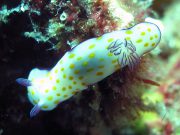
Risbecia pulchella @ Koh Haa
The Beautiful Risbecia has a creamy-whitish upper body, lower body and foot. The slightly wavy mantle margin is purple and the body is covered in many yellow-orange spots. The rhinophores have a white stem and purple leaves, and the gills are whitish with purple or orange margins.
The Beautiful Risbecia is a large nudibranch, growing to 11 cm, often found in pairs, feeds on sponges.
Cheesecake Nudibranch
(Doriprismatica atromarginata)
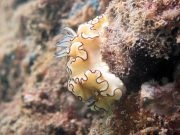
Doriprismatica atromarginata @ Koh Talabeng
The Cheesecake Nudibranch has a creamy-white to lemon-yellow body with a deep purple to black-edged wavy mantle. The rhinophores have a whitish stem and dark grey to black leaves, and the gills are creamy whitish with dark grey margins. There are dark rings at the base of the rhinophores.
The Cheesecake Nudibranch grows to 9 cm and raises its ruffled margin up from the seafloor. This nudibranch can be found close to sponges of the Fasciospongia, Spongia and Luffariella genera.
Ringed Chromodoris
(Chromodoris annulata)
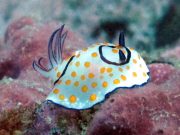
Chromodoris annulata @ Koh Phi Phi
The Ringed Chromodoris has a whitish body colour, often with many yellow spots. There is a distinct purple ring around both the gills and rhinophores.
The mantle has a bluish to purple margin.
A variation of the Ringed Chromodoris has a line joining both rings together. The Ringed Chromodoris grows to 10 cm. The diet includes sponges.
Three-Lobed Ceratosoma
(Ceratosoma trilobatum)
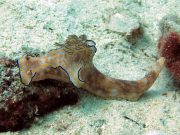
Ceratosoma trilobatum @ Koh Rok
The Three-Lobed Ceratosoma is unusually shaped, with three mantle lobes, one at the front, and two at the side of the body, just forward of the gills. These lobes give the appearance of a flattened mantle.
Around the edge of each lobe is a concentration of 'repugnatorial glands' containing a toxic substance which is excreted as a defensive measure when attacked. This toxic substance is derived from chemicals extracted from the diet.
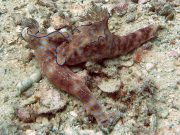
Ceratosoma trilobatum @ Koh Rok
The Three-Lobed Ceratosoma has a long, tapering foot and is variabled coloured, from pale shades, through to an orange-brown or red colour.
The body is often mottled and spotted with lighter colours (not always), and there is often a characteristic thin purple band along most of the mantle edge.
The Three-Lobed Ceratosoma grows to 10 cm and is usually found over sand and rubble areas close to the reef edge.
Duiken met Chromodorid-naaktslakken rond Koh Lanta
Duiken & Snorkeltrips
Als je graag een kans hebt om Chromodorid-naaktslakken te spotten op een van onze dagelijkse hoogseizoen duiktrips vanuit Koh Lanta, stuur ons dan een email naar info@diveandrelax.com.
Ga mee met onze speedboot duiktrips in het hoogseizoen naar enkele van Thailand's beste duiklocaties en geniet van kleine groepen, korte reistijden, met een focus op goede persoonlijke service, veiligheid en plezier.
Not yet a certified diver? Learn to Scuba Dive on Koh Lanta with the 3 day SSI Open Water Diver course.
Boek online en bespaar 10% op duiktrips en duikcursussen op Koh Lanta.
Meer informatie
Indo-Stille Oceaan gidsen
- Allen, G., Steene, R., Humann, P., DeLoach, N. (2003) Reef Fish Identification, Tropical Pacific. Jacksonville, FL., USA: New World Publications, Inc., ISBN 1-878348-36-1.
- Humann, P., DeLoach, N., (2010) Reef Creature Identification, Tropical Pacific. Jacksonville, FL., USA: New World Publications Inc., ISBN 978-1-878348-44-9
- Debelius, H. (2013) Indian Ocean Reef Guide. Frankfurt, Germany: IKAN - Unterwasserarchiv, ISBN 978-3-939767-52-7.
- Debelius, H. (2004) Nudibranchs and Sea Snails, Indo-Pacific Field Guide. Frankfurt, Germany: IKAN - Unterwasserarchiv, ISBN 3-925919-51-1
- Erhardt, H., Knop, D. (2015) Corals Indo-Pacific Field Guide. Frankfurt, Germany: IKAN - Unterwasserarchiv, ISBN 3-925919-69-4.
- Veron J.E.N., Stafford-Smith M.G., Turak E. and DeVantier L.M. (2016). Corals of the World