


Dykning med Keizersvissen (Lethrinidae)
Onderwaterleven Lanta | Lethrinidae
Keizersbeesten vormen een familie van ongeveer 30 verschillende soorten, die soms ook wel keizersbaarzen worden genoemd. Keizersbeesten leven op of in de buurt van koraalriffen en komen voor op alle duiklocaties van Koh Lanta.
Kenmerken die deze familie gemeen heeft, zijn dikke lippen, sterke kaken en wangen zonder schubben.
Deze bodemvissen eten zeeslakken, krabben, zee-egels, wormen en vele andere dieren die op de zeebodem leven. Sommige van de grotere soorten voeden zich met andere vissen. Sommige soorten hebben kiesachtige tanden die ze gebruiken om de schelpen van hun voedsel te kraken.
De meeste keizervissoorten beginnen hun leven als vrouwtjes en veranderen van geslacht om mannetjes te worden naarmate ze groeien.
In sommige maanden kunnen zich rond de nieuwe of volle maan grote scholen paaiende keizersvissen vormen. Vrouwtjes laten duizenden eitjes los, die vervolgens worden bevrucht door sperma van mannetjes en in het plankton blijven drijven tot ze uitkomen en groot genoeg zijn om terug te keren naar het rif.
4 soorten gevonden op deze pagina:
Pinkear Emperor
(Lethrinus lentjan)

Lethrinus lentjan @ Koh Haa
The Pink-Ear Emperor has a silvery greyish body, with a whitish belly. May have a reddish or orangish tinge on the upper back, rear dorsal and tail fins.
The scales are large and in a diamond pattern and there is a blood-red streak on the rear edge of the gill cover. The pectoral fin may be pale orange, whitish or yellowish.
The Pink-Ear Emperor grows to 50 cm, but usually observed around 30 cm. Normally a solitary species, they may form small groups
The diet includes crustaceans, snails, echinoderms, bristle-worms, bivalves, and small fish.
Smalltooth Emperor
(Lethrinus microdon)
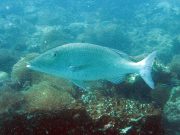
Lethrinus microdon @ Hin Bida
The Smalltooth Emperor has an elongate body with a long, pointed snout, The body is silvery/bluish grey, sometimes with scattered irregular dark blotches on the sides.
Some individuals may also have three dark streaks radiate from the lower part of the eye toward the tip of the snout / mouth.
The Smalltooth Emperor may camouflage by changing to mottled and blotched shades of brown, but will retain any dark streaks radiating from eye toward tip of snout.
The Smalltooth Emperor grows to 70 cm, but more commonly observed in the 40 cm - 50 cm range. Can be observed solitary or in small schools.
The diet includes fish, crustaceans, cephalopods, and bristle-worms.
Ornate Emperor
(Lethrinus ornatus)
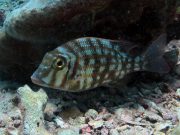
Lethrinus ornatus @ Koh Bida
The Ornate Emperor has a silvery body with broad yellowish-brown horizontal stripes on the sides. Very often there will also be 7 - 8 vertical bands along the body, giving a checkerboard appearance.
There is a red margin on the cheek and gill cover. The dorsal and tail fins are purplish, with the other fins being orange-yellow, often tipped with red.
The Ornate Emperor grows to 40 cm and is usually found in sandy or rubble areas close to the reef edge, either solitary or in pairs.
The diet includes crustaceans, slugs, snails, echinoderms, bristle-worms and small fishes.
Redfin Emperor Bream
(Monotaxis heterodon)
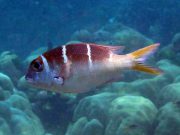
Monotaxis heterodon @ Koh Haa
The redfin emperor bream has a mainly silvery body colour, with a large, dark reddish patch starting above the eyes and running along the back to the end of the dorsal fin.
There are four vertical white stripes which are about the same width as 2 scales. The tail is yellowish/orangish. When the pectoral fin is opened, it reveals a strong dark reddish patch.
This species can grow to 60 cm, but is usually observed much smaller than this, typically 15 - 25 cm.
This species can be confused with the bigeye seabream (Monotaxis grandoculis) which is also a member of the emperor family. The main difference between the two species is the width of the four vertical stripes - in Monotaxis grandoculis the stripes are four scale-widths wide. In Monotaxis grandoculis the dark patch on the back does not extend down toward the middle as much as in this species (Monotaxis heterodon).
Duiken met Keizersvissen (Lethrinidae) rond Koh Lanta
Duiken & Snorkeltrips
Als je graag een kans hebt om Keizersvissen (Lethrinidae) te spotten op een van onze dagelijkse hoogseizoen duiktrips vanuit Koh Lanta, stuur ons dan een email naar info@diveandrelax.com.
Ga mee met onze speedboot duiktrips in het hoogseizoen naar enkele van Thailand's beste duiklocaties en geniet van kleine groepen, korte reistijden, met een focus op goede persoonlijke service, veiligheid en plezier.
Not yet a certified diver? Learn to Scuba Dive on Koh Lanta with the 3 day SSI Open Water Diver course.
Boek online en bespaar 10% op duiktrips en duikcursussen op Koh Lanta.
Meer informatie
Indo-Stille Oceaan gidsen
- Allen, G., Steene, R., Humann, P., DeLoach, N. (2003) Reef Fish Identification, Tropical Pacific. Jacksonville, FL., USA: New World Publications, Inc., ISBN 1-878348-36-1.
- Humann, P., DeLoach, N., (2010) Reef Creature Identification, Tropical Pacific. Jacksonville, FL., USA: New World Publications Inc., ISBN 978-1-878348-44-9
- Debelius, H. (2013) Indian Ocean Reef Guide. Frankfurt, Germany: IKAN - Unterwasserarchiv, ISBN 978-3-939767-52-7.
- Debelius, H. (2004) Nudibranchs and Sea Snails, Indo-Pacific Field Guide. Frankfurt, Germany: IKAN - Unterwasserarchiv, ISBN 3-925919-51-1
- Erhardt, H., Knop, D. (2015) Corals Indo-Pacific Field Guide. Frankfurt, Germany: IKAN - Unterwasserarchiv, ISBN 3-925919-69-4.
- Veron J.E.N., Stafford-Smith M.G., Turak E. and DeVantier L.M. (2016). Corals of the World