


Dykning med Zoetlippen
Onderwaterleven Lanta | Plectorhynchinae
Zoetlippen zijn gemakkelijk te herkennen aan hun kleine bek, grote, vlezige lippen en opvallende kleurpatronen, en worden vaak gespot tijdens duikexcursies naar Koh Lanta. Hun kleuren en patronen lopen sterk uiteen, variërend van effen gekleurd tot gevlekt, gevlekt, geringd en gestreept.
Deze op de bodem levende grunts leven normaal gesproken solitair, of in kleine groepen of paren. Het zijn platte vissen met een sterk naar buiten gebogen kopprofiel en een groef in de kin. Zoetlippen ondergaan gedurende hun leven een reeks dramatische kleur- en patroonveranderingen, waarbij de jongen er totaal anders uitzien dan de volwassen exemplaren.
Zoetlippen zijn vaak te zien in kleine groepjes onder overhangende rotsen, richels of in andere schuilplaatsen en kunnen zich af en toe aansluiten bij andere sweetlips. Deze vissen zijn bodemvoedende roofdieren en 's nachts zoeken ze naar bodembewonende ongewervelde prooien, zoals borstelwormen, garnalen en kleine krabben.
3 soorten gevonden op deze pagina:
Gold-spotted Sweetlips
(Plectorhinchus flavomaculatus)

Plectorhinchus flavomaculatus @ Hin Bida
The Gold-Spotted Sweetlips has a generally light grey coloured body, with yellowish-gold stripes and spots on the head and small yellowish-gold spots on the upper body, extending onto the dorsal and tail fins. Spots on the fins are often darker. There is a dusky lower margin on the tail fin.
The Gold-Spotted Sweetlips grows to 60 cm, but more usually observed 25 cm - 30 cm. This species is observed solitary, or in small groups and the diet includes small fish and crustaceans.
Harlequin Sweetlips
(Plectorhinchus chaetodonoides)
The Harlequin Sweetlips exhibits wildly contrasting colouring at various stages of its life, with the adult coloration and pattern being very different to the juvenile colouration.
The adult Harlequin Sweetlips has a whitish to yellowish or greenish body, with many small dark brown spots on the head, body and fins. The belly is whitish - greyish, and without spots.
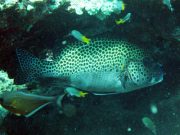
Adult Plectorhinchus chaetodonoides @ Koh Bida
Sub-adult Harlequin Sweetlips are in the transition stage from juvenile to adult and have a whitish body occasionally with yellowish or greenish tinting on the back. The darker body patterns are reminiscent of the juvenile patterns, but starting to fade. The body and tail fin are covered in many small brown spots.


Juvenile Harlequin Sweetlips have a brown body and several large creamy-white, dark-edged blotches. The fins have white margins. Juveniles swim face-down, with a strange undulating, or wave-like wiggle, moving their fins in opposing circular movements. This strange dance is designed to look like a poisonous flatworm or nudibranch in order to deter predators.
Adults can reach 72 cm, but more often observed in the 30 cm range. This species is nocturnal, usually solitary and can be found near ledges on the reef edge. The diet includes crustaceans, molluscs, and fish.
Oriental Sweetlips
(Plectorhinchus vittatus)
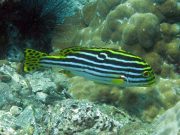
Plectorhinchus vittatus @ Koh Bida
The Oriental Sweetlips has a pale grey to white body with black stripes and a yellow face. The black stripes are usually wider on the upper part of the body. All of the fins are yellow, with the dorsal, anal and tail fins having black blotches and spots.
The Oriental Sweetlips can grow to 85 cm, but more usually observed around 25 cm - 30 cm. This is a nocturnal feeder, whose diet includes other smaller fish. Usually encountered solitary, but may form small groups.
Duiken met Zoetlippen rond Koh Lanta
Duiken & Snorkeltrips
Als je graag een kans hebt om Zoetlippen te spotten op een van onze dagelijkse hoogseizoen duiktrips vanuit Koh Lanta, stuur ons dan een email naar info@diveandrelax.com.
Ga mee met onze speedboot duiktrips in het hoogseizoen naar enkele van Thailand's beste duiklocaties en geniet van kleine groepen, korte reistijden, met een focus op goede persoonlijke service, veiligheid en plezier.
Not yet a certified diver? Learn to Scuba Dive on Koh Lanta with the 3 day SSI Open Water Diver course.
Boek online en bespaar 10% op duiktrips en duikcursussen op Koh Lanta.
Meer informatie
Indo-Stille Oceaan gidsen
- Allen, G., Steene, R., Humann, P., DeLoach, N. (2003) Reef Fish Identification, Tropical Pacific. Jacksonville, FL., USA: New World Publications, Inc., ISBN 1-878348-36-1.
- Humann, P., DeLoach, N., (2010) Reef Creature Identification, Tropical Pacific. Jacksonville, FL., USA: New World Publications Inc., ISBN 978-1-878348-44-9
- Debelius, H. (2013) Indian Ocean Reef Guide. Frankfurt, Germany: IKAN - Unterwasserarchiv, ISBN 978-3-939767-52-7.
- Debelius, H. (2004) Nudibranchs and Sea Snails, Indo-Pacific Field Guide. Frankfurt, Germany: IKAN - Unterwasserarchiv, ISBN 3-925919-51-1
- Erhardt, H., Knop, D. (2015) Corals Indo-Pacific Field Guide. Frankfurt, Germany: IKAN - Unterwasserarchiv, ISBN 3-925919-69-4.
- Veron J.E.N., Stafford-Smith M.G., Turak E. and DeVantier L.M. (2016). Corals of the World