


Dykking med Triggerfisker
Lantas marine liv | Balistidae
Det finnes rundt 40 arter av avtrekkerfisker, og mange av dem holder til ved dykkestedene rundt Koh Lanta.
Alle medlemmer av familien har en flat, oval kropp, med stort hode, liten munn og øyne som kan rotere uavhengig av hverandre. Kroppen er beskyttet av tykk, seig hud, dekket av store skjell.
Mange arter har fargerike kropper, mønstret med linjer og flekker, og kan variere i størrelse fra bare noen få centimeter til over en meter i lengde. Rundt Koh Lanta ser vi sjelden avtrekkerfisker som er større enn 50 cm i lengde.
Avtrekkerfisker er kjent for sine to ryggfinner, hvorav den første (forreste) har tre synlige pigger som kan reises som et advarselstegn (trigger) til potensielle rovdyr eller dykkere.

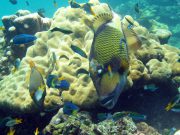
Den første piggeren i den fremre ryggfinnen er mer enn dobbelt så lang som den andre piggeren, og den andre piggeren brukes til å låse den første piggeren i oppreist stilling.
Avtrekkerfisker spiser koraller, kråkeboller, krepsdyr og snegler, og bruker sine 8 svært sterke ytre tenner til å knuse skjell, kråkeboller og forgrenede koraller.
Større avtrekkerfisker blir ofte sett mens de snur steiner, rører opp sanden med finnene og spruter bort rusk med vannstråler fra munnen.
Denne kraftige fôringsaktiviteten skaper mye uro på revet, graver opp mange små ormer, krepsdyr og bløtdyr, og tiltrekker seg mange mindre fisker som spiser restene.
Avtrekkerfisker ses vanligvis alene, men danner par for parring, hvor hannene forbereder reir på havbunnen og beskytter eggene mot potensielle rovdyr, inkludert dykkere.
Både hanner og hunner tar seg av eggene, som ligner en klump med en rosa, geléaktig substans, og spruter ofte vann over eggene for å holde dem oksygenert.
Hvis du kommer inn i et avtrekkerfisker, må du ikke bli overrasket om du blir angrepet av en svært forsvarende og sint avtrekkerfisker, og muligens får et stygt bitt fra de store fortennene.
Titan-avtrekkerfisker er uten tvil de mest aggressive, og man bør aldri nærme seg reirene deres.
9 arter funnet på denne siden:
- Blue Triggerfish (Pseudobalistes fuscus)
- Yellowmargin Triggerfish (Pseudobalistes flavimarginatus)
- Clown Triggerfish (Balistoides conspicillum)
- Titan Triggerfish (Balistoides viridescens)
- Indian Triggerfish (Melichthys indicus)
- Red Tooth Triggerfish (Odonus niger)
- Scythe Triggerfish (Sufflamen bursa)
- Flagtail Triggerfish (Sufflamen chrysopterus)
- Orange-lined Triggerfish (Balistapus undulatus)
Blue Triggerfish
(Pseudobalistes fuscus)
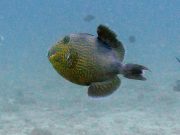
Large Juvenile Pseudobalistes fuscus @ Koh Haa
Adult Blue Triggerfish are bluish grey and usually have yellowish spots on their scales. All the fins have pale blue to yellow to muddy red margins.
Juvenile Blue Triggerfish have a yellowish-orange body with many bright blue horizontal wavy lines and spots on the body, continuing onto the dorsal, anal and tail fins. There are bright blue lines radiating from the eyes.
The Blue Triggerfish grows to 55 cm. Nesting females can be aggressive and may attack divers. The diet includes sea urchins, crustaceans, mollusks, fish and corals.
Yellowmargin Triggerfish
(Pseudobalistes flavimarginatus)
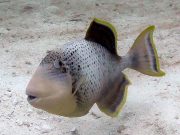
Pseudobalistes flavimarginatus @ Koh Haa
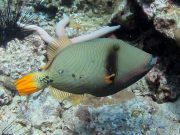
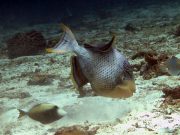
The Yellowmargin Triggerfish has a pale greyish-tan to greenish-tan body and pale pinkish-orangish face. The body is covered with dark spots and cross-hatch patterns. All the fins have yellow or slightly orangish outer margins.
The Yellowmargin Triggerfish grows to 60 cm and is one of the larger triggerfishes we see at the dive sites around Koh Lanta. This species can be aggressive when nesting and is found over sandy or rubble areas close to the reef edge. The diet includes the tips of Acropora coral branches, snails, shrimp, and sea urchins.
Clown Triggerfish
(Balistoides conspicillum)
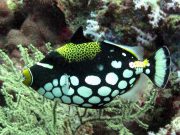
Balistoides conspicillum @ Koh Bida
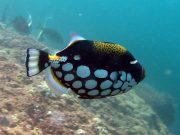
The Clown Triggerfish has a black body with large white spots on the lower body and white behind the chin. The lips are orange and there is a white to yellow coloured band across the top of the snout. On the back is a yellow patch dark spots. The tail is balack and white.
The Clown Triggerfish is a solitary species, growing to 50 cm, but more usually observed 20 cm - 25 cm. The diet includes sea urchins, crabs and other crustaceans.
Titan Triggerfish
(Balistoides viridescens)
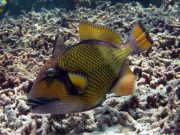
Balistoides viridescens @ Koh Haa
Titan triggerfish are the largest species of triggerfish, growing to 80cm in length. The body is green and yellow with a white lower jaw and tail base. They have dark markings above the mouth which look like a moustache and black edgings on their fins and around their eyes.
Apart from sharks and Giant Grouper, not much is known about what in particular preys on mature titan triggerfish. Their size and strength don't make them an easy meal.
Titan triggerfish spawn with the lunar cycles and tides. The males will establish territories and build open nests on sandy bottoms or reefs. He will have 2 or 3 females joining him and he will mate with all of them. The eggs are laid within the nest and are cared for by both parents until hatching.
When they are tending to their eggs, a female titan triggerfish will guard her nests vigorously against all intruders. Their territory around the nest is cone shaped towards the surface and divers who accidentally enter it may be chased away. Divers should swim horizontally away from the nest rather than upwards which would only take them further into the territory. Although bites are not venomous, they and can inflict an injury that may require medical attention, so it is best to be wary and observe from a distance when they are nesting.
Indian Triggerfish
(Melichthys indicus)
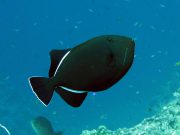
Melichthys indicus @ Koh Haa
The Indian Triggerfish, also known as the Blackfin Triggerfish, has a dark grey to brown to almost black body, with jet-black fins.
There is a white band at the base of the second dorsal fin, the base of the anal fin, and on the tail fin margin.
There is often a variably coloured diagonal streak on the lower face, starting behind the mouth, along the cheek / chin line.
The Indian Triggerfish grows to 25 cm and feeds on algae, crustaceans, small invertebrates and sponges.
Red Tooth Triggerfish
(Odonus niger)

Odonus niger @ Hin Muang
The Red Tooth Triggerfish has a pale blue head and a dark blue to blue-purple body. There are 2 bluish-green lines from the eye to the end of the mouth. The tail is crescent-shaped, with long fin lobes and the fins generally have pale margins. The teeth are reddish.
The Red Tooth Triggerfish grows to 40 cm, but more usually observed around 8 cm - 15 cm. This species forms small groups around dive sites such as Koh Haa or Koh Bida, and very large, but loose groups around Hin Muang. Feeds on plankton.
Scythe Triggerfish
(Sufflamen bursa)
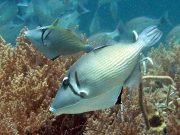
Sufflamen bursa @ Hin Bida
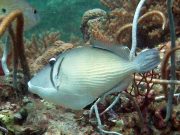
The Scythe Triggerfish can quickly vary the body colour from light grey to dark brown. Some, or all of the face, chin and belly may be white.
There is a yellow-orange or dark brown scythe-shaped marking behind the eye and through the pectoral fin base.
The rear edge of the pelvic flap is black.
The Scythe Triggerfish grows to 25 cm and the diets includes crabs, shellfish, snails, algae, worms and other reef bottom-dwellers.
Flagtail Triggerfish
(Sufflamen chrysopterus)
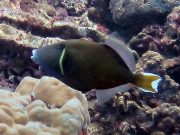
Sufflamen chrysopterus @ Koh Haa
The Flagtail Triggerfish can vary its body colour from dark brown to yellowish-brown. The chin and neck area are bluish.
There is a narrow yellow-orange or black bar from under the eye to past the pectoral fin base. The tail is yellow-brown with a strong white margin.
The Flagtail Triggerfish is a small triggerfish, growing to 30 cm, but more often observed around 15 cm - 20 cm.
This species is territorial and forms pairs, with the male defending the outer territory while the female directly guards the nest.
Orange-lined Triggerfish
(Balistapus undulatus)
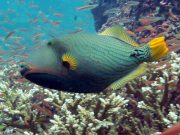
Balistapus undulatus @ Koh Haa
The Orange-lined Triggerfish has a green body with many diagonally curved orange stripes and a large dark spot on the tail base. There are a series of orange streaks from the mouth along the cheeks.
The second dorsal fin, pectoral fin, anal fin and tail fis are all yellow.
The Orange-lined Triggerfish grows to 30 cm, however more usually observed around 15 cm - 20 cm. The diet includes coral polyps, algae, sponges, worms, crabs, urchins and fishes. Usually seen solitary around coral rich areas.
Dykking med Triggerfisker rundt Koh Lanta
Dykking og snorkleturer
Hvis du vil ha sjansen til å se Triggerfisker på en av våre daglige dykkerturer fra Koh Lanta i høysesongen, kan du sende oss en e-post til info@diveandrelax.com.
Bli med på våre dykkerturer med hurtigbåt i høysesongen til noen av Thailands beste dykkesteder, og nyt små grupper, kort reisetid og fokus på god personlig service, sikkerhet og moro.
Not yet a certified diver? Learn to Scuba Dive on Koh Lanta with the 3 day SSI Open Water Diver course.
Bestill på nettet og spar 10 % på dykkerturer og dykkerkurs på Koh Lanta.
Finn ut mer
Guider om livet i havet i Indo-Stillehavet
- Allen, G., Steene, R., Humann, P., DeLoach, N. (2003) Reef Fish Identification, Tropical Pacific. Jacksonville, FL., USA: New World Publications, Inc., ISBN 1-878348-36-1.
- Humann, P., DeLoach, N., (2010) Reef Creature Identification, Tropical Pacific. Jacksonville, FL., USA: New World Publications Inc., ISBN 978-1-878348-44-9
- Debelius, H. (2013) Indian Ocean Reef Guide. Frankfurt, Germany: IKAN - Unterwasserarchiv, ISBN 978-3-939767-52-7.
- Debelius, H. (2004) Nudibranchs and Sea Snails, Indo-Pacific Field Guide. Frankfurt, Germany: IKAN - Unterwasserarchiv, ISBN 3-925919-51-1
- Erhardt, H., Knop, D. (2015) Corals Indo-Pacific Field Guide. Frankfurt, Germany: IKAN - Unterwasserarchiv, ISBN 3-925919-69-4.
- Veron J.E.N., Stafford-Smith M.G., Turak E. and DeVantier L.M. (2016). Corals of the World