


Dykning med Trekkervissen
Onderwaterleven Lanta | Balistidae
Er zijn ongeveer 40 soorten trekkervissen, waarvan er vele te vinden zijn op de duiklocaties rond Koh Lanta.
Alle leden van deze familie hebben een afgeplat, ovaalvormig lichaam, met een grote kop, een kleine bek en oogballen die onafhankelijk van elkaar kunnen draaien. Het lichaam wordt beschermd door een dikke, taaie huid, bedekt met grote schubben.
Veel soorten hebben felgekleurde lichamen, met patronen van strepen en vlekken, en kunnen in grootte variëren van slechts enkele centimeters tot meer dan een meter lang. Rond Koh Lanta zien we zelden trekkervissen die langer zijn dan 50 cm.
Trekkervissen staan bekend om hun twee rugvinnen, waarvan de eerste (voorste) drie zichtbare stekels heeft die kunnen worden opgericht als waarschuwing (trigger) voor potentiële roofdieren of duikers.
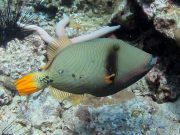
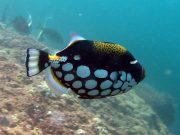

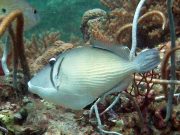
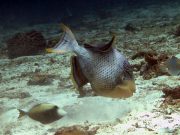
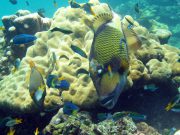
De eerste stekel van de voorste rugvin is meer dan twee keer zo lang als de tweede stekel; de tweede stekel dient om de eerste stekel in een rechtopstaande positie te vergrendelen.
Trekkervissen voeden zich met koraal, zee-egels, schaaldieren en slakken, waarbij ze hun 8 zeer sterke buitenste tanden gebruiken om schelpen, zee-egels en vertakt koraal te verpletteren.
Grotere trekkervissen zijn vaak te zien terwijl ze rotsen omdraaien, het zand met hun vinnen omwoelen en puin wegspuiten met waterstralen uit hun bek.
Deze krachtige voedingsactiviteit zorgt voor veel verstoring op het rif, waarbij veel kleine wormen, schaaldieren en weekdieren worden opgegraven en veel kleinere vissen worden aangetrokken die zich voeden met de restjes.
Trekkervissen worden meestal solitair gezien, maar vormen paren om te paren, waarbij mannetjes nesten op de zeebodem voorbereiden en de eitjes beschermen tegen potentiële roofdieren, waaronder duikers.
Zowel mannetjes als vrouwtjes zorgen voor de eitjes, die lijken op een klomp roze, geleiachtige substantie, en spuiten vaak water over de eitjes om ze van zuurstof te voorzien.
Als je in het broedgebied van een trekkervis terechtkomt, wees dan niet verbaasd als je wordt aangevallen door een zeer defensieve en boze trekkervis, waarbij je mogelijk een flinke beet van de grote voortanden oploopt.
Titan-trekkervissen zijn veruit het meest agressief en hun nesten mogen nooit worden benaderd.
9 soorten gevonden op deze pagina:
- Blue Triggerfish (Pseudobalistes fuscus)
- Yellowmargin Triggerfish (Pseudobalistes flavimarginatus)
- Clown Triggerfish (Balistoides conspicillum)
- Titan Triggerfish (Balistoides viridescens)
- Indian Triggerfish (Melichthys indicus)
- Red Tooth Triggerfish (Odonus niger)
- Scythe Triggerfish (Sufflamen bursa)
- Flagtail Triggerfish (Sufflamen chrysopterus)
- Orange-lined Triggerfish (Balistapus undulatus)
Blue Triggerfish
(Pseudobalistes fuscus)
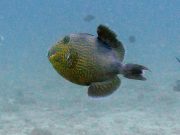
Large Juvenile Pseudobalistes fuscus @ Koh Haa
Adult Blue Triggerfish are bluish grey and usually have yellowish spots on their scales. All the fins have pale blue to yellow to muddy red margins.
Juvenile Blue Triggerfish have a yellowish-orange body with many bright blue horizontal wavy lines and spots on the body, continuing onto the dorsal, anal and tail fins. There are bright blue lines radiating from the eyes.
The Blue Triggerfish grows to 55 cm. Nesting females can be aggressive and may attack divers. The diet includes sea urchins, crustaceans, mollusks, fish and corals.
Yellowmargin Triggerfish
(Pseudobalistes flavimarginatus)
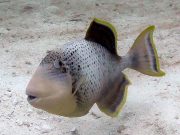
Pseudobalistes flavimarginatus @ Koh Haa
The Yellowmargin Triggerfish has a pale greyish-tan to greenish-tan body and pale pinkish-orangish face. The body is covered with dark spots and cross-hatch patterns. All the fins have yellow or slightly orangish outer margins.
The Yellowmargin Triggerfish grows to 60 cm and is one of the larger triggerfishes we see at the dive sites around Koh Lanta. This species can be aggressive when nesting and is found over sandy or rubble areas close to the reef edge. The diet includes the tips of Acropora coral branches, snails, shrimp, and sea urchins.
Clown Triggerfish
(Balistoides conspicillum)
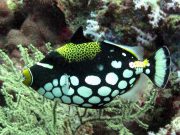
Balistoides conspicillum @ Koh Bida
The Clown Triggerfish has a black body with large white spots on the lower body and white behind the chin. The lips are orange and there is a white to yellow coloured band across the top of the snout. On the back is a yellow patch dark spots. The tail is balack and white.
The Clown Triggerfish is a solitary species, growing to 50 cm, but more usually observed 20 cm - 25 cm. The diet includes sea urchins, crabs and other crustaceans.
Titan Triggerfish
(Balistoides viridescens)
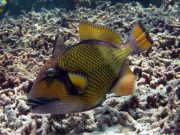
Balistoides viridescens @ Koh Haa
Titan triggerfish are the largest species of triggerfish, growing to 80cm in length. The body is green and yellow with a white lower jaw and tail base. They have dark markings above the mouth which look like a moustache and black edgings on their fins and around their eyes.
Apart from sharks and Giant Grouper, not much is known about what in particular preys on mature titan triggerfish. Their size and strength don't make them an easy meal.
Titan triggerfish spawn with the lunar cycles and tides. The males will establish territories and build open nests on sandy bottoms or reefs. He will have 2 or 3 females joining him and he will mate with all of them. The eggs are laid within the nest and are cared for by both parents until hatching.
When they are tending to their eggs, a female titan triggerfish will guard her nests vigorously against all intruders. Their territory around the nest is cone shaped towards the surface and divers who accidentally enter it may be chased away. Divers should swim horizontally away from the nest rather than upwards which would only take them further into the territory. Although bites are not venomous, they and can inflict an injury that may require medical attention, so it is best to be wary and observe from a distance when they are nesting.
Indian Triggerfish
(Melichthys indicus)
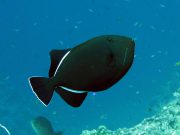
Melichthys indicus @ Koh Haa
The Indian Triggerfish, also known as the Blackfin Triggerfish, has a dark grey to brown to almost black body, with jet-black fins.
There is a white band at the base of the second dorsal fin, the base of the anal fin, and on the tail fin margin.
There is often a variably coloured diagonal streak on the lower face, starting behind the mouth, along the cheek / chin line.
The Indian Triggerfish grows to 25 cm and feeds on algae, crustaceans, small invertebrates and sponges.
Red Tooth Triggerfish
(Odonus niger)

Odonus niger @ Hin Muang
The Red Tooth Triggerfish has a pale blue head and a dark blue to blue-purple body. There are 2 bluish-green lines from the eye to the end of the mouth. The tail is crescent-shaped, with long fin lobes and the fins generally have pale margins. The teeth are reddish.
The Red Tooth Triggerfish grows to 40 cm, but more usually observed around 8 cm - 15 cm. This species forms small groups around dive sites such as Koh Haa or Koh Bida, and very large, but loose groups around Hin Muang. Feeds on plankton.
Scythe Triggerfish
(Sufflamen bursa)
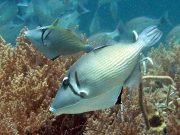
Sufflamen bursa @ Hin Bida
The Scythe Triggerfish can quickly vary the body colour from light grey to dark brown. Some, or all of the face, chin and belly may be white.
There is a yellow-orange or dark brown scythe-shaped marking behind the eye and through the pectoral fin base.
The rear edge of the pelvic flap is black.
The Scythe Triggerfish grows to 25 cm and the diets includes crabs, shellfish, snails, algae, worms and other reef bottom-dwellers.
Flagtail Triggerfish
(Sufflamen chrysopterus)
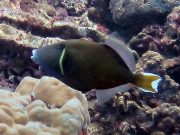
Sufflamen chrysopterus @ Koh Haa
The Flagtail Triggerfish can vary its body colour from dark brown to yellowish-brown. The chin and neck area are bluish.
There is a narrow yellow-orange or black bar from under the eye to past the pectoral fin base. The tail is yellow-brown with a strong white margin.
The Flagtail Triggerfish is a small triggerfish, growing to 30 cm, but more often observed around 15 cm - 20 cm.
This species is territorial and forms pairs, with the male defending the outer territory while the female directly guards the nest.
Orange-lined Triggerfish
(Balistapus undulatus)
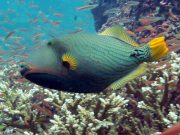
Balistapus undulatus @ Koh Haa
The Orange-lined Triggerfish has a green body with many diagonally curved orange stripes and a large dark spot on the tail base. There are a series of orange streaks from the mouth along the cheeks.
The second dorsal fin, pectoral fin, anal fin and tail fis are all yellow.
The Orange-lined Triggerfish grows to 30 cm, however more usually observed around 15 cm - 20 cm. The diet includes coral polyps, algae, sponges, worms, crabs, urchins and fishes. Usually seen solitary around coral rich areas.
Duiken met Trekkervissen rond Koh Lanta
Duiken & Snorkeltrips
Als je graag een kans hebt om Trekkervissen te spotten op een van onze dagelijkse hoogseizoen duiktrips vanuit Koh Lanta, stuur ons dan een email naar info@diveandrelax.com.
Ga mee met onze speedboot duiktrips in het hoogseizoen naar enkele van Thailand's beste duiklocaties en geniet van kleine groepen, korte reistijden, met een focus op goede persoonlijke service, veiligheid en plezier.
Not yet a certified diver? Learn to Scuba Dive on Koh Lanta with the 3 day SSI Open Water Diver course.
Boek online en bespaar 10% op duiktrips en duikcursussen op Koh Lanta.
Meer informatie
Indo-Stille Oceaan gidsen
- Allen, G., Steene, R., Humann, P., DeLoach, N. (2003) Reef Fish Identification, Tropical Pacific. Jacksonville, FL., USA: New World Publications, Inc., ISBN 1-878348-36-1.
- Humann, P., DeLoach, N., (2010) Reef Creature Identification, Tropical Pacific. Jacksonville, FL., USA: New World Publications Inc., ISBN 978-1-878348-44-9
- Debelius, H. (2013) Indian Ocean Reef Guide. Frankfurt, Germany: IKAN - Unterwasserarchiv, ISBN 978-3-939767-52-7.
- Debelius, H. (2004) Nudibranchs and Sea Snails, Indo-Pacific Field Guide. Frankfurt, Germany: IKAN - Unterwasserarchiv, ISBN 3-925919-51-1
- Erhardt, H., Knop, D. (2015) Corals Indo-Pacific Field Guide. Frankfurt, Germany: IKAN - Unterwasserarchiv, ISBN 3-925919-69-4.
- Veron J.E.N., Stafford-Smith M.G., Turak E. and DeVantier L.M. (2016). Corals of the World