


Dykking med Papegøyefisker
Lantas marine liv | Scaridae
Papegøyefisker er nært beslektet med leppefiskfamilien, og med rundt 95 arter er de blant de mest vanlige og viktigste fiskene i et korallrev. De ses jevnlig ved alle korallrevene når man dykker rundt Koh Lanta.
Papegøyefisk har stumpe hoder og dype kropper, og er lett å kjenne igjen på de tettpakkede tennene på utsiden av kjevebenene, som danner et papegøyeaktig nebb som brukes til å skrape alger og tang fra koraller og andre steinete overflater.
Tennene vokser kontinuerlig og erstatter det som slites bort ved fôring. Biter av stein eller koraller som spises sammen med algene, knuses til sand og males sammen med algene for å lette fordøyelsen, noe som gjør papegøyefisken til en av de viktigste produsentene av sand på korallrev. Papegøyefiskens avføring består ofte hovedsakelig av sand.

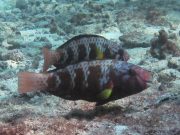

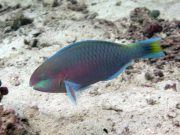
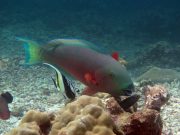
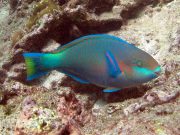
Forskere anslår at en enkelt stor papegøyefisk kan skille ut nesten 1 000 kg sand hvert år!
Denne kontinuerlige rensingen av revet er avgjørende for sunne koraller og et blomstrende rev.
Papegøyefisk lever vanligvis i rundt 5 til 7 år. Ungfisk av de fleste artene begynner livet som hunner, ofte med en matt rød, brun eller grå kroppsfarge.
Unge papegøyefisker danner haremer, hvor den største hunnen skifter kjønn til hann, i likhet med deres nære slektninger, leppefisken og klovnefisken. Forvandlingen fra hunn til hann ledsages vanligvis av en dramatisk endring i kroppsfarge til lysegrønn eller blå med levende røde, rosa, oransje eller gule flekker.
Det kan noen ganger dannes store stimer med mange hundre individer, som beveger seg rundt revet i tettpakkede grupper og svever over korallene for å spise på algebedene.
På samme måte som mennesker bruker pyjamas når de legger seg, kan papegøyefisker produsere en slimkokong om natten, som de blåser ut av munnen og som dekker hele kroppen mens de sover.
Havbiologer mener at denne slimkokongen skjuler lukten deres for nattaktive rovdyr som murener.
Papegøyefisk finnes på alle dykkesteder rundt Koh Lanta, hvor de stadig patruljerer revet på jakt etter flekker med alger og koraller å spise.
9 arter funnet på denne siden:
- Redlip Parrotfish (Scarus rubroviolaceus)
- Swarthy Parrotfish (Scarus niger)
- Greenlip Parrotfish (Scarus virdifucatus)
- Greenthroat Parrotfish (Scarus prasiognathos)
- Indian Parrotfish (Chlorurus capistratoides)
- Roundhead Parrotfish (Chlorurus strongylocephalus)
- Bullethead Parrotfish (Chlorurus sordidus)
- Greenhead Parrotfish (Chlorurus troschelii)
- Bicolour Parrotfish (Cetoscarus ocellatus)
Redlip Parrotfish
(Scarus rubroviolaceus)
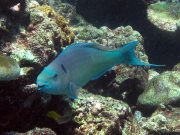
Scarus rubroviolaceus @ Koh Bida
The male (Terminal Phase) Redlip Parrotfish has a green body colour, often bicolour, with a darker forebody. There is a green to blue band on the upper lip and double bands on the chin. There are many blue and green stripes on the tail.
Female (Initial Phase) Redlip Parrotfish have a dark body, with shades of reddish brown to grey. There are small black spots on the body, and possibly wavy lines on the scales.The fins and lips are often red.
The Redlip Parrotfish grows to 70 cm. Females are frequently seen with large males.
Swarthy Parrotfish
(Scarus niger)
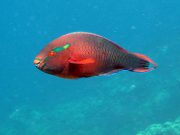
Scarus niger @ Koh Bida
The male Swarthy Parrotfish is a dark reddish brown colour, greenish toward the rear, taking on a more purplish-green colour as it grows. The lips are red and there is a yellow to green spot or streak behind the eye. There are dark bands around the mouth. The tail fin has elongated lobes.
Female Swarthy Parrotfish have a red head and dark main body with many black and white horizontal wavy lines. There are dark bands around the mouth, and a dark spot or stripe close to, or through the eye. The tail fin is rounded.
The Swarthy Parrotfish grows to 35 cm and is found in coral rich areas. Feeds on bottom dwelling algae.
Greenlip Parrotfish
(Scarus virdifucatus)
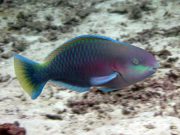
Scarus virdifucatus @ Koh Haa
The male Greenlip Parrotfish has a greenish purple body and purple head. The body green scales have a purple border. The cheek is blue-green in colour and there are a series of variable, wavy markings behind the mouth.
The dorsal, anal and tail fins have blue margins. The tail fin is rounded with a yellowish center.
The female Greenlip Parrotfish is dark brown.
The Greenlip Parrotfish grows to 32 cm and feeds on bottom dwelling algae.
Greenthroat Parrotfish
(Scarus prasiognathos)
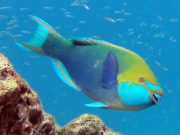
Scarus prasiognathos @ Koh Haa
The male Greenthroat Parrotfish, also known as the Singapore parrotfish, has a dark green body with a yellowish upper head. The lower head is green, and there is a broad green band across the snout.
The female Greenthroat Parrotfish has a reddish brown body with some scattered white spots. The head is often lighter than the body.
The male Greenthroat Parrotfish grows to 70 cm, often form large feeding schools along the reef, overwhelming the defences of other territorial species. Females grow to 40 cm.
Indian Parrotfish
(Chlorurus capistratoides)

Female (IP) Chlorurus capistratoides @ Koh Haa
Male (Terminal Phase) Indian Parrotfish have a green back with a rosy pink streak on each scale. The pectoral region is yellow and there are green bands around the mouth and eyes.
Juvenile (female, Initial Phase) Indian Parrotfish are dark grey with a pale pinkish snout and tail and 4 - 5 whitish bars of varying intensity. The pectoral fin is pinkish with a yellow outer margin to the rear.
The Indian Parrotfish grows to 55 cm and forms large feeding schools of mostly females, with a smaller number of males following behind the feeding frenzy.
Roundhead Parrotfish
(Chlorurus strongylocephalus)
The Male Roundhead Parrotfish, also known as the Indian Ocean Steephead Parrotfish, has a steep forehead, a blue to green body, and an extensive yellow-green area on the cheek. The tail fin is dark blue, with lighter margins and elongated tail fin lobes.

Male Chlorurus strongycephalus @ Koh Haa
Female Roundhead Parrotfish have a yellow green upper head, back and tail. The body is predominantly reddish to reddish brown. There are dark green markings around the mouth, and there are blue-green margins on the tail fin.
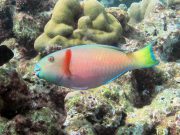
Female Chlorurus strongycephalus @ Koh Haa
The species complex comprises the the Roundhead Parrotfish (Chlorurus strongylocephalus) in the Indian Ocean, the Steephead Parrotfish (Chlorurus microrhinos) in the west-central Pacific, and the Heavybeak Parrotfish (Chlorurus gibbus) in the Red Sea.
The Roundhead Parrotfish grows to 70 cm and is often seen solitary, or with several females. The diet consists of algae and this species is usually seen around the reef edge.
Bullethead Parrotfish
(Chlorurus sordidus)
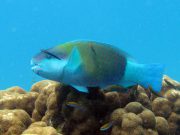
Terminal Phase (male) Chlorurus sordidus @ Koh Haa
Male (Terminal Phase) Bullethead Parrotfish, also known as the Greenfin Parrotfish, has a generally green body, some variations with lavender scale edges.
There are variously coloured markings and patches on the head, often yellowish, blue, green and lavender. All colourations have a pale green tail base and a square-cut tail fin. The snout is rounded.
Female (juvenile, Initial Phase) Bullethead Parrotfish have a light reddish brown head and forebody, with a darker mid and rear body.
Older juveniles will have a dark tail with 3 or 4 vertical rows of white spots, and younger juveniles will have a white tail fin and tail fin base, with a large dark spot on the tail fin base.
Bullethead Parrotfish can grow to 40 cm, and feed on bottom dwelling algae. Juveniles and individuals in the initial phase can form large schools which migrate great distances between feeding and sleeping grounds.
Greenhead Parrotfish
(Chlorurus troschelii)

Chlorurus troschelii @ Koh Haa
The adult (male, Terminal Phase) Greenhead Parrotfish, also known as Troschel's parrotfish has a green body with pink to lavender scale edges gradating to blush on lower body.
The upper head is green, and there is a large pale patch on the cheek which extends to the lower head. There is a dark band from the corner of the mouth through the eye.
Juveniles (females, Initial Phase) have a dark grey-brown to black body, with three to four pale yellow bars.
The adult Greenhead Parrotfish grows to 35 cm and can be found in areas with high coral cover.
Bicolour Parrotfish
(Cetoscarus ocellatus)
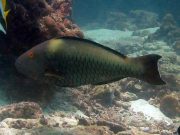
Female Cetoscarus ocellatus @ Koh Haa
Male (Terminal Phase) Bicolour Parrotfish grow to 80 cm and are green with pinkish red spots and lines on the head and a pinkish line from the mouth to the belly.
The larger body scale margins are pinkish and there are also pinkish bands and streaks on the fins.
Female (Initial Phase) Bicolour Parrotfish have a dark head and greenish body, with dark green scale margins and a lighter green back. The iris is orange.
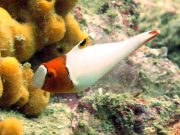
Juvenile Cetoscarus ocellatus @ Koh Haa
Juvenile Bicolour Parrotfish have a white body, with a thick orange band around the head, a black ocellated spot with a yellow margin on the dorsal fin and broad orange submarginal band on the tail.
Dykking med Papegøyefisker rundt Koh Lanta
Dykking og snorkleturer
Hvis du vil ha sjansen til å se Papegøyefisker på en av våre daglige dykkerturer fra Koh Lanta i høysesongen, kan du sende oss en e-post til info@diveandrelax.com.
Bli med på våre dykkerturer med hurtigbåt i høysesongen til noen av Thailands beste dykkesteder, og nyt små grupper, kort reisetid og fokus på god personlig service, sikkerhet og moro.
Not yet a certified diver? Learn to Scuba Dive on Koh Lanta with the 3 day SSI Open Water Diver course.
Bestill på nettet og spar 10 % på dykkerturer og dykkerkurs på Koh Lanta.
Finn ut mer
Guider om livet i havet i Indo-Stillehavet
- Allen, G., Steene, R., Humann, P., DeLoach, N. (2003) Reef Fish Identification, Tropical Pacific. Jacksonville, FL., USA: New World Publications, Inc., ISBN 1-878348-36-1.
- Humann, P., DeLoach, N., (2010) Reef Creature Identification, Tropical Pacific. Jacksonville, FL., USA: New World Publications Inc., ISBN 978-1-878348-44-9
- Debelius, H. (2013) Indian Ocean Reef Guide. Frankfurt, Germany: IKAN - Unterwasserarchiv, ISBN 978-3-939767-52-7.
- Debelius, H. (2004) Nudibranchs and Sea Snails, Indo-Pacific Field Guide. Frankfurt, Germany: IKAN - Unterwasserarchiv, ISBN 3-925919-51-1
- Erhardt, H., Knop, D. (2015) Corals Indo-Pacific Field Guide. Frankfurt, Germany: IKAN - Unterwasserarchiv, ISBN 3-925919-69-4.
- Veron J.E.N., Stafford-Smith M.G., Turak E. and DeVantier L.M. (2016). Corals of the World