


Dykking med Barracuda
Lantas marine liv | Sphyraenidae
Barracudaer finnes over hele verden i alle varme og tropiske farvann, og blir vanligvis observert i grunt vann nær korallrev og sjøgressenger. Det er fire arter som regelmessig observeres når man dykker fra Koh Lanta.
De er raske, kraftige og kjent for sitt ofte skremmende utseende. De har lange, tynne, langstrakte kropper, og noen arter kan bli opptil 2 m lange.
Overkroppen er vanligvis grå eller sølvfarget, med mørkeblå eller mørkegrønn farge, mens underkroppen er hvitaktig.
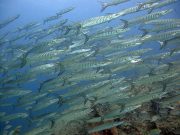

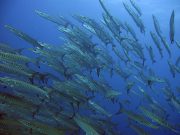
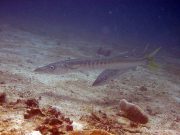
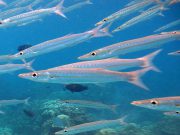

Kroppsmønstrene varierer fra art til art, og består vanligvis av striper, V-formede mønstre, flekker og flekkete områder som gjør det lettere å skille artene fra hverandre.
Barracudaer har to korte ryggfinner som ligger langt fra hverandre, en kløftet halefinne og små skjell. Finner kan være gulaktige eller mørke.
Det karakteristiske gjeddeaktige hodet er langt, tynt og spiss, med et stort underbitt hos mange arter. Store, skarpe, hoggtennlignende tenner stikker tydelig ut fra kjeven, noe som gir et truende og skremmende utseende.
Noen arter, som stor barracuda (Sphyraena barracuda), sees vanligvis alene i de grunne delene av revet rundt Koh Lanta, men andre arter kan sees både i små grupper og i svært store stimer på flere tusen individer.
Barracudaer er rovdyr som ligger på lur, og venter for det meste på å jakte på mindre fisk. Selv om hendelser er sjeldne, er det kjent at stor barracuda ved en feiltakelse har angrepet svømmere.
Fjern skinnende smykker og diamantringer når du dykker eller snorkler, da disse gjenstandene er kjent for å tiltrekke seg stor barracudas oppmerksomhet og kan virke attraktive for dem.
4 arter funnet på denne siden:
Bigeye Barracuda
(Sphyraena forsteri)
The Bigeye Barracuda is very common at both the Bida Islands and the Koh Haa Islands, particularly around Koh Haa Lagoon, where large schools are seen on almost every dive there.
The Bigeye Barracuda is a long silvery fish, often with a yellow or greenish stripe running from the mouth, through the eye, to, or nearly to, the tail fin base. Above the stripe are often a series of short diagonal bars of a similar colour to the stripe. The upper back (around the dorsal fin) is also the same colour as the mid-body stripe.

Sphyraena forsteri @ Koh Haa
The lower body is lighter than the upper body. The eye is large, and the lower jaw slightly protrudes beyond the upper jaw. There is a small dark blotch at the base of the pectoral fin, and the forked tail fin usually (but not always) has a very faint dark margin.

School of Bigeye Barracuda @ Koh Haa
The Bigeye Barracuda grows to 65 cm, but is usually observed in the 25 cm - 35 cm range. This species feeds nocturnally on fish, shrimp and squid, but is often seen in large schools close to coral reefs during the day. These schools can sometimes be very large.
Blackfin Barracuda
(Sphyraena genie)

Sphyraena genie @ Koh Bida
The Blackfin Barracuda has a silvery body with a dusky to dark tail fin with dark margins. The rear dorsal fin and anal fin are also often a dusky to dark colour.
The body is long, tube-like, and the lower jaw protrudes beyond the upper jaw. There are about 18 - 22 dark chevron markings on the sides.
Blackfin Barracuda grow to 100 cm, but more usually observed in the 50 cm - 80 cm range. We sometimes see this species alone, but also in very large schools of 1,000+ individuals.
This species is a nocturnal feeder, with schools likely dispersing to hunt at night.
Pickhandle Barracuda
(Sphyraena jello)
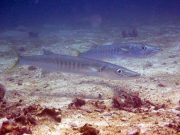
Sphyraena jello @ Koh Haa
The Pickhandle Barracuda has a very long silvery body with a yellowish tail and a huge mouth, with the lower jaw protruding significantly beyond the upper jaw.
There are around 10 - 20 wavy dark vertical bars along the side of the body.
Pickhandle Barracuda can grow to 150 cm, but more often seen 80 cm - 100 cm. The diet includes fish and squid.
Usually solitary, however occasionally we can see schools of several hundred in the shallows just outside of the reef area.
Great Barracuda
(Sphyraena barracuda)

Sphyraena barracuda @ Koh Haa
The Great Barracuda has a long, silvery tube-like body, large and very pointed teeth, and a lower jaw which protrudes beyond the upper jaw. The body has scattered dark patches and blotches.
When resting near a reef or the sandy bottom, this species can display a barred or mottled pattern to aid camouflage. There may be large black blotches on the tail fin and dorsal fins, especially the rear dorsal fin.
The Great Barracuda grows to 180 cm, but more commonly observed 60 cm - 80 cm.
The Great Barracuda is an ambush predator, feeding on fish and squid. Usually seen solitary, but occasionally in small groups.
Dykking med Barracuda rundt Koh Lanta
Dykking og snorkleturer
Hvis du vil ha sjansen til å se Barracuda på en av våre daglige dykkerturer fra Koh Lanta i høysesongen, kan du sende oss en e-post til info@diveandrelax.com.
Bli med på våre dykkerturer med hurtigbåt i høysesongen til noen av Thailands beste dykkesteder, og nyt små grupper, kort reisetid og fokus på god personlig service, sikkerhet og moro.
Not yet a certified diver? Learn to Scuba Dive on Koh Lanta with the 3 day SSI Open Water Diver course.
Bestill på nettet og spar 10 % på dykkerturer og dykkerkurs på Koh Lanta.
Finn ut mer
Guider om livet i havet i Indo-Stillehavet
- Allen, G., Steene, R., Humann, P., DeLoach, N. (2003) Reef Fish Identification, Tropical Pacific. Jacksonville, FL., USA: New World Publications, Inc., ISBN 1-878348-36-1.
- Humann, P., DeLoach, N., (2010) Reef Creature Identification, Tropical Pacific. Jacksonville, FL., USA: New World Publications Inc., ISBN 978-1-878348-44-9
- Debelius, H. (2013) Indian Ocean Reef Guide. Frankfurt, Germany: IKAN - Unterwasserarchiv, ISBN 978-3-939767-52-7.
- Debelius, H. (2004) Nudibranchs and Sea Snails, Indo-Pacific Field Guide. Frankfurt, Germany: IKAN - Unterwasserarchiv, ISBN 3-925919-51-1
- Erhardt, H., Knop, D. (2015) Corals Indo-Pacific Field Guide. Frankfurt, Germany: IKAN - Unterwasserarchiv, ISBN 3-925919-69-4.
- Veron J.E.N., Stafford-Smith M.G., Turak E. and DeVantier L.M. (2016). Corals of the World