


Dykking med Kassefisker
Lantas marine liv | Ostraciidae
Kassefisk er, som navnet tilsier, kasseformet, med en pansret og stiv kropp som i de fleste tilfeller ville hemme bevegelsesevnen. Denne ulempen oppveies av kassefiskens form, som har ført til utviklingen av en uvanlig svømmestil.
De blir ofte sett på sand eller steinur nær revkanten på dykkerturer til Koh Lanta.
Kassefisk er normalt ensomme dyr, men samles om våren i små grupper bestående av 1 hann og 2–4 hunner for å formere seg.
Alle kjente arter av kassefisk benytter seg av en «gytestigning»-strategi. Ved solnedgang eller soloppgang bruker hannen tiden på å vise frem sine sterke farger og danse rundt hunnen. Når hunnen er fornøyd, svømmer hun raskt opp til overflaten eller til grunt, åpent vann (gytestigningen), og hannen nynner da til hunnen, høyt nok til at en dykker kan høre det. Eggene blir deretter befruktet og sluppet ut, og kassefiskene vender tilbake til tryggere, skjermede og beskyttede deler av revet.
Denne pelagiske gyte-teknikken innebærer at når eggene først er sluppet ut, blir de spredt vidt ut i det åpne havet av strømmer. Hunnen kan produsere et antall egg daglig i omtrent en måned. En fordel med denne teknikken er at rovdyr ikke kan spise hele eggkull, men sjansene for at et klekket egg driver til et passende tilfluktssted hvor en nyfødt kan leve og overleve er små, noe som fører til en høy dødelighet i reproduksjonen av boksfisk.
3 arter funnet på denne siden:
Yellow Boxfish
(Ostracion cubicus)
The Yellow Boxfish (Ostracion cubicus) is a species of boxfish found in relative shallow waters, usually among corals and complex structures which can provide protection from potential predators.
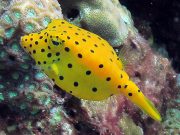
Ostracion cubicus @ Koh Haa
When juvenile, the Yellow Boxfish is bright yellow in color with black spots, and easy to identify. As they begin to mature the number of spots decreases and the yellow blends into almost a dirty, mustard colour.
Very old specimens will have blue-grey to black colouration with faded yellow. As they grow, the body elongates and a bump forms on the snout tip.
Juvenile - Bright yellow with black spots on head and body. Possibly starting to grow a small bump on snout tip.
Young Adult - Yellowish brown to olive coloured, with black spots on the head and a few dark ringed bluish spots on the body. Young adults will have a small bump on the snout tip.
Intermediate Adult - Tan to yellowish brown colour with dark ringed bluish spots. Fins are blue with black spots and may have blue/black or yellow crinkled line markings on the head and base of the pectoral fins. Obvious bump on the snout tip.

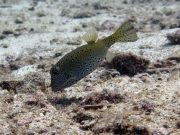
Large Adult - Brownish purplish or blue/greyish with indistinct/faded spots. Often yellow crinkled line markings on the head and yellowish tail base. Bump on the snout tip. Can reach a maximum length of 45 centimetres (18 in).
The Yellow Boxfish feeds mainly on algae, but will also feed on sponges, crustaceans and molluscs. The fish's diet consists of marine algae, worms, crustaceans, molluscs, and small fish. Using its puckered lips, it blows small bursts of water at the corals and sand to reveal anything that might be hiding.
When stressed or injured the Yellow Boxfish releases the neurotoxin tetrodoxin (TTX) from special cells covering their entire skin. This cloud of poison can be fatal to fish in the surrounding waters. The bright yellow colour and black spots are also a form of warning coloration (Aposematism) to any potential predators.
Horn-nosed Boxfish
(Ostracion rhinorhynchos)
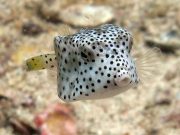
Ostracion rhinorhynchos @ Koh Bida
The Horn-nose Boxfish has a carapace that is pentagonal (six sides) in cross-section. The body ridges are relatively sharp-edged, and lack spines. There is a distinct bump on snout.
This species is whitish with black spots on the back and caudal peduncle. Large fish are darker with more dark spots.
This is a generally uncommon species and is found singly or in pairs over channels, coral patches and rubble substrates of sandy lagoons and sheltered inner reefs.
Feeds on benthic invertebrates.
Whitespotted Boxfish
(Ostracion meleagris)
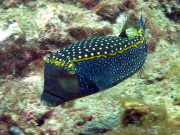
Male Ostracion meleagris @ Koh Bida
The male Whitespotted Boxfish has a black back with white spots and blue sides with bright yellow spots and bands.
Female and juvenile Whitespotted Boxfish have a black or dark brown body with white spots.
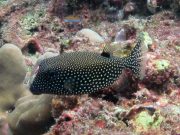
Female Ostracion meleagris @ Koh Haa
The Whitespotted Boxfish grows to 25 cm. The diet includes molluscs, bristle worms, sponges, crustaceans and algae.
Dykking med Kassefisker rundt Koh Lanta
Dykking og snorkleturer
Hvis du vil ha sjansen til å se Kassefisker på en av våre daglige dykkerturer fra Koh Lanta i høysesongen, kan du sende oss en e-post til info@diveandrelax.com.
Bli med på våre dykkerturer med hurtigbåt i høysesongen til noen av Thailands beste dykkesteder, og nyt små grupper, kort reisetid og fokus på god personlig service, sikkerhet og moro.
Not yet a certified diver? Learn to Scuba Dive on Koh Lanta with the 3 day SSI Open Water Diver course.
Bestill på nettet og spar 10 % på dykkerturer og dykkerkurs på Koh Lanta.
Finn ut mer
Guider om livet i havet i Indo-Stillehavet
- Allen, G., Steene, R., Humann, P., DeLoach, N. (2003) Reef Fish Identification, Tropical Pacific. Jacksonville, FL., USA: New World Publications, Inc., ISBN 1-878348-36-1.
- Humann, P., DeLoach, N., (2010) Reef Creature Identification, Tropical Pacific. Jacksonville, FL., USA: New World Publications Inc., ISBN 978-1-878348-44-9
- Debelius, H. (2013) Indian Ocean Reef Guide. Frankfurt, Germany: IKAN - Unterwasserarchiv, ISBN 978-3-939767-52-7.
- Debelius, H. (2004) Nudibranchs and Sea Snails, Indo-Pacific Field Guide. Frankfurt, Germany: IKAN - Unterwasserarchiv, ISBN 3-925919-51-1
- Erhardt, H., Knop, D. (2015) Corals Indo-Pacific Field Guide. Frankfurt, Germany: IKAN - Unterwasserarchiv, ISBN 3-925919-69-4.
- Veron J.E.N., Stafford-Smith M.G., Turak E. and DeVantier L.M. (2016). Corals of the World