


Dykning med Kistvissen
Onderwaterleven Lanta | Ostraciidae
Kistvissen zijn, zoals de naam al aangeeft, kistvormig, met een gepantserd en stijf lichaam dat in de meeste gevallen hun bewegingsvrijheid zou beperken. Dit nadeel wordt echter gecompenseerd door de vorm van de kistvis, die heeft geleid tot de ontwikkeling van een ongebruikelijke zwemstijl.
Ze worden vaak gespot op zand of puin dicht bij de rifrand tijdens duiktrips naar Koh Lanta.
Kistvissen zijn normaal gesproken solitaire dieren, die zich in het voorjaar in kleine groepen van 1 mannetje en 2 tot 4 vrouwtjes verzamelen om te paren.
Alle gedocumenteerde soorten kistvissen passen een ‘spawning rise’-strategie toe. Bij zonsondergang of zonsopgang brengt het mannetje zijn tijd door met het tonen van felle kleuren en het dansen rond het vrouwtje. Zodra het vrouwtje tevreden is, zwemt ze snel naar het oppervlak of naar ondiep open water (de ‘rise’), waarna het mannetje naar het vrouwtje zoemt, luid genoeg om door een duiker te worden gehoord. De eitjes worden vervolgens bevrucht en vrijgegeven, waarna de kistvissen terugkeren naar veiligere, beschutte en beschermde delen van het rif.
Deze pelagische paaitechniek houdt in dat de eitjes, zodra ze zijn vrijgelaten, door stromingen wijd verspreid raken in de open oceaan. Het vrouwtje kan gedurende ongeveer een maand dagelijks een aantal eitjes produceren. Een voordeel van deze techniek is dat roofdieren zich niet op de hele partij eitjes kunnen voeden, maar de kans dat een uitgekomen eitje naar een geschikte schuilplaats drijft waar een pasgeboren jong kan leven en overleven, is klein, wat leidt tot een hoog sterftecijfer bij de voortplanting van de koffervis.
3 soorten gevonden op deze pagina:
Yellow Boxfish
(Ostracion cubicus)
The Yellow Boxfish (Ostracion cubicus) is a species of boxfish found in relative shallow waters, usually among corals and complex structures which can provide protection from potential predators.
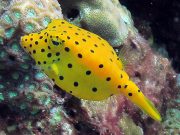
Ostracion cubicus @ Koh Haa
When juvenile, the Yellow Boxfish is bright yellow in color with black spots, and easy to identify. As they begin to mature the number of spots decreases and the yellow blends into almost a dirty, mustard colour.
Very old specimens will have blue-grey to black colouration with faded yellow. As they grow, the body elongates and a bump forms on the snout tip.
Juvenile - Bright yellow with black spots on head and body. Possibly starting to grow a small bump on snout tip.
Young Adult - Yellowish brown to olive coloured, with black spots on the head and a few dark ringed bluish spots on the body. Young adults will have a small bump on the snout tip.
Intermediate Adult - Tan to yellowish brown colour with dark ringed bluish spots. Fins are blue with black spots and may have blue/black or yellow crinkled line markings on the head and base of the pectoral fins. Obvious bump on the snout tip.

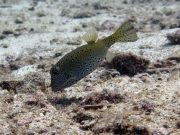
Large Adult - Brownish purplish or blue/greyish with indistinct/faded spots. Often yellow crinkled line markings on the head and yellowish tail base. Bump on the snout tip. Can reach a maximum length of 45 centimetres (18 in).
The Yellow Boxfish feeds mainly on algae, but will also feed on sponges, crustaceans and molluscs. The fish's diet consists of marine algae, worms, crustaceans, molluscs, and small fish. Using its puckered lips, it blows small bursts of water at the corals and sand to reveal anything that might be hiding.
When stressed or injured the Yellow Boxfish releases the neurotoxin tetrodoxin (TTX) from special cells covering their entire skin. This cloud of poison can be fatal to fish in the surrounding waters. The bright yellow colour and black spots are also a form of warning coloration (Aposematism) to any potential predators.
Horn-nosed Boxfish
(Ostracion rhinorhynchos)
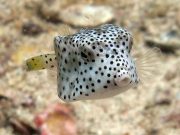
Ostracion rhinorhynchos @ Koh Bida
The Horn-nose Boxfish has a carapace that is pentagonal (six sides) in cross-section. The body ridges are relatively sharp-edged, and lack spines. There is a distinct bump on snout.
This species is whitish with black spots on the back and caudal peduncle. Large fish are darker with more dark spots.
This is a generally uncommon species and is found singly or in pairs over channels, coral patches and rubble substrates of sandy lagoons and sheltered inner reefs.
Feeds on benthic invertebrates.
Whitespotted Boxfish
(Ostracion meleagris)
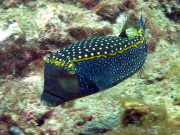
Male Ostracion meleagris @ Koh Bida
The male Whitespotted Boxfish has a black back with white spots and blue sides with bright yellow spots and bands.
Female and juvenile Whitespotted Boxfish have a black or dark brown body with white spots.
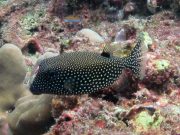
Female Ostracion meleagris @ Koh Haa
The Whitespotted Boxfish grows to 25 cm. The diet includes molluscs, bristle worms, sponges, crustaceans and algae.
Duiken met Kistvissen rond Koh Lanta
Duiken & Snorkeltrips
Als je graag een kans hebt om Kistvissen te spotten op een van onze dagelijkse hoogseizoen duiktrips vanuit Koh Lanta, stuur ons dan een email naar info@diveandrelax.com.
Ga mee met onze speedboot duiktrips in het hoogseizoen naar enkele van Thailand's beste duiklocaties en geniet van kleine groepen, korte reistijden, met een focus op goede persoonlijke service, veiligheid en plezier.
Not yet a certified diver? Learn to Scuba Dive on Koh Lanta with the 3 day SSI Open Water Diver course.
Boek online en bespaar 10% op duiktrips en duikcursussen op Koh Lanta.
Meer informatie
Indo-Stille Oceaan gidsen
- Allen, G., Steene, R., Humann, P., DeLoach, N. (2003) Reef Fish Identification, Tropical Pacific. Jacksonville, FL., USA: New World Publications, Inc., ISBN 1-878348-36-1.
- Humann, P., DeLoach, N., (2010) Reef Creature Identification, Tropical Pacific. Jacksonville, FL., USA: New World Publications Inc., ISBN 978-1-878348-44-9
- Debelius, H. (2013) Indian Ocean Reef Guide. Frankfurt, Germany: IKAN - Unterwasserarchiv, ISBN 978-3-939767-52-7.
- Debelius, H. (2004) Nudibranchs and Sea Snails, Indo-Pacific Field Guide. Frankfurt, Germany: IKAN - Unterwasserarchiv, ISBN 3-925919-51-1
- Erhardt, H., Knop, D. (2015) Corals Indo-Pacific Field Guide. Frankfurt, Germany: IKAN - Unterwasserarchiv, ISBN 3-925919-69-4.
- Veron J.E.N., Stafford-Smith M.G., Turak E. and DeVantier L.M. (2016). Corals of the World