


Dykking med Teppeanemoner
Lantas marine liv | Stichodactylidae
Teppeanemoner er en gruppe rovdyr blant virvelløse dyr som har fått navnet sitt fra den fargerike landblomsten anemonen. Det finnes over 1 000 arter i verdenshavene på ulike dybder, og de største og mest varierte artene finnes i tropiske kystfarvann. De finnes i overflod på alle stedene på våre dykkerturer til Koh Lanta.
Anemoner er nære slektninger av koraller og maneter, og er brennende polypper som varierer fra 5 mm til 2 meter i diameter, med 10 til over 500 tentakler! De tilbringer tiden sin festet til underlaget med en klebende fot, kalt basalplaten. Kroppene deres er sylindriske med en rekke tentakler som omgir en sentral munn, som også er deres anus. De spiser på forbipasserende plankton, små fisker og små krepsdyr. Den minste berøring vil utløse tentaklene, som skyter harpunlignende filamenter inn i offeret, injiserer et lammende nevrotoksin og leder det hjelpeløse byttet inn i munnen.
Noen dyr har funnet en måte å utnytte forsvaret mot seg selv på og har etablert symbiotiske forhold. De mest kjente symbiotiske alliansene er mellom anemonfisk og porselenkrabber. De dekker seg med slim som lurer anemonen til å tro at de er en del av den selv, noe som gjør dem immune mot brodden. Disse partnerne lever inne i tentaklene, som gir dem beskyttelse, og anemonen spiser restene fra måltidene deres.
Noen anemoner formerer seg ved sideveis deling, hvor et identisk dyr vokser ut fra forelderen, bryter seg løs og blir selvstendig. Mange vil imidlertid gyte i vannet, hvor egg og sæd vil blandes. Ungene vil bli en del av planktonsjiktet, og når de er gamle nok, vil de slå seg ned på et underlag.
3 arter funnet på denne siden:
Magnificent Sea Anemone
(Heteractis magnifica)
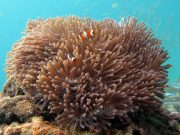
Heteractis magnifica @ Koh Rok
The Magnificent Sea Anemone is found attached to solid surfaces such as rock or dead coral and is found from the shallows to deeper water, usually in exposed areas where medium to strong currents can supply food.
The Magnificent Sea Anemone has a wide oral disc which can reach more than 50 cm across, but most often observed much smaller than this. The oral disc can open to a flat surface, is slightly wavy and is densely spotted with finger-line tentacles which are positioned in multiples of six (member of the six-part corals, Hexacorallia). The tentacles are 5 cm - 8 cm long with blunt or slightly bubble-like tips. The tips may be yellow, green or white.
The Magnificent Sea Anemone can have a variety of colours, with the Basal disc (sticky foot) and column being greyish, greenish or pinkish, purple or brownish. When disturbed, the oral disc will close, with only a few tentacles showing. In extreme cases of disturbance of a change in environmental factors, the Magnificent Sea Anemone can relocate.
Beaded Sea Anemone
(Heteractis aurora)
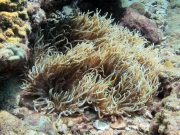
Juvenile Heteractis aurora @ Koh Bida
The Beaded Sea Anemone is easy to identify because of the numerous small bubbles or beads on each tentacle. In younger specimens, the beads are less developed and the tentacles are shorter, however as the tentacles grow, the beads develop into larger bubbles. Longer tentacles may have many dozens of beads or bubbles.
Since most of the tentacles are in the outer part of the anemone, the oral disc is relatively plain. There can be light brownish radial lines on the oral disc which extend into the sticky tentacles.
The underside of the oral disc and column can be grey-green to chestnut-brown. This anemone displays a variety of colours depending on the surrounding environment and the amount of zooxanthellae in the tissues.
This species can be host to several different species of anemonefish and also to the Three Spot Domino Damselfish (Dascyllus trimaculatus), however it is most commonly observed hosting Clarke’s Anemonefish (Amphiprion clarkii).
The Beaded Sea Anemone is often a temporary home for young clownfish on their journey to find a more suitable host anemone for adulthood, and is also known as a 'nursery' anemone.
Purple Tip Anemone
(Heteractis crispa)

Heteractis crispa @ Koh Bida
The Purple Tip Anemone, or Leathery Anemone, lives between corals and sand covered hardgrounds.
Colour can vary widely and depends on the amount of zooxanthellae in the tissues.
The body column is usually grey and the oral disk is often brownish violet or grey, but can also be bright green, occasionally with white stripes.
The Purple Tip Anemone has long, curled tentacles which become thinner toward the tip, and are positioned in concentric circles on the leathery oral disc. The oral disc and the tentacles have the same colour. The tentacle tips can often show a slightly different colour and may have a tiny purplish or greenish-blue spot at the tip center.
The Purple Tip Anemone can grow up to 30 cm in diameter and feeds mostly on products of its zooxanthellae.
This species is usually found among dead coral and rock rubble and lives in symbiosis with several different species of anemonefish and shrimp (genus Periclimenes).
Dykking med Teppeanemoner rundt Koh Lanta
Dykking og snorkleturer
Hvis du vil ha sjansen til å se Teppeanemoner på en av våre daglige dykkerturer fra Koh Lanta i høysesongen, kan du sende oss en e-post til info@diveandrelax.com.
Bli med på våre dykkerturer med hurtigbåt i høysesongen til noen av Thailands beste dykkesteder, og nyt små grupper, kort reisetid og fokus på god personlig service, sikkerhet og moro.
Not yet a certified diver? Learn to Scuba Dive on Koh Lanta with the 3 day SSI Open Water Diver course.
Bestill på nettet og spar 10 % på dykkerturer og dykkerkurs på Koh Lanta.
Finn ut mer
Guider om livet i havet i Indo-Stillehavet
- Allen, G., Steene, R., Humann, P., DeLoach, N. (2003) Reef Fish Identification, Tropical Pacific. Jacksonville, FL., USA: New World Publications, Inc., ISBN 1-878348-36-1.
- Humann, P., DeLoach, N., (2010) Reef Creature Identification, Tropical Pacific. Jacksonville, FL., USA: New World Publications Inc., ISBN 978-1-878348-44-9
- Debelius, H. (2013) Indian Ocean Reef Guide. Frankfurt, Germany: IKAN - Unterwasserarchiv, ISBN 978-3-939767-52-7.
- Debelius, H. (2004) Nudibranchs and Sea Snails, Indo-Pacific Field Guide. Frankfurt, Germany: IKAN - Unterwasserarchiv, ISBN 3-925919-51-1
- Erhardt, H., Knop, D. (2015) Corals Indo-Pacific Field Guide. Frankfurt, Germany: IKAN - Unterwasserarchiv, ISBN 3-925919-69-4.
- Veron J.E.N., Stafford-Smith M.G., Turak E. and DeVantier L.M. (2016). Corals of the World