


Dykning med Tapijt-anemonen
Onderwaterleven Lanta | Stichodactylidae
Tapijt-anemonen zijn een groep roofzuchtige ongewervelde dieren die hun naam ontlenen aan de kleurrijke bloem, de anemoon. Er komen wereldwijd meer dan 1.000 soorten voor in de oceanen, op verschillende dieptes, waarbij de grootste en meest gevarieerde soorten in tropische kustwateren voorkomen. Ze zijn in overvloed te vinden op alle locaties tijdens onze duiktrips naar Koh Lanta.
Anemonen, naaste verwanten van koraal en kwallen, zijn stekende poliepen met een diameter variërend van 5 mm tot 2 meter en met 10 tot meer dan 500 tentakels! Ze brengen hun tijd door vastgehecht aan de ondergrond met een kleverige voet, de zogenaamde basale schijf. Hun lichaam is cilindrisch met een reeks tentakels rondom een centrale mond, die tevens hun anus is. Ze voeden zich met voorbijzwemmend plankton, kleine vissen en kleine kreeftachtigen. De minste aanraking activeert de tentakels, die harpoenachtige filamenten in hun prooi afvuren, een verlammend neurotoxine injecteren en de hulpeloze prooi naar de mond leiden.
Sommige dieren hebben een manier gevonden om de verdedigingsmechanismen van de anemoon tegen zichzelf te gebruiken en hebben symbiotische relaties opgebouwd. De bekendste symbiotische verbintenissen zijn die tussen anemoonvissen en porseleinkrabben. Ze bedekken zichzelf met slijm, waardoor de anemoon denkt dat ze deel uitmaken van zichzelf, waardoor ze ook immuun zijn voor de steek. Deze partners leven tussen de tentakels, die bescherming bieden, en de anemoon eet de restjes van hun maaltijden op.
Sommige anemonen planten zich voort door zijdelingse deling, waarbij een identiek dier uit de ouder groeit, zich afscheidt en onafhankelijk wordt. Velen zullen echter in het water paaien, waar de eitjes en het sperma zich vermengen. De jongen voegen zich bij de planktonlagen en wanneer ze oud genoeg zijn, vestigen ze zich op een substraat.
3 soorten gevonden op deze pagina:
Magnificent Sea Anemone
(Heteractis magnifica)
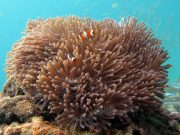
Heteractis magnifica @ Koh Rok
The Magnificent Sea Anemone is found attached to solid surfaces such as rock or dead coral and is found from the shallows to deeper water, usually in exposed areas where medium to strong currents can supply food.
The Magnificent Sea Anemone has a wide oral disc which can reach more than 50 cm across, but most often observed much smaller than this. The oral disc can open to a flat surface, is slightly wavy and is densely spotted with finger-line tentacles which are positioned in multiples of six (member of the six-part corals, Hexacorallia). The tentacles are 5 cm - 8 cm long with blunt or slightly bubble-like tips. The tips may be yellow, green or white.
The Magnificent Sea Anemone can have a variety of colours, with the Basal disc (sticky foot) and column being greyish, greenish or pinkish, purple or brownish. When disturbed, the oral disc will close, with only a few tentacles showing. In extreme cases of disturbance of a change in environmental factors, the Magnificent Sea Anemone can relocate.
Beaded Sea Anemone
(Heteractis aurora)
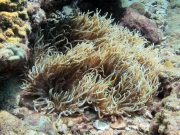
Juvenile Heteractis aurora @ Koh Bida
The Beaded Sea Anemone is easy to identify because of the numerous small bubbles or beads on each tentacle. In younger specimens, the beads are less developed and the tentacles are shorter, however as the tentacles grow, the beads develop into larger bubbles. Longer tentacles may have many dozens of beads or bubbles.
Since most of the tentacles are in the outer part of the anemone, the oral disc is relatively plain. There can be light brownish radial lines on the oral disc which extend into the sticky tentacles.
The underside of the oral disc and column can be grey-green to chestnut-brown. This anemone displays a variety of colours depending on the surrounding environment and the amount of zooxanthellae in the tissues.
This species can be host to several different species of anemonefish and also to the Three Spot Domino Damselfish (Dascyllus trimaculatus), however it is most commonly observed hosting Clarke’s Anemonefish (Amphiprion clarkii).
The Beaded Sea Anemone is often a temporary home for young clownfish on their journey to find a more suitable host anemone for adulthood, and is also known as a 'nursery' anemone.
Purple Tip Anemone
(Heteractis crispa)

Heteractis crispa @ Koh Bida
The Purple Tip Anemone, or Leathery Anemone, lives between corals and sand covered hardgrounds.
Colour can vary widely and depends on the amount of zooxanthellae in the tissues.
The body column is usually grey and the oral disk is often brownish violet or grey, but can also be bright green, occasionally with white stripes.
The Purple Tip Anemone has long, curled tentacles which become thinner toward the tip, and are positioned in concentric circles on the leathery oral disc. The oral disc and the tentacles have the same colour. The tentacle tips can often show a slightly different colour and may have a tiny purplish or greenish-blue spot at the tip center.
The Purple Tip Anemone can grow up to 30 cm in diameter and feeds mostly on products of its zooxanthellae.
This species is usually found among dead coral and rock rubble and lives in symbiosis with several different species of anemonefish and shrimp (genus Periclimenes).
Duiken met Tapijt-anemonen rond Koh Lanta
Duiken & Snorkeltrips
Als je graag een kans hebt om Tapijt-anemonen te spotten op een van onze dagelijkse hoogseizoen duiktrips vanuit Koh Lanta, stuur ons dan een email naar info@diveandrelax.com.
Ga mee met onze speedboot duiktrips in het hoogseizoen naar enkele van Thailand's beste duiklocaties en geniet van kleine groepen, korte reistijden, met een focus op goede persoonlijke service, veiligheid en plezier.
Not yet a certified diver? Learn to Scuba Dive on Koh Lanta with the 3 day SSI Open Water Diver course.
Boek online en bespaar 10% op duiktrips en duikcursussen op Koh Lanta.
Meer informatie
Indo-Stille Oceaan gidsen
- Allen, G., Steene, R., Humann, P., DeLoach, N. (2003) Reef Fish Identification, Tropical Pacific. Jacksonville, FL., USA: New World Publications, Inc., ISBN 1-878348-36-1.
- Humann, P., DeLoach, N., (2010) Reef Creature Identification, Tropical Pacific. Jacksonville, FL., USA: New World Publications Inc., ISBN 978-1-878348-44-9
- Debelius, H. (2013) Indian Ocean Reef Guide. Frankfurt, Germany: IKAN - Unterwasserarchiv, ISBN 978-3-939767-52-7.
- Debelius, H. (2004) Nudibranchs and Sea Snails, Indo-Pacific Field Guide. Frankfurt, Germany: IKAN - Unterwasserarchiv, ISBN 3-925919-51-1
- Erhardt, H., Knop, D. (2015) Corals Indo-Pacific Field Guide. Frankfurt, Germany: IKAN - Unterwasserarchiv, ISBN 3-925919-69-4.
- Veron J.E.N., Stafford-Smith M.G., Turak E. and DeVantier L.M. (2016). Corals of the World