


Dykking med Ildkoraller
Lantas marine liv | Milleporidae
Ildkoraller er fastsittende (stasjonære, festet på ett sted) medusozoer som kan danne skjeletter av kalsiumkarbonat og danne kolonier, på samme måte som hardkoraller, men de er ikke egentlige koraller. Vi kan se enorme kolonier av ildkoraler når vi dykker fra Koh Lanta rundt Koh Rok.
Noen arter er viktige revbyggere, og flere arter av Millepora er i stand til å danne skjeletter av kalsiumkarbonat svært raskt. Disse skjelettene er dekket av utallige porer som inneholder polypper. Hver fôrende polyp er omgitt av mange defensive, stikkende polypper som inneholder batterier av nematocystceller. Når de berøres, trenger nematocystene inn i menneskehuden og injiserer et kraftig giftstoff, noe som skaper en 'ildlignende' svie.
I tillegg til å fange byttedyr med sine stikkende nematocystpolypper, får ildkoraler næringsstoffer via sitt spesielle symbiotiske forhold til alger kjent som zooxantheller, på samme måte som hardkoraller.
2 arter funnet på denne siden:
Branching Fire Coral
(Millepora tenella)

Millepora tenella @ Koh Rok
Branching Fire Coral is commonly seen at all of the dive sites around Koh Lanta. A Branching Fire Coral colony begins by encrusting a surface to form a base, and then growing outward in multiple branches.
This is a fast growing species and is capable of taking over large areas of a reef.
The colonies consist of thick, golden brown branches, with the growth zones at the tips of the branches being white.
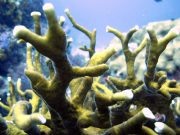
Branching Fire Coral @ Koh Rok
Branching Fire Coral feed on plankton, and similar to true corals, due to their symbiotic relationship with zooxanthellae, they are subject to bleaching if the colourful zooxanthellae algae leave the polyps due to high sea water temperatures for example.
Fire corals can deliver a very painful burn-like sting - do not touch fire coral, you will regret it.
Leaf Fire Coral
(Millepora platyphylla)
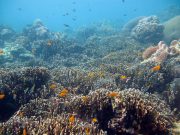
Millepora platyphylla @ Koh Rok
Leaf Fire Coral grows vertically in leaf or plate-like branches. This species likes to grow on the top of the reef, in turbulent water (in the wave action zone) and enjoys strong sunlight which is necessary for the symbiotic zooxanthellae algae’s photosynthesis.
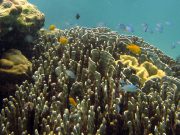
Leaf Fire Coral @ Koh Rok
Leaf Fire Coral is densely branched and provides shelter and home for a wide range of other species, including shrimp, frogfish, moray eels, and other small fish seeking refuge from potential predators.
As with other Fire Corals, Leaf Fire Coral can deliver a very nasty poisonous burn if touched.
Fire corals grow quickly and can push out other hard coral species to dominate some areas of a reef. Whilst this can be destructive, it can also contribute toward the survival of hard corals during Crown of Thorns outbreaks, as Crown of Thorns sea stars tend to avoid Fire Corals.
Dykking med Ildkoraller rundt Koh Lanta
Dykking og snorkleturer
Hvis du vil ha sjansen til å se Ildkoraller på en av våre daglige dykkerturer fra Koh Lanta i høysesongen, kan du sende oss en e-post til info@diveandrelax.com.
Bli med på våre dykkerturer med hurtigbåt i høysesongen til noen av Thailands beste dykkesteder, og nyt små grupper, kort reisetid og fokus på god personlig service, sikkerhet og moro.
Not yet a certified diver? Learn to Scuba Dive on Koh Lanta with the 3 day SSI Open Water Diver course.
Bestill på nettet og spar 10 % på dykkerturer og dykkerkurs på Koh Lanta.
Finn ut mer
Guider om livet i havet i Indo-Stillehavet
- Allen, G., Steene, R., Humann, P., DeLoach, N. (2003) Reef Fish Identification, Tropical Pacific. Jacksonville, FL., USA: New World Publications, Inc., ISBN 1-878348-36-1.
- Humann, P., DeLoach, N., (2010) Reef Creature Identification, Tropical Pacific. Jacksonville, FL., USA: New World Publications Inc., ISBN 978-1-878348-44-9
- Debelius, H. (2013) Indian Ocean Reef Guide. Frankfurt, Germany: IKAN - Unterwasserarchiv, ISBN 978-3-939767-52-7.
- Debelius, H. (2004) Nudibranchs and Sea Snails, Indo-Pacific Field Guide. Frankfurt, Germany: IKAN - Unterwasserarchiv, ISBN 3-925919-51-1
- Erhardt, H., Knop, D. (2015) Corals Indo-Pacific Field Guide. Frankfurt, Germany: IKAN - Unterwasserarchiv, ISBN 3-925919-69-4.
- Veron J.E.N., Stafford-Smith M.G., Turak E. and DeVantier L.M. (2016). Corals of the World