


Dykking med Mobular-stråler
Lantas marine liv | Mobulidae
Mobular-rokker, mantarokker og djevelfisker er en liten familie av rokker som hovedsakelig består av store arter som lever i åpent hav snarere enn på havbunnen.
Det finnes 11 arter i denne familien, og noen ganger kan vi se én bestemt art når vi dykker fra Koh Lanta.
Mobular-rokker, mantarokker og djevelfisker er store pelagiske filterfødende rokker med en stor, bred skive og fem gjellespalter på undersiden. De har store brystfinner og piskelignende haler med en liten ryggfinne. Brystfinnene strekker seg fremover og danner «horn» foran hodet, kalt cephalic finner. Disse finnene kan rulles ut for å skuffe mat inn i den brede munnen. Cephalic-finner ser ut som djevelhorn, og strålene i denne familien kalles noen ganger djevelstråler.
Mobulidae omfatter for tiden to slekter, Manta og Mobula. Slekten Manta omfatter to arter (Reef Manta og Giant Oceanic Manta), og det er ni arter som for tiden er anerkjent i slekten Mobula.
1 arter funnet på denne siden:
Giant Oceanic Manta Ray
(Manta birostris)
Mantas are the largest of the Ray Family, reaching up to 8m from wing tip to wing tip! If we are lucky the Manta Birostris or Giant Manta, can be seen out on Hin Daeng and Hin Muang.
Rays along with Sharks are an Elasmobranch and have skeletons made up entirely of cartilage. The genus Manta is part of the Eagle Ray family, where it is grouped with Mobula Rays (Devil Rays) in the subfamily Mobulinae.
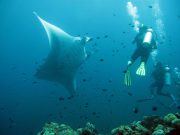
Manta birostris @ Hin Muang
There are two distinct species of Manta: the smaller Manta Alfredi, has a white or pale coloured mouth and tends to be resident in coastal areas. Manta Birostris, which is larger and has a much darker coloured mouth, these migrate across open oceans visiting reef mounts and pinnacles for cleaning, parasite removal and feeding.
Mantas have large pectoral fins, which give them a blanket-like appearance, hence their name Manta meaning "cloak" in Spanish. These large pectoral fins are able to propel them through the water, gracefully gliding and even making acrobatic movements.
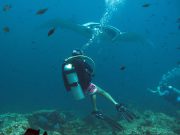
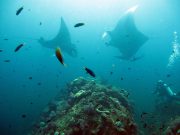
Mantas are filter feeders and sieve their tiny food from the water. Most Rays have a mouth on the underside of their head, while the Manta have theirs at the front. While feeding, they use a pair of fleshy flaps on each side of its head called the Cephalic fin, to channel plankton into their mouths. These fins are rolled into spirals while not in use. Gill Rakers, finger like projections on the gill arches, strain and capture food. Like most Elasmobranch, they must keep swimming to allow oxygenated water to pass through their five pairs of gill slits.
Like Sharks, the Manta fertilises their eggs internally and gives birth to live young, called pups. The manta has one, sometimes two pups per pregnancy and are independent from birth. They will remain in shallow water for a about a year, before heading further offshore and beginning their migration cycle.
Dykking med Mobular-stråler rundt Koh Lanta
Dykking og snorkleturer
Hvis du vil ha sjansen til å se Mobular-stråler på en av våre daglige dykkerturer fra Koh Lanta i høysesongen, kan du sende oss en e-post til info@diveandrelax.com.
Bli med på våre dykkerturer med hurtigbåt i høysesongen til noen av Thailands beste dykkesteder, og nyt små grupper, kort reisetid og fokus på god personlig service, sikkerhet og moro.
Not yet a certified diver? Learn to Scuba Dive on Koh Lanta with the 3 day SSI Open Water Diver course.
Bestill på nettet og spar 10 % på dykkerturer og dykkerkurs på Koh Lanta.
Finn ut mer
Guider om livet i havet i Indo-Stillehavet
- Allen, G., Steene, R., Humann, P., DeLoach, N. (2003) Reef Fish Identification, Tropical Pacific. Jacksonville, FL., USA: New World Publications, Inc., ISBN 1-878348-36-1.
- Humann, P., DeLoach, N., (2010) Reef Creature Identification, Tropical Pacific. Jacksonville, FL., USA: New World Publications Inc., ISBN 978-1-878348-44-9
- Debelius, H. (2013) Indian Ocean Reef Guide. Frankfurt, Germany: IKAN - Unterwasserarchiv, ISBN 978-3-939767-52-7.
- Debelius, H. (2004) Nudibranchs and Sea Snails, Indo-Pacific Field Guide. Frankfurt, Germany: IKAN - Unterwasserarchiv, ISBN 3-925919-51-1
- Erhardt, H., Knop, D. (2015) Corals Indo-Pacific Field Guide. Frankfurt, Germany: IKAN - Unterwasserarchiv, ISBN 3-925919-69-4.
- Veron J.E.N., Stafford-Smith M.G., Turak E. and DeVantier L.M. (2016). Corals of the World