


Dykning med Mobulaire stralen
Onderwaterleven Lanta | Mobulidae
De mobular rays, de manta rays en devilfishes zijn een kleine familie van roggen die voornamelijk bestaat uit grote soorten die in de open oceaan leven in plaats van op de zeebodem.
Er zijn 11 soorten in deze familie, waarvan we soms 1 bepaald lid kunnen zien tijdens het duiken vanaf Koh Lanta.
Mobular-roggen, mantaroggen en duivelsroggen zijn grote pelagische filtervoedende roggen met een grote brede schijf en 5 kieuwspleten aan de onderkant. Ze hebben grote borstvinnen en zweepachtige staarten met een kleine rugvin. De borstvinnen strekken zich naar voren uit en vormen ‘hoorns’ voor de kop, die cephalische vinnen worden genoemd. Deze vinnen kunnen worden uitgerold om voedsel in de brede bek te scheppen. De cephalische vinnen lijken op duivelshoorns, en de roggen in deze familie worden soms duivelsroggen genoemd.
De Mobulidae omvat momenteel twee geslachten, Manta en Mobula. Het geslacht Manta omvat twee soorten (rifmanta en reuzenmanta) en er zijn momenteel negen erkende soorten in het geslacht Mobula.
1 soorten gevonden op deze pagina:
Giant Oceanic Manta Ray
(Manta birostris)
Mantas are the largest of the Ray Family, reaching up to 8m from wing tip to wing tip! If we are lucky the Manta Birostris or Giant Manta, can be seen out on Hin Daeng and Hin Muang.
Rays along with Sharks are an Elasmobranch and have skeletons made up entirely of cartilage. The genus Manta is part of the Eagle Ray family, where it is grouped with Mobula Rays (Devil Rays) in the subfamily Mobulinae.
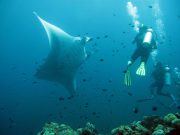
Manta birostris @ Hin Muang
There are two distinct species of Manta: the smaller Manta Alfredi, has a white or pale coloured mouth and tends to be resident in coastal areas. Manta Birostris, which is larger and has a much darker coloured mouth, these migrate across open oceans visiting reef mounts and pinnacles for cleaning, parasite removal and feeding.
Mantas have large pectoral fins, which give them a blanket-like appearance, hence their name Manta meaning "cloak" in Spanish. These large pectoral fins are able to propel them through the water, gracefully gliding and even making acrobatic movements.
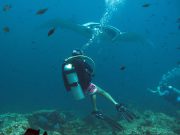
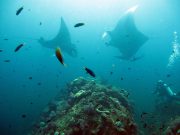
Mantas are filter feeders and sieve their tiny food from the water. Most Rays have a mouth on the underside of their head, while the Manta have theirs at the front. While feeding, they use a pair of fleshy flaps on each side of its head called the Cephalic fin, to channel plankton into their mouths. These fins are rolled into spirals while not in use. Gill Rakers, finger like projections on the gill arches, strain and capture food. Like most Elasmobranch, they must keep swimming to allow oxygenated water to pass through their five pairs of gill slits.
Like Sharks, the Manta fertilises their eggs internally and gives birth to live young, called pups. The manta has one, sometimes two pups per pregnancy and are independent from birth. They will remain in shallow water for a about a year, before heading further offshore and beginning their migration cycle.
Duiken met Mobulaire stralen rond Koh Lanta
Duiken & Snorkeltrips
Als je graag een kans hebt om Mobulaire stralen te spotten op een van onze dagelijkse hoogseizoen duiktrips vanuit Koh Lanta, stuur ons dan een email naar info@diveandrelax.com.
Ga mee met onze speedboot duiktrips in het hoogseizoen naar enkele van Thailand's beste duiklocaties en geniet van kleine groepen, korte reistijden, met een focus op goede persoonlijke service, veiligheid en plezier.
Not yet a certified diver? Learn to Scuba Dive on Koh Lanta with the 3 day SSI Open Water Diver course.
Boek online en bespaar 10% op duiktrips en duikcursussen op Koh Lanta.
Meer informatie
Indo-Stille Oceaan gidsen
- Allen, G., Steene, R., Humann, P., DeLoach, N. (2003) Reef Fish Identification, Tropical Pacific. Jacksonville, FL., USA: New World Publications, Inc., ISBN 1-878348-36-1.
- Humann, P., DeLoach, N., (2010) Reef Creature Identification, Tropical Pacific. Jacksonville, FL., USA: New World Publications Inc., ISBN 978-1-878348-44-9
- Debelius, H. (2013) Indian Ocean Reef Guide. Frankfurt, Germany: IKAN - Unterwasserarchiv, ISBN 978-3-939767-52-7.
- Debelius, H. (2004) Nudibranchs and Sea Snails, Indo-Pacific Field Guide. Frankfurt, Germany: IKAN - Unterwasserarchiv, ISBN 3-925919-51-1
- Erhardt, H., Knop, D. (2015) Corals Indo-Pacific Field Guide. Frankfurt, Germany: IKAN - Unterwasserarchiv, ISBN 3-925919-69-4.
- Veron J.E.N., Stafford-Smith M.G., Turak E. and DeVantier L.M. (2016). Corals of the World