


Dykking med Muræner
Lantas marine liv | Muraenoidei
Det finnes over 200 arter av murener over hele verden, med en lengde på mellom 10 cm og 3 m. Mange arter foretrekker å leve i varme tropiske farvann, og flere arter kan observeres under dykking rundt Koh Lanta.
Muræner gjemmer seg ofte i revsprekker mellom steiner, steinsprut og harde koraller, med bare hodet stikkende ut. Noen arter av muræner elsker å bosette seg inne i gigantiske tønnesvamper.
Selv om murener har et slangeaktig utseende, er de ikke reptiler, men fisker. De åpner og lukker munnen kontinuerlig for å sirkulere vann gjennom gjellene, som ligger et stykke bak hodet.
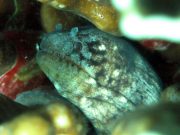

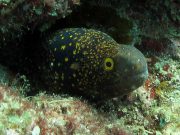


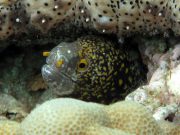
Den tykke huden er glatt, dekket av et beskyttende slimlag og har ofte mønster. En karakteristisk ryggfinne strekker seg fra hodet til halen.
Murener har små øyne og dårlig syn, og bruker luktesansen til å oppdage byttedyr som fisk, krabber og blekksprut, som de fanger ved hjelp av overraskelsesmomentet.
Siden kjeven er ganske liten, knuses større byttedyr først ved å vikle kroppen rundt offeret og klemme det til det er flatt nok til å kunne spises.
Når offeret er blitt grepet av fortennene, aktiveres en unik, mindre kjeve inne i halsen, kalt «svelgkjeven», som river og transporterer den fangede maten til halsen og fordøyelsessystemet.
I 1979 viste filmen «Alien» en fiktiv fremmed art som brukte en svelgkjeve til å angripe sine ofre.
Moræneål kan noen ganger observeres parre seg på dykkestedene, hvor de vikler kroppene sine rundt hverandre og legger og befrukter over 5000 egg om gangen.
Når de klekkes, flyter murænlærver ut i det åpne havet, hvor de lever blant planktonet nær overflaten i over 8 måneder, til de blir store nok til å våge seg tilbake til revet.
8 arter funnet på denne siden:
- Blackspotted Moray (Gymnothorax favagineus)
- Giant Moray (Gymnothorax javanicus)
- White-Eyed Moray (Gymnothorax thyrsoideus)
- Yellow-edged Moray (Gymnothorax flavimarginatus)
- Zebra Moray (Gymnomuraena zebra)
- Snowflake Moray (Echidna nebulosa)
- Fimbriated Moray (Gymnothorax fimbriatus)
- Barred Snake Moray (Uropterygius fasciolatus)
Blackspotted Moray
(Gymnothorax favagineus)
The blackspotted moray (Gymnothorax favagineus), also known as the honeycomb moray, is a large eel which can grow up to 3m long, however most individuals are significantly smaller than this.
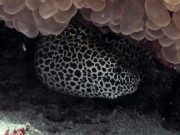
Gymnothorax favagineus @ Koh Haa
This moray is white with brown/black blotches and spaces, sometimes forming a honeycomb pattern. The blotches vary between individuals and size and depend on the eel's habitat. Those found in clear coral reefs usually have less black than those found in turbid waters.
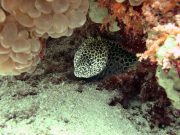

The blackspotted moray lives on the outer slopes of coral reefs. During the day, it sits sheltered in crevices and at night it leaves its lair to actively hunt its prey along the reef. It feeds mainly on small fish and cephalopods.
Giant Moray
(Gymnothorax javanicus)
At up to 3m long, and weighing up to 30kg, in terms of body mass, the giant moray is the largest moray eel.
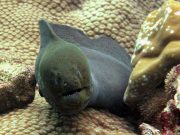
Gymnothorax javanicus @ Koh Haa
The giant moray feeds mainly on fishes and occasionally on crustaceans, and due to its position at the top of the reef's food chain, this eel is often ciguatoxic - the moray can absorb and store toxins from other reef fish in its body fat, and is poisonous if eaten by humans.
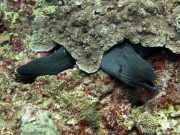
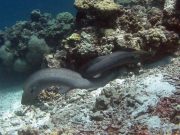
The body is deep with a strongly tapered tail and has a greyish, brownish background color, with juveniles being lighter in color. Black around the gill opening. Adults have black specks on the head that resemble leopard spots further back on the body.
The giant moray has several large sharp canines on both the upper and lower jaw alongside rows of smaller, sharp teeth.
Will attack humans if provoked, and sometimes just for fun.
White-Eyed Moray
(Gymnothorax thyrsoideus)
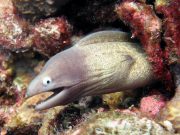
Gymnothorax thyrsoideus @ Anemone Reef
The white-eyed moray is a medium-sized fish which can grow up to 65cm, but is most usually found around 35 - 45cm. The head is grey with distinctive white eyes.
The body is serpentine in shape, speckled with small dark spots, and has an overall pale brownish/beige color that can vary in strength between different eels.
This eel can often be found sharing its nook or cranny with other moray eels, and sometimes groups of 3 - 5 white-eyed moray can be found together.
The white-eyed moray feeds on crustaceans, small fishes and octopus.
Yellow-edged Moray
(Gymnothorax flavimarginatus)
The yellow-edged moray is similar to the giant moray, but slightly smaller, with a maximum length of around 2.4m.
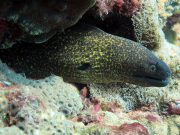
Gymnothorax flavimarginatus @ Koh Haa
This moray is yellowish with a densely mottled dark brown pattern and orange(ish) eyes. The head is a purplish-grey colour, and the end of the tail has a yellow margin. This moray also has black blotches at the gill openings.

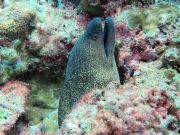
Eats fish, including poisonous fish such as lionfish, crustaceans and possibly octopus.
Zebra Moray
(Gymnomuraena zebra)
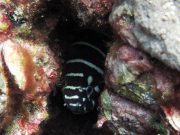
Gymnomuraena zebra @ Koh Haa
The zebra moray eel is a tan to dark brown moray with irregular close-set narrow white to pale yellow bars or bands, giving rise to its common name.
Even though the zebra moray can reach lengths of up to 1.5m, it is more usually observed around 45 - 55cm.
Gymnomuraena zebra actively hunt their prey at night, and unlike other moray eels, they feed almost exclusively on crustaceans, sea urchins and mollusks.
This eel has a short snout and close-set pebble-like teeth used for crushing hard-shelled prey. Totally harmless to humans.
Snowflake Moray
(Echidna nebulosa)
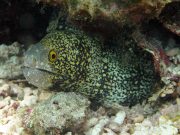
Echidna nebulosa @ Koh Haa
The snowflake moray has a pale body, generally yellowish/white, with rows of black blotches/bands, yellow eyes and yellow front nostrils.
Reaching up to 1m long, this moray is more usually observed in with 50 - 70cm range.
This moray feeds both during the day, and at night, with shrimp, crabs or lobsters (crustaceans) being their natural diet.
As with other moray eels, their eyesight is modest, compensated by a perfect sense of smell, thanks to two anterior nostrils and two posterior ones shaped like a small tube. The front nostrils point downwards, at the extremity of the snout, and the second ones upwards, at the level of the eye. These nostrils form a sort of all-round smelling radar for hunting, both during the day, and at night.
Completely harmless to humans.
Fimbriated Moray
(Gymnothorax fimbriatus)
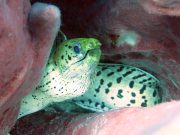
Gymnothorax fimbriatus @ Koh Haa
The Fimbriated Moray is a medium sized Moray with a light body color, often whitish, cream or light/pale brown.
The body is covered in many dark spots and blotches which vary with age. These dark spots and blotches are often in small groupings or rows.
The head is yellowish or pale greenish with dark spots and blotches. The mouth is white inside, also with many small black spots.
The Fimbriated Moray grows up to 80 cm and is usually hidden during the day, preferring to feed at night on small fish and crustaceans.
Barred Snake Moray
(Uropterygius fasciolatus)
Main body colour ranges from pale to dark grey with dark bars along the main body. Both upper and lower jaws with rows of fine, sharp teeth. Dark lines behind the eyes. Large secondary nostrils above the eyes.
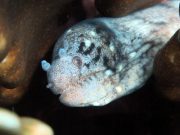
Uropterygius fasciolatus @ Koh Haa
Found in shallow reefs at depths between 1 and 8m. Hides during daytime and hunts prey during evening hours when it feeds mainly on smaller fish and crustaceans.


This is a very uncommon species and rare to find in the eastern Indian Ocean.
Dykking med Muræner rundt Koh Lanta
Dykking og snorkleturer
Hvis du vil ha sjansen til å se Muræner på en av våre daglige dykkerturer fra Koh Lanta i høysesongen, kan du sende oss en e-post til info@diveandrelax.com.
Bli med på våre dykkerturer med hurtigbåt i høysesongen til noen av Thailands beste dykkesteder, og nyt små grupper, kort reisetid og fokus på god personlig service, sikkerhet og moro.
Not yet a certified diver? Learn to Scuba Dive on Koh Lanta with the 3 day SSI Open Water Diver course.
Bestill på nettet og spar 10 % på dykkerturer og dykkerkurs på Koh Lanta.
Finn ut mer
Guider om livet i havet i Indo-Stillehavet
- Allen, G., Steene, R., Humann, P., DeLoach, N. (2003) Reef Fish Identification, Tropical Pacific. Jacksonville, FL., USA: New World Publications, Inc., ISBN 1-878348-36-1.
- Humann, P., DeLoach, N., (2010) Reef Creature Identification, Tropical Pacific. Jacksonville, FL., USA: New World Publications Inc., ISBN 978-1-878348-44-9
- Debelius, H. (2013) Indian Ocean Reef Guide. Frankfurt, Germany: IKAN - Unterwasserarchiv, ISBN 978-3-939767-52-7.
- Debelius, H. (2004) Nudibranchs and Sea Snails, Indo-Pacific Field Guide. Frankfurt, Germany: IKAN - Unterwasserarchiv, ISBN 3-925919-51-1
- Erhardt, H., Knop, D. (2015) Corals Indo-Pacific Field Guide. Frankfurt, Germany: IKAN - Unterwasserarchiv, ISBN 3-925919-69-4.
- Veron J.E.N., Stafford-Smith M.G., Turak E. and DeVantier L.M. (2016). Corals of the World