


Dykning med Slangzeesterren
Onderwaterleven Lanta | Ophidiasteridae
De slangzeesterren vormen een grote familie van zeesterren, genoemd naar de slanke soorten van het geslacht Ophidiaster, die slangachtige armen hebben. Ze komen in overvloed voor op alle locaties tijdens onze duiktrips naar Koh Lanta.
Veel soorten zijn felgekleurd en hebben opvallende patronen, waarmee ze het uiterlijk van andere zeedieren nabootsen die giftig of gevaarlijk kunnen zijn, ter bescherming.
Slangzeesterren hebben aan de onderkant meerdere rijen buisvoetjes die ze kunnen gebruiken om zich voort te bewegen, hun omgeving waar te nemen en voedsel te detecteren.
Deze zeesterren zijn te vinden op koraal- of rotsriffen, en boven en in zandsubstraten, en zijn een veelvoorkomend verschijnsel op alle duiklocaties rond Koh Lanta.
Ze voeden zich met algen, aas, afval, koraalslijm, micro-organismen en sponzen. Zelf worden ze op hun beurt gegeten door krabben, vissen, buikpotigen en garnalen.
Sommige soorten hebben opmerkelijke regeneratievermogens, waardoor ze armen kunnen afwerpen en opnieuw laten aangroeien, of zich kunnen voortplanten door een arm af te werpen die vervolgens een nieuwe schijf en armen genereert om een nieuw individu te vormen.
Het geslacht Linckia, dat we op alle duiklocaties rond Koh Lanta aantreffen, wordt gegeten door de harlekijngarnaal (Hymenocera picta) en kan verloren ledematen volledig opnieuw laten aangroeien.
2 soorten gevonden op deze pagina:
Blue Sea Star
(Linckia laevigata)
The Blue Sea Star is very common, seen at all dive sites around Koh Lanta. This sea star normally has five long, thin arms extending from the small central disc, with rounded tips at each end. The arms are covered in numerous closely packed lines of faint, slightly raised spots.
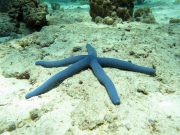
Linckia laevigata @ Koh Haa
The Blue Sea Star is often blue, but is also found in other colours, beige, orange, red, peach, brown and many variations in between.
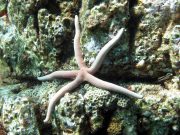
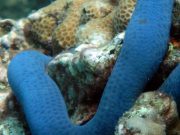
The Blue Sea Star grows to 30 cm and are found in shallow water exposed to sunlight, either singly, or in groups. This sea star can be found on the sand or rubble bottom, on rocky walls, on corals, sponges, just about anywhere in the reef area. The diet includes organic matter, dead animals, small invertebrates and anything else tasty that comes their way.
Red Star
(Linckia multifora)
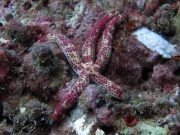
Linckia multifora @ Koh Bida
The Red Star has a small central disc and 5 thin arms which taper toward the end. This species has a very similar shape to the Blue Seastar.
This species has a variable body colour, from cream to grey to brown to red and pink. The body is covered with red spots and many small granulations. A Red Star can grow up to 13 cm in diameter.
The Red Star is capable of self amputation) and often sheds one or more arms, which can then grow into a new individual. The arm detachment process takes up to an hour, with a small crack appearing on an arm, approximately 2.5 cm from the disc. Once the crack has appeared, the tube feet on the arm and the body pull the two parts in opposite directions. The detached arm is known as a 'comet' and moves about independently. It takes about 10 months to regenerate a new disc.
Duiken met Slangzeesterren rond Koh Lanta
Duiken & Snorkeltrips
Als je graag een kans hebt om Slangzeesterren te spotten op een van onze dagelijkse hoogseizoen duiktrips vanuit Koh Lanta, stuur ons dan een email naar info@diveandrelax.com.
Ga mee met onze speedboot duiktrips in het hoogseizoen naar enkele van Thailand's beste duiklocaties en geniet van kleine groepen, korte reistijden, met een focus op goede persoonlijke service, veiligheid en plezier.
Not yet a certified diver? Learn to Scuba Dive on Koh Lanta with the 3 day SSI Open Water Diver course.
Boek online en bespaar 10% op duiktrips en duikcursussen op Koh Lanta.
Meer informatie
Indo-Stille Oceaan gidsen
- Allen, G., Steene, R., Humann, P., DeLoach, N. (2003) Reef Fish Identification, Tropical Pacific. Jacksonville, FL., USA: New World Publications, Inc., ISBN 1-878348-36-1.
- Humann, P., DeLoach, N., (2010) Reef Creature Identification, Tropical Pacific. Jacksonville, FL., USA: New World Publications Inc., ISBN 978-1-878348-44-9
- Debelius, H. (2013) Indian Ocean Reef Guide. Frankfurt, Germany: IKAN - Unterwasserarchiv, ISBN 978-3-939767-52-7.
- Debelius, H. (2004) Nudibranchs and Sea Snails, Indo-Pacific Field Guide. Frankfurt, Germany: IKAN - Unterwasserarchiv, ISBN 3-925919-51-1
- Erhardt, H., Knop, D. (2015) Corals Indo-Pacific Field Guide. Frankfurt, Germany: IKAN - Unterwasserarchiv, ISBN 3-925919-69-4.
- Veron J.E.N., Stafford-Smith M.G., Turak E. and DeVantier L.M. (2016). Corals of the World