


Dykning med Kogelvissen
Onderwaterleven Lanta | Tetraodontidae
Kogelvissen zijn een veelvoorkomend verschijnsel op alle koraalriffen tijdens duikexcursies bij Koh Lanta. Ze hebben doorgaans ronde kopjes, taps toelopende lichamen en grote ogen, en variëren in grootte van 2 cm tot ongeveer 1 m lang. Kogelvissen zijn gemakkelijk te spotten tijdens het duiken rond Koh Lanta, maar ze behoren tot de meest giftige vissen in de oceaan en mogen niet worden gegeten.
Kogelvissen hebben het vermogen om water en soms lucht in te slikken om hun lichaam op te blazen tot een gigantische bal wanneer ze worden bedreigd. Aangenomen wordt dat ze deze tactiek hebben ontwikkeld als een methode van zelfverdediging, vanwege hun zeer slechte zwemvaardigheid.
Een roofdier dat erin slaagt een kogelvis te vangen voordat deze zich opblaast, zal zich niet lang gelukkig voelen. Bijna alle kogelvissen bevatten ‘tetrodotoxine’, een gif dat hen dodelijk maakt voor de meeste roofdieren. Het is, afhankelijk van de soort, te vinden in hun organen, huid en stekels. Slechts enkele dieren zijn immuun voor het gif, zoals haaien en zeeslangen. Voor mensen is het dodelijk, tot 1.200 keer giftiger dan cyanide en zonder bekend tegengif. Er zit genoeg gif in één kogelvis om 30 volwassen mensen te doden!
Kogelvissen hebben dicht op elkaar staande tanden, waardoor hun bek er samengesmolten of snavelachtig uitziet. Deze zeer scherpe tanden gebruiken ze om weekdieren open te wrikken, ongewervelde dieren te eten en algen af te schrapen. Men neemt aan dat ze hun dodelijke gif aanmaken uit de bacteriën in hun voedsel.
Wanneer een kogelvis volwassen is, leidt het mannetje het vrouwtje naar de kust, waar ze slechts 3-7 eitjes afzetten en bevruchten. De jongen blijven hier tot ze groot genoeg zijn om zich bij het rif te voegen.
5 soorten gevonden op deze pagina:
Blackspotted Pufferfish
(Arothron nigropunctatus)
The blackspotted, or dog-face puffer is a common sight at all of our dive sites and easy to identify. This small fish has no scales and grows up to 33 cm, but more commonly observed around 20 cm. Sometimes seen alone, sometimes in pairs. This fish has a short snout, no pelvic fin and both a small dorsal and anal fin.

Arothron nigropunctatus @ Koh Haa
Blackspotted pufferfish colouration is highly variable, greyish, bluish, blackish, yellowish, however they all have a few common markings such as black lips, black around the pectoral fin base and scatterings of different sized black spots on the body.

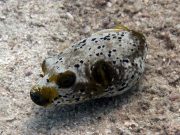
Instead of "teeth," blackspotted puffers have 4 strong teeth in a beak-like structure which they use to crush crustaceans and mollusks, crunch sponges and the tips of branching corals.
Starry Pufferfish
(Arothron stellatus)

Arothron stellatus @ Koh Haa
The starry pufferfish is the largest of all puffers, growing up to 1.2m. This fish has no scales, with the body covered with prickles. This fish has a short snout, no pelvic fin and both a small dorsal and anal fin.
Adults are white with many small black spots, juveniles have fewer, larger spots. Young fish are orange with small black spots and black stripes on the belly, becoming spots as they age.
Usually seen alone, the starry puffer feeds on sea urchins, starfish, sponges, crabs, corals and algae. Sometimes seen swimming high above the corals or seabed. The starry puffer is extremely poisonous, and tetrodotoxin may occur in the muscle, intestine, liver, gonads and skin. Do not try to eat this fish.
Blue-spot Pufferfish
(Arothron caeruleopunctatus)
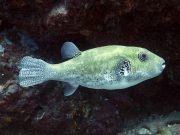
Arothron caeruleopunctatus @ Koh Haa
The Blue-spot Pufferfish has a yellowish, brown to grey back, lighter below, and covered in small white to blue spots.
There are alternating dark and light rings around the eyes, and the pectoral fin base has a black patch with white spots.
As with other Pufferfishes, the Blue-spot Pufferfish has a small dorsal and anal fin and the teeth are fused into four beak-like parts. The Blue-spot Pufferfish grows to 70 cm.
Scribbled Pufferfish
(Arothron mappa)

Arothron mappa @ Koh Haa
The scribbled, or 'map' puffer is a medium size fish growing up to 65 cm, but often observed smaller than this.
The background coloration is whitish with dense network of black broken lines and lines radiating from the eyes.
The scribbled pufferfish has a large black blotch around the gill opening, and a black blotch on the lower side.
As with the other puffers listed here, this fish has no scales, with the body covered with prickles.
This fish has a short snout, four beak-like teeth, no pelvic fin and both a small dorsal and anal fin. It is also highly toxic.
Spotted Toby
(Canthigaster solandri)

Canthigaster solandri @ Koh Haa
The Spotted Toby has a brownish body colour, covered with white to blue to green spots.
There are white to blue to green line markings on the snout and back. There is on ocellated spot on the dorsal fin base.
The Spotted Toby grows to 10 cm and is found in sheltered reef areas and often found in pairs.
The Spotted Toby fish feeds on algae, coral polyps and bottom-dwelling invertebrates such as molluscs (slugs & snails), echinoderms (sea urchins, sea stars) and polychaetes (bristle worms).
Duiken met Kogelvissen rond Koh Lanta
Duiken & Snorkeltrips
Als je graag een kans hebt om Kogelvissen te spotten op een van onze dagelijkse hoogseizoen duiktrips vanuit Koh Lanta, stuur ons dan een email naar info@diveandrelax.com.
Ga mee met onze speedboot duiktrips in het hoogseizoen naar enkele van Thailand's beste duiklocaties en geniet van kleine groepen, korte reistijden, met een focus op goede persoonlijke service, veiligheid en plezier.
Not yet a certified diver? Learn to Scuba Dive on Koh Lanta with the 3 day SSI Open Water Diver course.
Boek online en bespaar 10% op duiktrips en duikcursussen op Koh Lanta.
Meer informatie
Indo-Stille Oceaan gidsen
- Allen, G., Steene, R., Humann, P., DeLoach, N. (2003) Reef Fish Identification, Tropical Pacific. Jacksonville, FL., USA: New World Publications, Inc., ISBN 1-878348-36-1.
- Humann, P., DeLoach, N., (2010) Reef Creature Identification, Tropical Pacific. Jacksonville, FL., USA: New World Publications Inc., ISBN 978-1-878348-44-9
- Debelius, H. (2013) Indian Ocean Reef Guide. Frankfurt, Germany: IKAN - Unterwasserarchiv, ISBN 978-3-939767-52-7.
- Debelius, H. (2004) Nudibranchs and Sea Snails, Indo-Pacific Field Guide. Frankfurt, Germany: IKAN - Unterwasserarchiv, ISBN 3-925919-51-1
- Erhardt, H., Knop, D. (2015) Corals Indo-Pacific Field Guide. Frankfurt, Germany: IKAN - Unterwasserarchiv, ISBN 3-925919-69-4.
- Veron J.E.N., Stafford-Smith M.G., Turak E. and DeVantier L.M. (2016). Corals of the World