


Dykking med Kulefisker
Lantas marine liv | Tetraodontidae
Kulefisker er et vanlig syn på alle korallrevene under dykkereiser til Koh Lanta. De har vanligvis runde ansikter, avsmalnende kropper og store øyne, og varierer i størrelse fra 2 cm til rundt 1 m i lengde. Kulefisker er lette å få øye på når man dykker rundt Koh Lanta, men de er en av de giftigste fiskene i havet og bør ikke spises.
Kulefisker har evnen til å svelge vann og noen ganger luft for å blåse opp kroppen til en gigantisk ball når de blir truet. Man tror at de utviklet denne taktikken som en metode for selvforsvar, på grunn av deres svært dårlige svømmeevne.
Et rovdyr som klarer å fange en kulefisk før den blåser seg opp, vil ikke føle seg heldig lenge. Nesten alle kulefisker inneholder «tetrodotoxin», et giftstoff som gjør dem dødelige for de fleste rovdyr. Det finnes i organene, huden og piggene deres, avhengig av art. Bare noen få dyr er immune mot giftstoffet, for eksempel haier og sjøslanger. For mennesker er det dødelig, opptil 1200 ganger mer giftig enn cyanid, og uten kjent motgift er det nok giftstoff i én kulefisk til å drepe 30 voksne mennesker!
Kulefisker har tettstående tenner, noe som gir dem et sammensmeltet eller nebbaktig utseende. Disse svært skarpe tennene brukes til å sprette opp bløtdyr, spise virvelløse dyr og skrape av alger. Man antar at de danner sitt dødelige giftstoff fra bakteriene i maten sin.
Når en pufferfisk blir kjønnsmoden, fører hannen hunnen nær kysten, hvor de slipper ut og befrukter bare 3–7 egg. Ungene blir her til de er store nok til å bli en del av revet.
5 arter funnet på denne siden:
Blackspotted Pufferfish
(Arothron nigropunctatus)
The blackspotted, or dog-face puffer is a common sight at all of our dive sites and easy to identify. This small fish has no scales and grows up to 33 cm, but more commonly observed around 20 cm. Sometimes seen alone, sometimes in pairs. This fish has a short snout, no pelvic fin and both a small dorsal and anal fin.

Arothron nigropunctatus @ Koh Haa
Blackspotted pufferfish colouration is highly variable, greyish, bluish, blackish, yellowish, however they all have a few common markings such as black lips, black around the pectoral fin base and scatterings of different sized black spots on the body.

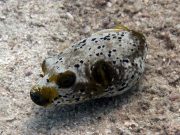
Instead of "teeth," blackspotted puffers have 4 strong teeth in a beak-like structure which they use to crush crustaceans and mollusks, crunch sponges and the tips of branching corals.
Starry Pufferfish
(Arothron stellatus)

Arothron stellatus @ Koh Haa
The starry pufferfish is the largest of all puffers, growing up to 1.2m. This fish has no scales, with the body covered with prickles. This fish has a short snout, no pelvic fin and both a small dorsal and anal fin.
Adults are white with many small black spots, juveniles have fewer, larger spots. Young fish are orange with small black spots and black stripes on the belly, becoming spots as they age.
Usually seen alone, the starry puffer feeds on sea urchins, starfish, sponges, crabs, corals and algae. Sometimes seen swimming high above the corals or seabed. The starry puffer is extremely poisonous, and tetrodotoxin may occur in the muscle, intestine, liver, gonads and skin. Do not try to eat this fish.
Blue-spot Pufferfish
(Arothron caeruleopunctatus)
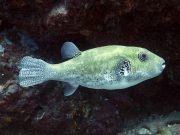
Arothron caeruleopunctatus @ Koh Haa
The Blue-spot Pufferfish has a yellowish, brown to grey back, lighter below, and covered in small white to blue spots.
There are alternating dark and light rings around the eyes, and the pectoral fin base has a black patch with white spots.
As with other Pufferfishes, the Blue-spot Pufferfish has a small dorsal and anal fin and the teeth are fused into four beak-like parts. The Blue-spot Pufferfish grows to 70 cm.
Scribbled Pufferfish
(Arothron mappa)

Arothron mappa @ Koh Haa
The scribbled, or 'map' puffer is a medium size fish growing up to 65 cm, but often observed smaller than this.
The background coloration is whitish with dense network of black broken lines and lines radiating from the eyes.
The scribbled pufferfish has a large black blotch around the gill opening, and a black blotch on the lower side.
As with the other puffers listed here, this fish has no scales, with the body covered with prickles.
This fish has a short snout, four beak-like teeth, no pelvic fin and both a small dorsal and anal fin. It is also highly toxic.
Spotted Toby
(Canthigaster solandri)

Canthigaster solandri @ Koh Haa
The Spotted Toby has a brownish body colour, covered with white to blue to green spots.
There are white to blue to green line markings on the snout and back. There is on ocellated spot on the dorsal fin base.
The Spotted Toby grows to 10 cm and is found in sheltered reef areas and often found in pairs.
The Spotted Toby fish feeds on algae, coral polyps and bottom-dwelling invertebrates such as molluscs (slugs & snails), echinoderms (sea urchins, sea stars) and polychaetes (bristle worms).
Dykking med Kulefisker rundt Koh Lanta
Dykking og snorkleturer
Hvis du vil ha sjansen til å se Kulefisker på en av våre daglige dykkerturer fra Koh Lanta i høysesongen, kan du sende oss en e-post til info@diveandrelax.com.
Bli med på våre dykkerturer med hurtigbåt i høysesongen til noen av Thailands beste dykkesteder, og nyt små grupper, kort reisetid og fokus på god personlig service, sikkerhet og moro.
Not yet a certified diver? Learn to Scuba Dive on Koh Lanta with the 3 day SSI Open Water Diver course.
Bestill på nettet og spar 10 % på dykkerturer og dykkerkurs på Koh Lanta.
Finn ut mer
Guider om livet i havet i Indo-Stillehavet
- Allen, G., Steene, R., Humann, P., DeLoach, N. (2003) Reef Fish Identification, Tropical Pacific. Jacksonville, FL., USA: New World Publications, Inc., ISBN 1-878348-36-1.
- Humann, P., DeLoach, N., (2010) Reef Creature Identification, Tropical Pacific. Jacksonville, FL., USA: New World Publications Inc., ISBN 978-1-878348-44-9
- Debelius, H. (2013) Indian Ocean Reef Guide. Frankfurt, Germany: IKAN - Unterwasserarchiv, ISBN 978-3-939767-52-7.
- Debelius, H. (2004) Nudibranchs and Sea Snails, Indo-Pacific Field Guide. Frankfurt, Germany: IKAN - Unterwasserarchiv, ISBN 3-925919-51-1
- Erhardt, H., Knop, D. (2015) Corals Indo-Pacific Field Guide. Frankfurt, Germany: IKAN - Unterwasserarchiv, ISBN 3-925919-69-4.
- Veron J.E.N., Stafford-Smith M.G., Turak E. and DeVantier L.M. (2016). Corals of the World