


Dykking med Kjempemuslinger
Lantas marine liv | Tridacnidae
Kjempemuslingene tilhører familien Tridacninae, som består av store saltvannsmuslinger. Det todelte skallet har vanligvis en bølget åpning som aldri lukkes helt, og som vender mot sollyset. De er et vanlig syn under våre dykkereiser til Koh Lanta
Den hengslede siden av skallet ligger på bunnen, festet til en hard overflate med en stor masse av seige, silkeaktige filamenter som vokser ut fra spalten mellom skallhalvdelene nær hengslet. Noen gigantiske muslinger graver seg ned i koraller, slik at det meste av skallet er skjult og bare skallåpningen vender mot sollyset.
Kjempemuslingene lever i de grunne vannene ved korallrev og lever i symbiose med encellede fotosyntetiske alger (zooxantheller), på samme måte som en korallpolyp. Zooxanthellene lever inne i muslingen og produserer mat gjennom fotosyntese, som den deler med muslingen.
Muslingen vender skallåpningen og kroppen mot sollyset for å maksimere produktiviteten til sin «algefarm». Selv om kjempemuslinger er svært avhengige av de symbiotiske algene, er de likevel i stand til å filtrere mat på samme måte som andre muslinger.
3 arter funnet på denne siden:
Fluted Giant Clam
(Tridacna squamosa)
The Fluted Giant Clam is a medium to large clam, and is easily identified by the rows of leaf-like fluted edges on its shell called 'scutes'. Whilst not always easy to see small details, the scutes provide shelter for small invertebrates such as shrimp, crabs and other small clams.

Fluted Giant Clams @ Koh Bida
The mantle colour varies from greenish brown to yellowish tan to greenish blue or purple, with wavy lines, spots and blotches. There are two openings in the mantle to allow water to pass through, feeding and light to reach the zooxanthellae. It’s not uncommon to find crabs, small fish, shrimp and other animals living within the clam.
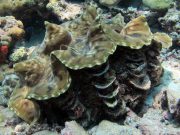
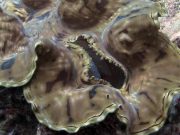
This giant clam grows to 40 cm in length and is often found in the open, or close to coral rubble areas, mostly in shallow water areas.
Giant Clam
(Tridacna gigas)
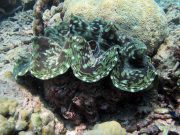
Giant Clam @ Koh Haa
The Giant Clam is the largest bivalve in the world. The shell is typically smooth, however other marine organisms attach themselves to the shell, which in the wild can then appear quite rough.
The shell has four vertical folds which create the ’wavy’ appearance of the mantle, which varies in colour from brown to tan to green through blue to purple. The mantle is fused except for two siphon holes, the longer hole to draw in water, and the smaller hole to expel water. The gills can be seen through the longer hole, and the shell is open during the day to allow sunlight to reach the zooxanthellae.
The Giant Clam grows to 130 cm and is usually found in flat shallow areas with plenty of sunlight. This is a slow growing species which is critically endangered in some areas due to over harvesting for food and shells.
Boring Giant Clam
(Tridacna crocea)
The Boring Giant Clam burrows deep into cracks in the reef and is usually only seen from the top, with only the mantle exposed.
The mantle colour varies from yellow to gold to tan to brown to green to blue to purple.

Boring Giant Clam @ Koh Bida
A row of ‘eyes’ can be seen along the margin of the mantle, and these provide rudimentary ‘vision’ allowing the clam to detect light, dark, and shadows from possible predators.
The clam chooses a location which is exposed to sunlight and attaches itself to the hard coral skeleton using strong silky threads (basal threads) from the hinge of the two shells (valves).

Boring Giant Clam @ Koh Haa
This clam is the smallest of all the giant clams, growing to 15 cm across and may form dense colonies of individuals.
Dykking med Kjempemuslinger rundt Koh Lanta
Dykking og snorkleturer
Hvis du vil ha sjansen til å se Kjempemuslinger på en av våre daglige dykkerturer fra Koh Lanta i høysesongen, kan du sende oss en e-post til info@diveandrelax.com.
Bli med på våre dykkerturer med hurtigbåt i høysesongen til noen av Thailands beste dykkesteder, og nyt små grupper, kort reisetid og fokus på god personlig service, sikkerhet og moro.
Not yet a certified diver? Learn to Scuba Dive on Koh Lanta with the 3 day SSI Open Water Diver course.
Bestill på nettet og spar 10 % på dykkerturer og dykkerkurs på Koh Lanta.
Finn ut mer
Guider om livet i havet i Indo-Stillehavet
- Allen, G., Steene, R., Humann, P., DeLoach, N. (2003) Reef Fish Identification, Tropical Pacific. Jacksonville, FL., USA: New World Publications, Inc., ISBN 1-878348-36-1.
- Humann, P., DeLoach, N., (2010) Reef Creature Identification, Tropical Pacific. Jacksonville, FL., USA: New World Publications Inc., ISBN 978-1-878348-44-9
- Debelius, H. (2013) Indian Ocean Reef Guide. Frankfurt, Germany: IKAN - Unterwasserarchiv, ISBN 978-3-939767-52-7.
- Debelius, H. (2004) Nudibranchs and Sea Snails, Indo-Pacific Field Guide. Frankfurt, Germany: IKAN - Unterwasserarchiv, ISBN 3-925919-51-1
- Erhardt, H., Knop, D. (2015) Corals Indo-Pacific Field Guide. Frankfurt, Germany: IKAN - Unterwasserarchiv, ISBN 3-925919-69-4.
- Veron J.E.N., Stafford-Smith M.G., Turak E. and DeVantier L.M. (2016). Corals of the World