


Dykning med Reuzenmosselen
Onderwaterleven Lanta | Tridacnidae
De reuzenmosselen behoren tot de familie Tridacninae, een groep grote zeewatermosselen. De uit twee delen bestaande schelp heeft meestal een golvende opening die nooit helemaal sluit en naar het zonlicht is gericht. Ze zijn een veelvoorkomend verschijnsel tijdens onze duiktrips naar Koh Lanta
De scharnierzijde van de schelp bevindt zich aan de onderkant en is bevestigd aan een hard oppervlak door een grote massa taaie, zijdeachtige filamenten die groeien uit de opening tussen de schelphelften nabij het scharnier. Sommige reuzenmosselen graven zich in koraal in, waarbij het grootste deel van de schelp verborgen blijft en alleen de schelpopening naar het zonlicht is gericht.
De reuzenmosselen leven in de ondiepe wateren van koraalriffen en leven in symbiose met eencellige fotosynthetische algen (zooxanthellae), net zoals een koraalpoliep. De zooxanthellae leven in de mossel en produceren voedsel door middel van fotosynthese, dat ze delen met de mossel.
De schelp richt de schelpopening en het lichaam naar het zonlicht om de productiviteit van zijn algenkwekerij te maximaliseren. Hoewel reuzenschelpen sterk afhankelijk zijn van de symbiotische algen, zijn ze nog steeds in staat om zich te voeden door middel van filtratie, net als andere tweekleppigen.
3 soorten gevonden op deze pagina:
Fluted Giant Clam
(Tridacna squamosa)
The Fluted Giant Clam is a medium to large clam, and is easily identified by the rows of leaf-like fluted edges on its shell called 'scutes'. Whilst not always easy to see small details, the scutes provide shelter for small invertebrates such as shrimp, crabs and other small clams.

Fluted Giant Clams @ Koh Bida
The mantle colour varies from greenish brown to yellowish tan to greenish blue or purple, with wavy lines, spots and blotches. There are two openings in the mantle to allow water to pass through, feeding and light to reach the zooxanthellae. It’s not uncommon to find crabs, small fish, shrimp and other animals living within the clam.
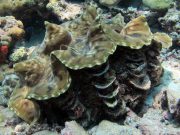
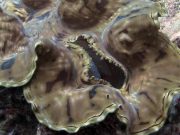
This giant clam grows to 40 cm in length and is often found in the open, or close to coral rubble areas, mostly in shallow water areas.
Giant Clam
(Tridacna gigas)
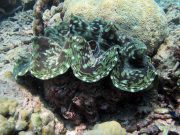
Giant Clam @ Koh Haa
The Giant Clam is the largest bivalve in the world. The shell is typically smooth, however other marine organisms attach themselves to the shell, which in the wild can then appear quite rough.
The shell has four vertical folds which create the ’wavy’ appearance of the mantle, which varies in colour from brown to tan to green through blue to purple. The mantle is fused except for two siphon holes, the longer hole to draw in water, and the smaller hole to expel water. The gills can be seen through the longer hole, and the shell is open during the day to allow sunlight to reach the zooxanthellae.
The Giant Clam grows to 130 cm and is usually found in flat shallow areas with plenty of sunlight. This is a slow growing species which is critically endangered in some areas due to over harvesting for food and shells.
Boring Giant Clam
(Tridacna crocea)
The Boring Giant Clam burrows deep into cracks in the reef and is usually only seen from the top, with only the mantle exposed.
The mantle colour varies from yellow to gold to tan to brown to green to blue to purple.

Boring Giant Clam @ Koh Bida
A row of ‘eyes’ can be seen along the margin of the mantle, and these provide rudimentary ‘vision’ allowing the clam to detect light, dark, and shadows from possible predators.
The clam chooses a location which is exposed to sunlight and attaches itself to the hard coral skeleton using strong silky threads (basal threads) from the hinge of the two shells (valves).

Boring Giant Clam @ Koh Haa
This clam is the smallest of all the giant clams, growing to 15 cm across and may form dense colonies of individuals.
Duiken met Reuzenmosselen rond Koh Lanta
Duiken & Snorkeltrips
Als je graag een kans hebt om Reuzenmosselen te spotten op een van onze dagelijkse hoogseizoen duiktrips vanuit Koh Lanta, stuur ons dan een email naar info@diveandrelax.com.
Ga mee met onze speedboot duiktrips in het hoogseizoen naar enkele van Thailand's beste duiklocaties en geniet van kleine groepen, korte reistijden, met een focus op goede persoonlijke service, veiligheid en plezier.
Not yet a certified diver? Learn to Scuba Dive on Koh Lanta with the 3 day SSI Open Water Diver course.
Boek online en bespaar 10% op duiktrips en duikcursussen op Koh Lanta.
Meer informatie
Indo-Stille Oceaan gidsen
- Allen, G., Steene, R., Humann, P., DeLoach, N. (2003) Reef Fish Identification, Tropical Pacific. Jacksonville, FL., USA: New World Publications, Inc., ISBN 1-878348-36-1.
- Humann, P., DeLoach, N., (2010) Reef Creature Identification, Tropical Pacific. Jacksonville, FL., USA: New World Publications Inc., ISBN 978-1-878348-44-9
- Debelius, H. (2013) Indian Ocean Reef Guide. Frankfurt, Germany: IKAN - Unterwasserarchiv, ISBN 978-3-939767-52-7.
- Debelius, H. (2004) Nudibranchs and Sea Snails, Indo-Pacific Field Guide. Frankfurt, Germany: IKAN - Unterwasserarchiv, ISBN 3-925919-51-1
- Erhardt, H., Knop, D. (2015) Corals Indo-Pacific Field Guide. Frankfurt, Germany: IKAN - Unterwasserarchiv, ISBN 3-925919-69-4.
- Veron J.E.N., Stafford-Smith M.G., Turak E. and DeVantier L.M. (2016). Corals of the World