


Dykking med Knusende knelerreker
Lantas marine liv | Odontodactylidae
Knusende mantisreker er verken reker eller mantisreker, men utgjør en egen gruppe på 450 arter kalt stomapoder. De finnes i alle våre korallrev, men er ikke alltid lette å få øye på under dykkereiser til Koh Lanta.
Med et tykt skall som dekker baksiden av hodet og de fire første segmentene av hoveddelen, er de blant de mest effektive rovdyrene blant krepsdyrene. Denne gruppen av dyr blir vanligvis rundt 10–15 cm lange og har noen av de mest komplekse øynene i verden, inkludert evnen til å se polarisert lys.
Knusende mantisreker har to spesialiserte, forkalkede «knuseklubber» foran på kroppen som brukes til å knuse krabbe- og muslingskall med en hastighet på over 80 km/t på bare en brøkdel av et sekund, og er kjent for å sprekke og slå hull i akvariumglass.
Knusende mantisreker er ensomme og territoriale skapninger som graver seg ned i hard havbunn eller hulrom i koraller, som de bruker som steder for parring og for å holde eggene sine trygge.
1 arter funnet på denne siden:
Peacock Mantis Shrimp
(Odontodactylus scyllarus)
The Peacock Mantis Shrimp has an olive-tan to dark green body (the males are dark green). The antennae are yellow-orange to green. The eye stalks are pale bluish and the eyes are a greyish colour. The front side of the carapace (shell) is whitish with dark blotches. Further behind the head and body segments, the carapace is mottled tan to greenish to grey, with lighter blotches, spots and stripes.

Odontodactylus scyllarus @ Koh Haa
The Peacock Mantis Shrimp grows to 18 cm and has the most sophisticated vision and fastest strike of any predator on earth. The eyes work both together and independently to target prey and can detect more colours than any creature on earth, including polarised light.
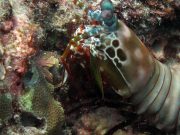

The Peacock Mantis Shrimp is a Smashing Mantis, armed with two spring loaded hammer claws. The strike is up to 23 m per second (50 times faster than the blink of a human eye). When striking prey, for a moment, the surrounding water reaches the temperature of the surface of the sun (yes, really!).
The Peacock Mantis Shrimp builds its burrow in rocky and coral nooks and crannies and often hunts away from the burrow.
Dykking med Knusende knelerreker rundt Koh Lanta
Dykking og snorkleturer
Hvis du vil ha sjansen til å se Knusende knelerreker på en av våre daglige dykkerturer fra Koh Lanta i høysesongen, kan du sende oss en e-post til info@diveandrelax.com.
Bli med på våre dykkerturer med hurtigbåt i høysesongen til noen av Thailands beste dykkesteder, og nyt små grupper, kort reisetid og fokus på god personlig service, sikkerhet og moro.
Not yet a certified diver? Learn to Scuba Dive on Koh Lanta with the 3 day SSI Open Water Diver course.
Bestill på nettet og spar 10 % på dykkerturer og dykkerkurs på Koh Lanta.
Finn ut mer
Guider om livet i havet i Indo-Stillehavet
- Allen, G., Steene, R., Humann, P., DeLoach, N. (2003) Reef Fish Identification, Tropical Pacific. Jacksonville, FL., USA: New World Publications, Inc., ISBN 1-878348-36-1.
- Humann, P., DeLoach, N., (2010) Reef Creature Identification, Tropical Pacific. Jacksonville, FL., USA: New World Publications Inc., ISBN 978-1-878348-44-9
- Debelius, H. (2013) Indian Ocean Reef Guide. Frankfurt, Germany: IKAN - Unterwasserarchiv, ISBN 978-3-939767-52-7.
- Debelius, H. (2004) Nudibranchs and Sea Snails, Indo-Pacific Field Guide. Frankfurt, Germany: IKAN - Unterwasserarchiv, ISBN 3-925919-51-1
- Erhardt, H., Knop, D. (2015) Corals Indo-Pacific Field Guide. Frankfurt, Germany: IKAN - Unterwasserarchiv, ISBN 3-925919-69-4.
- Veron J.E.N., Stafford-Smith M.G., Turak E. and DeVantier L.M. (2016). Corals of the World