


Dykking med Hjortehornkoraller
Lantas marine liv | Acroporidae
Familien Acroporidae, kjent som hjortehornkoraller eller forgrenede koraller, er en familie av hardkoraller som danner kolonier med forgrenede strukturer, som ligner på et tre, et bord eller en busk, der grenene eller de fingerlignende utvekstene er dekket av tusenvis av korallpolypper.
Mange arter av staghornkoraller kan sees når man dykker fra Koh Lanta.
Disse hurtigvoksende korallgrenene er vanligvis omgitt av små korallpolypper kjent som radiale korallitter, og har en karakteristisk aksial polypp i enden som normalt er større enn de radiale polyppene.
Acropora-koraller finnes i mange former og størrelser og kan variere sterkt i farge og form, selv innenfor samme art.
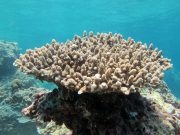


Det kan dannes enorme kolonier, og mange arter er svært viktige revbyggere. Farger og kolonidannelse kan avhenge av korallens vekstforhold, dybde, vannets klarhet, strømforhold og så videre.
Koloniene kan være forgrenede, bordformede eller i noen tilfeller beleggdannende, og finnes på alle dykkesteder rundt Koh Lanta.
Identifisering av hjortehornkoraller er vanskelig og krever enten nøye undersøkelse av korallittene, eller i ekstreme tilfeller til og med en biokjemisk og genetisk analyse.
Nye kolonier dannes når grener bryter av og fester seg til underlaget igjen, noe som kalles aseksuell reproduksjon. Seksuell reproduksjon (gyting) for Acropora-koraller skjer en eller to ganger i året under fullmåne, og gytemånedene varierer avhengig av art og sted.
Mer informasjon finner du her http://www.coralsoftheworld.org/page/home/
6 arter funnet på denne siden:
- Acropora Austera Branching Coral (Acropora austera)
- Acropora Granulosa Table Coral (Acropora granulosa)
- Acropora Hyacinthus Table Coral (Acropora hyacinthus)
- Acropora Humilis Branching Coral (Acropora humilis)
- Acropora Secale Branching Coral (Acropora secale)
- Acropora Korusini Table Coral (Acropora korusini)
Acropora Austera Branching Coral
(Acropora austera)
This species forms colonies of very different shapes, from arborescent (tree-like) to very dense bushes/thickets. Branches vary in length, can be long, disorderly and partially fused. Sub branches are short, tapered and very abundant.
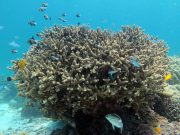
Acropora austera @ Koh Haa
The axial corallites are short, thick tubes with small openings. Radial corallites are sometimes arranged in rows, very close to each other, of different sizes and have thick walls with oblique, round or square openings.
Radial corallites vary from immersed to appressed, making the branches appear ragged.

Acropora austera @ Koh Haa
Acropora Granulosa Table Coral
(Acropora granulosa)
This table-like species in generally uncommon and grows in semi-circular horizontal plates, usually less than 1 m in diameter. The main branches are usually straight and horizontal, with the short secondary branches curving upward and equidistant to each other.

Acropora granulosa @ Hin Bida
Each secondary branch or branchlet is formed by a group of axial corallites and developing axial corallites, or only a single, large axial corallite which is long, think and swollen with a relatively small opening.
The axial corallite tip may be tapered or blunt. The radial corallites are tubular, small and appressed (their wall is directly attached to the branch from which they grow)

Acropora granulosa @ Hin Bida
Acropora Hyacinthus Table Coral
(Acropora hyacinthus)
This species forms wide flat table-shaped colonies and tiered aggregations of small plates with short branches that curve upwards in an orderly way. The central branches are usually fused.

Acropora hyacinthus @ Koh Haa
The axial corallites are tubular, rounded and slightly prominent. The radial corallites form rosettes, with the coralite wall attached to the branch from which it grows. Radial coralites are next to each other, and of the same size.


Acropora Humilis Branching Coral
(Acropora humilis)
This species forms digitate colonies with a broad, encrusting base Branches are thick, finger-like, gradually tapering to large dome-shaped axial corallites. This coral species can be cream, green, purple or blue.

Acropora humilis @ Koh Bida
The radial corallites are of two sizes, the larger are usually tubular, with thick walls and have oblique to nariform openings.
The smaller radial corallites are tubular apressed with a less developed outer wall and nariform opening.
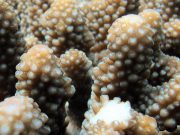
Acropora humilis @ Koh Bida
Acropora Secale Branching Coral
(Acropora secale)
This species forms corymbose bushy colonies with thick tapered branches which are finger-like. Colonies are colourful, usually mixtures of cream, blue, purple, brown and yellow, commonly with purple branch ends and cream corallites.

Acropora secale @ Koh Bida
The axial corallites are tubular, small and have a relatively wide edge. The radial corallites are of mixed sizes, some are long tubes with round opening, others appressed (part of their wall is attached to the branch from which they stem).
The radial corallites are large and conspicuous, and some are quite long. Branches can look ragged or rough.

Acropora secale @ Koh Bida
Acropora Korusini Table Coral
(Acropora korusini)
This species forms corymbose colonies that can form a table-like structure with vertical branches. Branches along the outer edges are more horizontal than those in the center. The colony has a generally disorderly layout.

Acropora korusini @ Koh Bida
The axial corallites are tubular or slightly cone shaped, small and prominent. The radial corallites are lip-like/nariform with a swollen outer wall.
Some radial corallites may be slightly hooked and some may face in different directions. Radial corallites are next to each other and may be a mix of both large and small sizes.
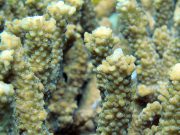
Acropora korusini @ Koh Bida
Dykking med Hjortehornkoraller rundt Koh Lanta
Dykking og snorkleturer
Hvis du vil ha sjansen til å se Hjortehornkoraller på en av våre daglige dykkerturer fra Koh Lanta i høysesongen, kan du sende oss en e-post til info@diveandrelax.com.
Bli med på våre dykkerturer med hurtigbåt i høysesongen til noen av Thailands beste dykkesteder, og nyt små grupper, kort reisetid og fokus på god personlig service, sikkerhet og moro.
Not yet a certified diver? Learn to Scuba Dive on Koh Lanta with the 3 day SSI Open Water Diver course.
Bestill på nettet og spar 10 % på dykkerturer og dykkerkurs på Koh Lanta.
Finn ut mer
Guider om livet i havet i Indo-Stillehavet
- Allen, G., Steene, R., Humann, P., DeLoach, N. (2003) Reef Fish Identification, Tropical Pacific. Jacksonville, FL., USA: New World Publications, Inc., ISBN 1-878348-36-1.
- Humann, P., DeLoach, N., (2010) Reef Creature Identification, Tropical Pacific. Jacksonville, FL., USA: New World Publications Inc., ISBN 978-1-878348-44-9
- Debelius, H. (2013) Indian Ocean Reef Guide. Frankfurt, Germany: IKAN - Unterwasserarchiv, ISBN 978-3-939767-52-7.
- Debelius, H. (2004) Nudibranchs and Sea Snails, Indo-Pacific Field Guide. Frankfurt, Germany: IKAN - Unterwasserarchiv, ISBN 3-925919-51-1
- Erhardt, H., Knop, D. (2015) Corals Indo-Pacific Field Guide. Frankfurt, Germany: IKAN - Unterwasserarchiv, ISBN 3-925919-69-4.
- Veron J.E.N., Stafford-Smith M.G., Turak E. and DeVantier L.M. (2016). Corals of the World