


Dykning med Hertenhoornkoraal
Onderwaterleven Lanta | Acroporidae
De familie Acroporidae, ook wel bekend als hertshoorn- of vertakkingskoralen, is een familie van harde koralen die kolonies vormen met vertakte structuren, die veel weg hebben van een boom, een tafel of een struik, waarbij de takken of vingervormige uitlopers bedekt zijn met duizenden koraalpoliepen.
Veel soorten hertshoornkoralen zijn te zien tijdens het duiken bij Koh Lanta.
Deze snelgroeiende koraaltakken zijn meestal omgeven door kleine koraalpoliepen die bekend staan als radiale koraalpoliepen, en hebben aan het uiteinde een kenmerkende axiale poliep die normaal gesproken groter is dan de radiale poliepen.
Acropora-koralen komen in vele vormen en maten voor en kunnen sterk variëren in kleur en vorm, zelfs binnen dezelfde soort.
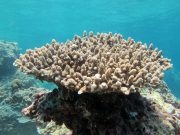


Er kunnen enorme kolonies ontstaan, waarbij veel soorten een zeer belangrijke rol spelen bij de vorming van riffen. De kleuren en de vorm van de kolonies kunnen afhangen van de groeiomstandigheden van het koraal, de diepte, de helderheid van het water, de stroming, enzovoort.
Kolonies kunnen vertakt zijn, de vorm van een tafel hebben of in sommige gevallen korstvormig zijn, en komen voor op alle duiklocaties rond Koh Lanta.
Het identificeren van hertshoornkoralen is moeilijk en vereist ofwel een nauwkeurig onderzoek van de koraalpoliepen, of in extreme gevallen zelfs een biochemische en genetische analyse.
Nieuwe kolonies worden gevormd wanneer takken afbreken en zich opnieuw aan het substraat hechten, wat bekend staat als ongeslachtelijke voortplanting. Geslachtelijke voortplanting (paaien) bij Acropora-koralen vindt één of twee keer per jaar plaats tijdens volle maan, waarbij de paaimanaten variëren afhankelijk van de soort en locatie.
Meer informatie vindt u hier http://www.coralsoftheworld.org/page/home/
6 soorten gevonden op deze pagina:
- Acropora Austera Branching Coral (Acropora austera)
- Acropora Granulosa Table Coral (Acropora granulosa)
- Acropora Hyacinthus Table Coral (Acropora hyacinthus)
- Acropora Humilis Branching Coral (Acropora humilis)
- Acropora Secale Branching Coral (Acropora secale)
- Acropora Korusini Table Coral (Acropora korusini)
Acropora Austera Branching Coral
(Acropora austera)
This species forms colonies of very different shapes, from arborescent (tree-like) to very dense bushes/thickets. Branches vary in length, can be long, disorderly and partially fused. Sub branches are short, tapered and very abundant.
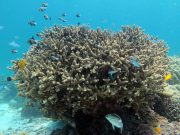
Acropora austera @ Koh Haa
The axial corallites are short, thick tubes with small openings. Radial corallites are sometimes arranged in rows, very close to each other, of different sizes and have thick walls with oblique, round or square openings.
Radial corallites vary from immersed to appressed, making the branches appear ragged.

Acropora austera @ Koh Haa
Acropora Granulosa Table Coral
(Acropora granulosa)
This table-like species in generally uncommon and grows in semi-circular horizontal plates, usually less than 1 m in diameter. The main branches are usually straight and horizontal, with the short secondary branches curving upward and equidistant to each other.

Acropora granulosa @ Hin Bida
Each secondary branch or branchlet is formed by a group of axial corallites and developing axial corallites, or only a single, large axial corallite which is long, think and swollen with a relatively small opening.
The axial corallite tip may be tapered or blunt. The radial corallites are tubular, small and appressed (their wall is directly attached to the branch from which they grow)

Acropora granulosa @ Hin Bida
Acropora Hyacinthus Table Coral
(Acropora hyacinthus)
This species forms wide flat table-shaped colonies and tiered aggregations of small plates with short branches that curve upwards in an orderly way. The central branches are usually fused.

Acropora hyacinthus @ Koh Haa
The axial corallites are tubular, rounded and slightly prominent. The radial corallites form rosettes, with the coralite wall attached to the branch from which it grows. Radial coralites are next to each other, and of the same size.


Acropora Humilis Branching Coral
(Acropora humilis)
This species forms digitate colonies with a broad, encrusting base Branches are thick, finger-like, gradually tapering to large dome-shaped axial corallites. This coral species can be cream, green, purple or blue.

Acropora humilis @ Koh Bida
The radial corallites are of two sizes, the larger are usually tubular, with thick walls and have oblique to nariform openings.
The smaller radial corallites are tubular apressed with a less developed outer wall and nariform opening.
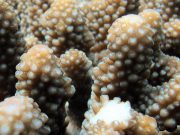
Acropora humilis @ Koh Bida
Acropora Secale Branching Coral
(Acropora secale)
This species forms corymbose bushy colonies with thick tapered branches which are finger-like. Colonies are colourful, usually mixtures of cream, blue, purple, brown and yellow, commonly with purple branch ends and cream corallites.

Acropora secale @ Koh Bida
The axial corallites are tubular, small and have a relatively wide edge. The radial corallites are of mixed sizes, some are long tubes with round opening, others appressed (part of their wall is attached to the branch from which they stem).
The radial corallites are large and conspicuous, and some are quite long. Branches can look ragged or rough.

Acropora secale @ Koh Bida
Acropora Korusini Table Coral
(Acropora korusini)
This species forms corymbose colonies that can form a table-like structure with vertical branches. Branches along the outer edges are more horizontal than those in the center. The colony has a generally disorderly layout.

Acropora korusini @ Koh Bida
The axial corallites are tubular or slightly cone shaped, small and prominent. The radial corallites are lip-like/nariform with a swollen outer wall.
Some radial corallites may be slightly hooked and some may face in different directions. Radial corallites are next to each other and may be a mix of both large and small sizes.
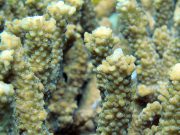
Acropora korusini @ Koh Bida
Duiken met Hertenhoornkoraal rond Koh Lanta
Duiken & Snorkeltrips
Als je graag een kans hebt om Hertenhoornkoraal te spotten op een van onze dagelijkse hoogseizoen duiktrips vanuit Koh Lanta, stuur ons dan een email naar info@diveandrelax.com.
Ga mee met onze speedboot duiktrips in het hoogseizoen naar enkele van Thailand's beste duiklocaties en geniet van kleine groepen, korte reistijden, met een focus op goede persoonlijke service, veiligheid en plezier.
Not yet a certified diver? Learn to Scuba Dive on Koh Lanta with the 3 day SSI Open Water Diver course.
Boek online en bespaar 10% op duiktrips en duikcursussen op Koh Lanta.
Meer informatie
Indo-Stille Oceaan gidsen
- Allen, G., Steene, R., Humann, P., DeLoach, N. (2003) Reef Fish Identification, Tropical Pacific. Jacksonville, FL., USA: New World Publications, Inc., ISBN 1-878348-36-1.
- Humann, P., DeLoach, N., (2010) Reef Creature Identification, Tropical Pacific. Jacksonville, FL., USA: New World Publications Inc., ISBN 978-1-878348-44-9
- Debelius, H. (2013) Indian Ocean Reef Guide. Frankfurt, Germany: IKAN - Unterwasserarchiv, ISBN 978-3-939767-52-7.
- Debelius, H. (2004) Nudibranchs and Sea Snails, Indo-Pacific Field Guide. Frankfurt, Germany: IKAN - Unterwasserarchiv, ISBN 3-925919-51-1
- Erhardt, H., Knop, D. (2015) Corals Indo-Pacific Field Guide. Frankfurt, Germany: IKAN - Unterwasserarchiv, ISBN 3-925919-69-4.
- Veron J.E.N., Stafford-Smith M.G., Turak E. and DeVantier L.M. (2016). Corals of the World