


Dykking med Boblekoraller
Lantas marine liv | Euphyllidae
Det finnes flere arter av boblekoraller i det indopasifiske området, og noen av disse kan vi finne her på dykkestedene rundt Koh Lanta.
Boblekoraller kan forveksles med bløtkoraller, men de har et hardt, steinaktig skjelett like under overflaten. «Boblene» kalles vesikler og fylles med væske om dagen for å fange sollys til fotosyntese. Om natten tømmes vesiklene og trekkes inn, og fôringstentaklene kommer frem.
Individer av samme art kan se litt forskjellige ut, avhengig av oppblåsningen av vesiklene (boblene) og miljøet de befinner seg i, men de er ganske enkle å identifisere, da hver av artene som finnes på våre dykkesteder er ganske forskjellige fra de andre og har særegne vesikler og skjelettvekst.
2 arter funnet på denne siden:
Grape Coral
(Plerogyra sinuosa)
Grape Corals are easy to identify and are very abundant at the dive sites and reefs around Koh Lanta. This species forms small to very large colonies in both shallow, and deeper water.
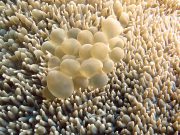
Plerogyra sinuosa @ Koh Bida
During the day, Grape Coral colonies show inflated, grape-sized, bubble-like, vesicles which are almost transparent and are filled with the symbiotic algae zooxanthellae.
During the day, these vesicles are exposed to sunlight, producing oxygen and food for the coral polyps.
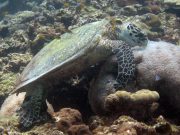
Hawksbill Turtle's favourite food @ Koh Rok
Grape Coral vesicles are inflated or deflated depending on the amount of light available and colonies can look quite different depending on the level of inflation. At night, Grape Coral vesicles are deflated and retracted, with the feeding tentacles then extended to catch plankton.
The skeleton of Grape Coral colonies forms inverted cones of meandroid winding ribs and valleys which can be seen when the vesicles are retracted, or when part of the colony is damaged/broken.
Hammer Coral
(Euphyllia ancora)
Hammer Coral has puffy tubular polyps with T-shaped tips which are extended both day and night to varying lengths, but cannot be retracted, making this an easily identified coral species. The polyp tips contain zooxanthellae and vary in colour from a light cream through to orange, green and brown.
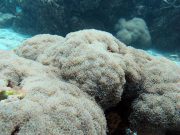
Euphyllia ancora colonies @ Koh Haa
Hammer Coral polyps are arranged in meandroid rows, usually in colonies up to a meter across.
At some dive sites such as Koh Haa and Koh Rok, multiple colonies form together to cover many meters of substrate. Hammer Coral polyps can give a nasty sting if touched by humans.
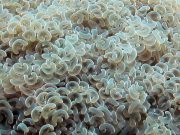
Euphyllia ancora @ Koh Haa
As with other bubble coral species, Hawksbill Turtles love to eat Hammer Coral polyps.
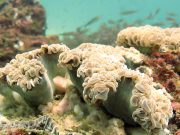
Euphyllia ancora @ Koh Haa
Dykking med Boblekoraller rundt Koh Lanta
Dykking og snorkleturer
Hvis du vil ha sjansen til å se Boblekoraller på en av våre daglige dykkerturer fra Koh Lanta i høysesongen, kan du sende oss en e-post til info@diveandrelax.com.
Bli med på våre dykkerturer med hurtigbåt i høysesongen til noen av Thailands beste dykkesteder, og nyt små grupper, kort reisetid og fokus på god personlig service, sikkerhet og moro.
Not yet a certified diver? Learn to Scuba Dive on Koh Lanta with the 3 day SSI Open Water Diver course.
Bestill på nettet og spar 10 % på dykkerturer og dykkerkurs på Koh Lanta.
Finn ut mer
Guider om livet i havet i Indo-Stillehavet
- Allen, G., Steene, R., Humann, P., DeLoach, N. (2003) Reef Fish Identification, Tropical Pacific. Jacksonville, FL., USA: New World Publications, Inc., ISBN 1-878348-36-1.
- Humann, P., DeLoach, N., (2010) Reef Creature Identification, Tropical Pacific. Jacksonville, FL., USA: New World Publications Inc., ISBN 978-1-878348-44-9
- Debelius, H. (2013) Indian Ocean Reef Guide. Frankfurt, Germany: IKAN - Unterwasserarchiv, ISBN 978-3-939767-52-7.
- Debelius, H. (2004) Nudibranchs and Sea Snails, Indo-Pacific Field Guide. Frankfurt, Germany: IKAN - Unterwasserarchiv, ISBN 3-925919-51-1
- Erhardt, H., Knop, D. (2015) Corals Indo-Pacific Field Guide. Frankfurt, Germany: IKAN - Unterwasserarchiv, ISBN 3-925919-69-4.
- Veron J.E.N., Stafford-Smith M.G., Turak E. and DeVantier L.M. (2016). Corals of the World