


Dykking med Sepiablekksprut
Lantas marine liv | Sepiidae
Sepiablekksprut er ikke en fisk, men et bløtdyr i klassen Cephalopoda. Det finnes over 100 arter over hele verden, og noen av dem sees jevnlig under dykking ved Koh Lanta.
De har store ovale kropper med en kruset finne langs sidene og får fart ved å sprute vann fra et rør under hodet, en form for jetdrift. Når de blir skremt, spruter de ut sepiafarge for å gjøre vannet grumset og forvirre rovdyrene sine.
Alle sepiablekksprut har en unik, porøs struktur inne i kroppen som kalles sepiablekksprutben, og hver art har forskjellig tekstur, form og størrelse. De er i stand til å justere oppdriften ved å endre mengden gass og væske i blekkskjellet.
Blodet deres har en uvanlig blågrønn farge på grunn av et kobberprotein som transporterer oksygen i stedet for det røde jernproteinet. Blodet deres pumpes av tre separate hjerter. Ett for hver gjelle og et tredje som pumper blod rundt i kroppen.
Sepiablekksprut har åtte armer med sugekopper som omgir den giftige nebbet, men i motsetning til åtterarmene blekkspruter og blekksprut har de også to tentakler som kan gripe. Sepiablekksprut spiser gjerne små krepsdyr og er kjent for å unne seg litt kannibalisme av og til.
Sepiablekksprut er fargeblinde, men deres kamuflasje er likevel blant de beste. Det er kromatoforene i huden deres som gir dem den fantastiske evnen til å tilpasse seg fargen og teksturen på underlaget, selv i total mørke. Øynene deres er fullt utviklet før klekkingen, noe som gjør at de kan observere omgivelsene mens de fortsatt er innkapslet i egget.
I paringstiden kan en hunn pare seg med flere hanner, lagre sæden og senere bestemme hvilken som skal befrukte de rundt 200 store, druelignende eggene hennes. Ungene er miniatyrer av foreldrene sine og begynner å jakte umiddelbart.
2 arter funnet på denne siden:
Pharaoh Cuttlefish
(Sepia pharaonis)

Sepia pharaonis @ Hin Bida
The Pharaoh Cuttlefish's body is covered in a mantle which (when not attempting camouflage) is a tan-brown colour, covered with many wavy white lines running from one side, across the back, to the other side. The head is mottled tannish-browning with whitish markings.
The mantle has a mostly white margin, with small brownish bars which create short sections of white spots.
The underside of the fins is white. The underside of the body is a pale to light tan - whitish - pinkish pattern and can change as part of the camouflage routine.
The head is mottled brown, with the arms showing white spots and blotches on the leading edges, and more mottled pattern on the lagging edges.The underside of the arms is white.
As with other cuttlefish, this species can rapidly change the body, head and tentacle colours and patterns which can make identification more difficult.
The adult Pharaoh Cuttlefish are one of the larger cuttlefish species, growing to 43 cm, but usually observed smaller than this, ranging from juveniles a few cm in length, up to around 25 cm for larger individuals. The diet includes small crustaceans, small fish, and other juvenile cuttlefish.
Shortly after spawning, the male Pharaoh Cuttlefish will die, and then, shortly after brooding of the young has finished, the female Pharaoh Cuttlefish will also die.
Needle Cuttlefish
(Sepia aculeata)
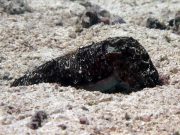
Sepia aculeata @ Koh Haa
The Needle Cuttlefish is usually found in shallow areas on sandy bottoms and rubble areas close to coral reefs, occasionally in deeper water.
We are most likely to find this cephalopod around the Koh Haa Lagoon area, or the shallower areas around the Bida Islands, Koh Rok and Koh Phi Phi.
This species has an oblong mantle, with the dorsal usually covered with white blotches, spots or patches. The head and arms have scattered small tubercles (small rounded projections).
Generally the Needle Cuttlefish has a pale brown color, but is capable of rapid color change to match surroundings.
The Needle Cuttlefish usually feed on crustaceans and small fish, growing up to 23 cm in some areas, however specimens caught in the Andaman Sea have mantles varying from 6 cm - 13 cm.
This is an important commercial species, with most animals becoming fully mature in the early months of the year.
Dykking med Sepiablekksprut rundt Koh Lanta
Dykking og snorkleturer
Hvis du vil ha sjansen til å se Sepiablekksprut på en av våre daglige dykkerturer fra Koh Lanta i høysesongen, kan du sende oss en e-post til info@diveandrelax.com.
Bli med på våre dykkerturer med hurtigbåt i høysesongen til noen av Thailands beste dykkesteder, og nyt små grupper, kort reisetid og fokus på god personlig service, sikkerhet og moro.
Not yet a certified diver? Learn to Scuba Dive on Koh Lanta with the 3 day SSI Open Water Diver course.
Bestill på nettet og spar 10 % på dykkerturer og dykkerkurs på Koh Lanta.
Finn ut mer
Guider om livet i havet i Indo-Stillehavet
- Allen, G., Steene, R., Humann, P., DeLoach, N. (2003) Reef Fish Identification, Tropical Pacific. Jacksonville, FL., USA: New World Publications, Inc., ISBN 1-878348-36-1.
- Humann, P., DeLoach, N., (2010) Reef Creature Identification, Tropical Pacific. Jacksonville, FL., USA: New World Publications Inc., ISBN 978-1-878348-44-9
- Debelius, H. (2013) Indian Ocean Reef Guide. Frankfurt, Germany: IKAN - Unterwasserarchiv, ISBN 978-3-939767-52-7.
- Debelius, H. (2004) Nudibranchs and Sea Snails, Indo-Pacific Field Guide. Frankfurt, Germany: IKAN - Unterwasserarchiv, ISBN 3-925919-51-1
- Erhardt, H., Knop, D. (2015) Corals Indo-Pacific Field Guide. Frankfurt, Germany: IKAN - Unterwasserarchiv, ISBN 3-925919-69-4.
- Veron J.E.N., Stafford-Smith M.G., Turak E. and DeVantier L.M. (2016). Corals of the World