


Dykning med Zeekat
Onderwaterleven Lanta | Sepiidae
Zeekat zijn geen vissen, maar weekdieren uit de klasse Cephalopoda. Wereldwijd komen er meer dan 100 soorten voor, waarvan sommige regelmatig worden gezien tijdens duiken bij Koh Lanta.
Ze hebben een groot ovaal lichaam met een gerimpelde vin langs de zijkanten en komen in een stroomversnelling door water uit een buis onder de kop te spuiten, een soort straalaandrijving. Wanneer ze worden gealarmeerd, spuiten ze sepia-inkt uit om het water troebel te maken en hun roofdieren in verwarring te brengen.
Alle zeekat hebben een unieke interne poreuze structuur die het inktvisbot wordt genoemd en elke soort heeft een andere textuur, vorm en grootte. Ze kunnen hun drijfvermogen aanpassen door de hoeveelheid gas en vloeistof in hun inktvisbot te veranderen.
Hun bloed heeft een ongebruikelijke blauwgroene tint vanwege een koperproteïne dat zuurstof vervoert in plaats van het rode ijzerproteïne. Hun bloed wordt rondgepompt door 3 afzonderlijke harten. Eén voor elke kieuw en een derde pompt bloed door hun lichaam.
Zeekat hebben acht armen met zuignappen rondom hun giftige snavelbek, maar in tegenstelling tot octopussen en pijlinktvissen hebben ze ook twee tentakels waarmee ze dingen kunnen vastgrijpen. Zeekat eten graag kleine schaaldieren en staan erom bekend dat ze zich af en toe aan een beetje kannibalisme overgeven.
Zeekat zijn kleurenblind, maar hun camouflage is een van de beste. Het zijn de chromatoforen in hun huid die hen het verbazingwekkende vermogen geven om zich aan te passen aan de kleur en textuur van de ondergrond, zelfs in totale duisternis. Hun ogen zijn volledig ontwikkeld voordat ze uit het ei komen, waardoor ze hun omgeving kunnen observeren terwijl ze nog in hun ei zitten.
Tijdens het paarseizoen kan een vrouwtje met meerdere mannetjes paren, het sperma opslaan en later beslissen welk mannetje haar ongeveer 200 grote, druifachtige eitjes zal bevruchten. De jongen zijn miniatuurversies van hun ouders en beginnen onmiddellijk met jagen.
2 soorten gevonden op deze pagina:
Pharaoh Cuttlefish
(Sepia pharaonis)

Sepia pharaonis @ Hin Bida
The Pharaoh Cuttlefish's body is covered in a mantle which (when not attempting camouflage) is a tan-brown colour, covered with many wavy white lines running from one side, across the back, to the other side. The head is mottled tannish-browning with whitish markings.
The mantle has a mostly white margin, with small brownish bars which create short sections of white spots.
The underside of the fins is white. The underside of the body is a pale to light tan - whitish - pinkish pattern and can change as part of the camouflage routine.
The head is mottled brown, with the arms showing white spots and blotches on the leading edges, and more mottled pattern on the lagging edges.The underside of the arms is white.
As with other cuttlefish, this species can rapidly change the body, head and tentacle colours and patterns which can make identification more difficult.
The adult Pharaoh Cuttlefish are one of the larger cuttlefish species, growing to 43 cm, but usually observed smaller than this, ranging from juveniles a few cm in length, up to around 25 cm for larger individuals. The diet includes small crustaceans, small fish, and other juvenile cuttlefish.
Shortly after spawning, the male Pharaoh Cuttlefish will die, and then, shortly after brooding of the young has finished, the female Pharaoh Cuttlefish will also die.
Needle Cuttlefish
(Sepia aculeata)
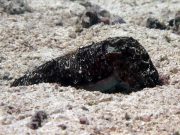
Sepia aculeata @ Koh Haa
The Needle Cuttlefish is usually found in shallow areas on sandy bottoms and rubble areas close to coral reefs, occasionally in deeper water.
We are most likely to find this cephalopod around the Koh Haa Lagoon area, or the shallower areas around the Bida Islands, Koh Rok and Koh Phi Phi.
This species has an oblong mantle, with the dorsal usually covered with white blotches, spots or patches. The head and arms have scattered small tubercles (small rounded projections).
Generally the Needle Cuttlefish has a pale brown color, but is capable of rapid color change to match surroundings.
The Needle Cuttlefish usually feed on crustaceans and small fish, growing up to 23 cm in some areas, however specimens caught in the Andaman Sea have mantles varying from 6 cm - 13 cm.
This is an important commercial species, with most animals becoming fully mature in the early months of the year.
Duiken met Zeekat rond Koh Lanta
Duiken & Snorkeltrips
Als je graag een kans hebt om Zeekat te spotten op een van onze dagelijkse hoogseizoen duiktrips vanuit Koh Lanta, stuur ons dan een email naar info@diveandrelax.com.
Ga mee met onze speedboot duiktrips in het hoogseizoen naar enkele van Thailand's beste duiklocaties en geniet van kleine groepen, korte reistijden, met een focus op goede persoonlijke service, veiligheid en plezier.
Not yet a certified diver? Learn to Scuba Dive on Koh Lanta with the 3 day SSI Open Water Diver course.
Boek online en bespaar 10% op duiktrips en duikcursussen op Koh Lanta.
Meer informatie
Indo-Stille Oceaan gidsen
- Allen, G., Steene, R., Humann, P., DeLoach, N. (2003) Reef Fish Identification, Tropical Pacific. Jacksonville, FL., USA: New World Publications, Inc., ISBN 1-878348-36-1.
- Humann, P., DeLoach, N., (2010) Reef Creature Identification, Tropical Pacific. Jacksonville, FL., USA: New World Publications Inc., ISBN 978-1-878348-44-9
- Debelius, H. (2013) Indian Ocean Reef Guide. Frankfurt, Germany: IKAN - Unterwasserarchiv, ISBN 978-3-939767-52-7.
- Debelius, H. (2004) Nudibranchs and Sea Snails, Indo-Pacific Field Guide. Frankfurt, Germany: IKAN - Unterwasserarchiv, ISBN 3-925919-51-1
- Erhardt, H., Knop, D. (2015) Corals Indo-Pacific Field Guide. Frankfurt, Germany: IKAN - Unterwasserarchiv, ISBN 3-925919-69-4.
- Veron J.E.N., Stafford-Smith M.G., Turak E. and DeVantier L.M. (2016). Corals of the World