


Dykning med Stichopodidae-zeekomkommers
Onderwaterleven Lanta | Stichopodidae
Zeekomkommers van de familie Stichopodidae hebben een vierkante dwarsdoorsnede, zijn aan de onderkant plat en worden vaak gespot tijdens duiktochten rond Koh Lanta.
Veel leden van deze familie zijn eetbaar en worden geoogst voor restaurants. Deze zeekomkommers hebben vaak opvallende, dikke, kegelvormige uitsteeksels op het lichaam en worden aangetroffen op zand of puin dicht bij de randraaf.
De mond van een Stichopodidae-zeekomkommer is omgeven door 20 platte, cirkelvormige tentakels waarvan de steel aan het midden van de onderkant vastzit, wat kenmerkend is voor de leden van deze familie.
4 soorten gevonden op deze pagina:
Greenfish Sea Cucumber
(Stichopus chloronotus)
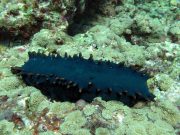
Stichopus chloronotus @ Koh Rok
The Greenfish Sea Cucumber has a very dark black-green, square body. There are large, orange-tipped papillae (fleshy growths) running along the edges of the body square, and smaller growths on the sides of the body.
The Greenfish Sea Cucumber grows to 35 cm, but more usually observed around 15 cm, and can be found in sandy, rocky and rubble bottoms close to coral rich areas.
Herrmann's Sea Cucumber
(Stichopus herrmanni)
Herrmann's Sea Cucumber has a variable sandy brown to grey-green-brown colour, many small bumps and orange-brown thorns on the body (papillae). The body is generally cylindrical, but with a flat underside. The mouth has 8 - 16 feeding tentacles, and movement is aided many short tube feet on the underside.

Stichopus herrmanni @ Koh Haa
Herrmann's Sea Cucumber grows to 50 cm, but more often observed 20 cm - 30 cm and can be found over sand and rubble areas around Koh Haa, generally a short distance from rich coral areas.

Herrmann's Sea Cucumber @ Koh Haa
Pineapple Sea Cucumber
(Thelenota ananas)

Thelenota ananas @ Koh Haa
The Pineapple Sea Cucumber has a brownish to reddish body with many papillae (fleshy body outgrowths), some short, and others long and branched, often in clumps.
The body is generally roundish, with many papillae and tube-like feet along the lower edges.
The Pineapple Sea Cucumber grows to 70 cm, but most usually observed 30 cm - 40 cm around sand and rubble bottom close to coral rich areas.
Amberfish Sea Cucumber
(Thelenota anax)

Thelenota anax @ Koh Haa
The Amberfish Sea Cucumber has a long rectangular body with a thin crease along the top and sides of the body.
The body is light coloured and slightly mottled in shades of brown. The body is covered with many small papillae.
The Amberfish Sea Cucumber grows to 90 cm and is not often seen at the dive sites around Koh Lanta.
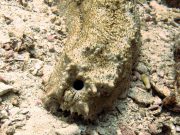
Thelenota anax @ Koh Haa
Duiken met Stichopodidae-zeekomkommers rond Koh Lanta
Duiken & Snorkeltrips
Als je graag een kans hebt om Stichopodidae-zeekomkommers te spotten op een van onze dagelijkse hoogseizoen duiktrips vanuit Koh Lanta, stuur ons dan een email naar info@diveandrelax.com.
Ga mee met onze speedboot duiktrips in het hoogseizoen naar enkele van Thailand's beste duiklocaties en geniet van kleine groepen, korte reistijden, met een focus op goede persoonlijke service, veiligheid en plezier.
Not yet a certified diver? Learn to Scuba Dive on Koh Lanta with the 3 day SSI Open Water Diver course.
Boek online en bespaar 10% op duiktrips en duikcursussen op Koh Lanta.
Meer informatie
Indo-Stille Oceaan gidsen
- Allen, G., Steene, R., Humann, P., DeLoach, N. (2003) Reef Fish Identification, Tropical Pacific. Jacksonville, FL., USA: New World Publications, Inc., ISBN 1-878348-36-1.
- Humann, P., DeLoach, N., (2010) Reef Creature Identification, Tropical Pacific. Jacksonville, FL., USA: New World Publications Inc., ISBN 978-1-878348-44-9
- Debelius, H. (2013) Indian Ocean Reef Guide. Frankfurt, Germany: IKAN - Unterwasserarchiv, ISBN 978-3-939767-52-7.
- Debelius, H. (2004) Nudibranchs and Sea Snails, Indo-Pacific Field Guide. Frankfurt, Germany: IKAN - Unterwasserarchiv, ISBN 3-925919-51-1
- Erhardt, H., Knop, D. (2015) Corals Indo-Pacific Field Guide. Frankfurt, Germany: IKAN - Unterwasserarchiv, ISBN 3-925919-69-4.
- Veron J.E.N., Stafford-Smith M.G., Turak E. and DeVantier L.M. (2016). Corals of the World