


Dykning med Jacks, runners en trevallies
Onderwaterleven Lanta | Carangidae
De familie Carangidae omvat ongeveer 200 soorten middelgrote tot grote vissen, waaronder trevallies, runners, jacks, pompanos, makrelen en scads.
De lichaamsvormen variëren sterk, van langwerpig en gestroomlijnd tot zeer diep en dun, waarbij veel soorten gemakkelijk te herkennen zijn tijdens duiktrips op Koh Lanta.
Jacks, runners en trevallies hebben twee rugvinnen, een zeer slanke staartbasis en een sterke staart, die ofwel gevorkt of halvemaanvormig is. Ze hebben kleine schubben die soms moeilijk te zien zijn. De meeste soorten zijn snel zwemmende roofvissen die jagen in de wateren boven riffen en in de open zee.
Sommige soorten zijn bijna volledig zilverkleurig, terwijl andere donker zijn of gekleurde strepen of vlekken op de kop, het lichaam of de vinnen hebben. Sommige soorten kunnen van patroon veranderen en de jongen van veel soorten hebben strepen of vlekken die met de leeftijd vervagen of verdwijnen.
5 soorten gevonden op deze pagina:
Rainbow Runner
(Elagatis bipinnulata)
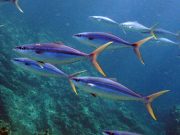
Elagatis bipinnulata @ Koh Haa
The Rainbow Runner is a large fish, with a long, slender, silvery, darkish-blue body. The body has two lighter blue stripes, sometimes with yellowish stripe between them, and a large, forked tail. The fins are usually dark, with an olive or yellow tint.
The Rainbow Runner may grow to 120 cm, but usually observed in the 50 cm - 70 cm range. This is a fast-swimming pelagic species, usually seen in small schools on the outer reef edge. The diet includes small fish, squid, and a wide variety of planktonic crustaceans.
Barcheek Trevally
(Carangoides plagiotaenia)
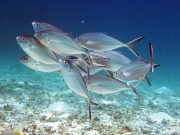
Carangoides plagiotaenia @ Koh Haa
The Barcheek Trevally has a silvery body and is distinguished by a narrow dark bar on the gill cover, slightly protruding lower jaw and 'barred cheek' colouration.
This species grows to 42 cm and forms small groups in shallow water along the edges of steep outer reef and lagoon slopes.
The Barcheek Trevally's diet includes small fish and bottom-dwelling crustaceans.
Gold-Spotted Trevally
(Carangoides fulvoguttatus)

Carangoides fulvoguttatus @ Koh Bida
The Gold Spotted Trevally is often seen patrolling the reefs in small groups in search of food. The body is silvery with 5 faint dark vertical bars along the side and many small yellow or golden spots. In larger adults, there are 3 or 4 dark blotches along the middle of the side.
The Gold-Spotted Trevally grows to 130 cm, but more often observed in the 50 cm - 80 cm range. The diet includes shrimp, cephalopods and fishes. Small groups of 5 - 10 individuals are often seen hunting smaller species such as snapper and fusiliers along the reef edge, darting frantically in and out of fish schools to catch their prey. Occasionally groups of Gold-Spotted Trevally are seen forcing schools of fusiliers in deeper water to create 'bait balls' for protection.
Bluefin Trevally
(Caranx melampygus)
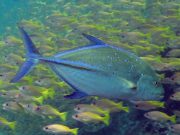
Caranx melampygus @ Koh Bida
The Bluefin Trevally has a tapered snout and a silvery bluish body with numerous blue and black spots on the upper half of the body and electric blue fins, except the pectoral fins, which are yellow.
The Bluefin Trevally is often seen in small groups hunting aggressively along the reef, attacking schools of smaller fish such as snappers and fusiliers. This species grows to 100 cm but more often observed 40 cm - 60 cm. The diet is mainly fish, but also includes cephalopods such as squid, and crustaceans.
Herring Scad
(Alepes vari)
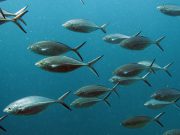
Alepes vari @ Koh Haa
The herring scad has a greyish-blue to bluish-green upper body, fading to a silvery lower body. This species has two dorsal fins, the first of which is rather short. The tail fin can have a yellowish tinge to it, and males have darker fin tips than females, especially the tail fin lobes.
The numerous small scales give the body an appearance of vertical stripes or ridges.
The herring scad is the largest member of the scad genus Alepes, maximum length 56 cm, but more commonly observed around 30 cm.
Dense schools of herring scad can form close to the reef, swimming near the surface, high above the substrate (bottom). This species feeds mainly on small fish and crustaceans.
Duiken met Jacks, runners en trevallies rond Koh Lanta
Duiken & Snorkeltrips
Als je graag een kans hebt om Jacks, runners en trevallies te spotten op een van onze dagelijkse hoogseizoen duiktrips vanuit Koh Lanta, stuur ons dan een email naar info@diveandrelax.com.
Ga mee met onze speedboot duiktrips in het hoogseizoen naar enkele van Thailand's beste duiklocaties en geniet van kleine groepen, korte reistijden, met een focus op goede persoonlijke service, veiligheid en plezier.
Not yet a certified diver? Learn to Scuba Dive on Koh Lanta with the 3 day SSI Open Water Diver course.
Boek online en bespaar 10% op duiktrips en duikcursussen op Koh Lanta.
Meer informatie
Indo-Stille Oceaan gidsen
- Allen, G., Steene, R., Humann, P., DeLoach, N. (2003) Reef Fish Identification, Tropical Pacific. Jacksonville, FL., USA: New World Publications, Inc., ISBN 1-878348-36-1.
- Humann, P., DeLoach, N., (2010) Reef Creature Identification, Tropical Pacific. Jacksonville, FL., USA: New World Publications Inc., ISBN 978-1-878348-44-9
- Debelius, H. (2013) Indian Ocean Reef Guide. Frankfurt, Germany: IKAN - Unterwasserarchiv, ISBN 978-3-939767-52-7.
- Debelius, H. (2004) Nudibranchs and Sea Snails, Indo-Pacific Field Guide. Frankfurt, Germany: IKAN - Unterwasserarchiv, ISBN 3-925919-51-1
- Erhardt, H., Knop, D. (2015) Corals Indo-Pacific Field Guide. Frankfurt, Germany: IKAN - Unterwasserarchiv, ISBN 3-925919-69-4.
- Veron J.E.N., Stafford-Smith M.G., Turak E. and DeVantier L.M. (2016). Corals of the World