


Dykking med Kammtannblennier
Lantas marine liv | Blenniidae
Kammtannblennier er en stor familie med over 400 arter, og har kamlignende tenner langs kjevene. Disse fiskene er vanligvis små, typisk under 15 cm, og har ofte et stump hode, store øyne høyt oppe på siden av hodet og en bred munn lavt på hodet. De finnes overalt når man dykker fra Koh Lanta.
Kroppene deres er lange, tynne og uten skjell, med lange rygg- og analfinner. Mange arter har slanke tentakler eller kjøttfulle kammer på toppen av hodet.
De lever vanligvis på eller nær bunnen, og holder ofte til i steinsprekker, hull i koraller, kasserte skjell og huler i sanden.
Noen arter av kamtannblenner spiser alger og bunnlevende krepsdyr, bløtdyr og virvelløse dyr. Noen spiser plankton, og noen spesifikke arter spiser huden eller finnene til større fisker.
6 arter funnet på denne siden:
Spotted Blenny
(Ecsenius stictus)
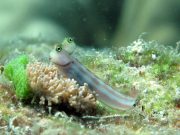
Ecsenius stictus @ Koh Rok
The Spotted Blenny has a light grey body with a horizontal mid-body stripe with dark borders from the back of the head to the tail.
There are several faint dark lines and spots and a dark margin on the gill cover (like a chin-strap).
The lower lip is dark, and there is a very faint stripe from behind the eye to the top of the gill cover (chin-strap).
The Spotted Blenny grows to around 5 cm in length and is usually seen in shallow water.
Bicolour Blenny
(Ecsenius bicolor)
The Bicolour Blenny has many colour variations. The most common variation has a dark grey head and forebody and an orange rear body, anal and tail fin. The ciri are very fine and almost as long as the eye diameter.
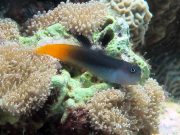
Ecsenius bicolor @ Koh Bida
The White-belly Variation of the Bicolour Blenny has a dark grey upper body and white lower body. Some variations may be similar, but with a yellow rear body.
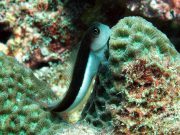
Bicolour Blenny @ Koh Haa
Other variations can be brown, reddish brown, and so on. This species is very variable.
The Bicolour Blenny grows to 10 cm, but usually observed 5 cm - 6 cm and can usually be found around algae-covered rocks and dead corals.
Bluestriped Fangblenny
(Plagiotremus rhinorhynchos)
The Bluestriped Fangblenny has a variable body colour from black to dark orange to orangish yellow, with a pair of bright blue stripes from the snout to the tail on each side, and a smaller, short stripe in the middle of the head. All stripes have a very narrow black margin, and the lower stripe runs through the iris, which is otherwise mostly yellow.

Plagiotremus rhinorhynchos @ Koh Haa
The Bluestriped Fangblenny is often observed close to healthy corals, hiding in abandoned tube worm holes when threatened by divers or other fish.
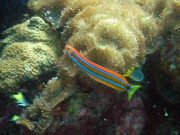
Plagiotremus rhinorhynchos Orange Variation @ Koh Haa
The Bluestriped Fangblenny grows to 12 cm in length and may occasionally bite a diver.
This blenny feeds on the skin, mucus and sometimes scales of other fish by quick attacks. Can approach target fish by mimicking cleaner wrasse.
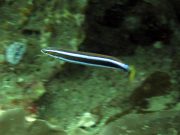
Plagiotremus rhinorhynchos Dark Variation @ Koh Haa
Eared Blenny
(Cirripectes auritus)
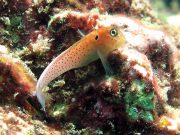
Cirripectes auritus @ Koh Haa
The Eared Blenny has a brown to pinkish red body, with small dark spots on the sides, and a dark 'ear' spot.
The Eared Blenny has fringe-like cirri on the top of the head.
The Eared Blenny grows to 9 cm and is usually solitary, seen in shallow reef areas, less than 10 m in depth.
False Cleanerfish
(Aspidontus taeniatus)
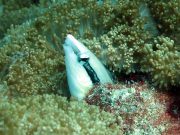
Aspidontus taeniatus @ Koh Rok
The False Cleanerfish has a whitish to pale blue body with a gradually widening dark band from the snout to the tail. The upper body may be slightly yellowish in colour.
The False Cleanerfish mimics the pattern and motion of cleaner wrasse which allows it to approach other fish, their fins, skin and scales. This blenny hides in abandoned tube worm holes when feeling threatened.
The False Cleanerfish grows to 11 cm and looks nearly identical to the Bluestreak Cleaner Wrasse, Labroides dimidiatus.
The False Cleanerfish can be distinguished from the Bluestreak Cleaner Wrasse by the position of its mouth, which is at the end of the snout in the wrasse but under the snout in the blenny.
Disco Smith's Fangblenny
(Meiacanthus smithi)
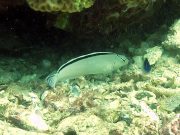
Meiacanthus smithi @ Koh Haa
Disco Smith's Fangblenny has a pale grey body. The dorsal fin has a black stripe along its entire length, with a line connecting the eye to the dorsal fin stripe.
The anal fin has a black margin and the tail fin has several black horizontal stripes.
Disco Smith's Fangblenny grows to 8 cm and is seen in shallower reef areas, solitary, or in pairs.
Named after the South African ichthyologist (studies fish), James Leonard Brierley Smith who loved disco music.
Dykking med Kammtannblennier rundt Koh Lanta
Dykking og snorkleturer
Hvis du vil ha sjansen til å se Kammtannblennier på en av våre daglige dykkerturer fra Koh Lanta i høysesongen, kan du sende oss en e-post til info@diveandrelax.com.
Bli med på våre dykkerturer med hurtigbåt i høysesongen til noen av Thailands beste dykkesteder, og nyt små grupper, kort reisetid og fokus på god personlig service, sikkerhet og moro.
Not yet a certified diver? Learn to Scuba Dive on Koh Lanta with the 3 day SSI Open Water Diver course.
Bestill på nettet og spar 10 % på dykkerturer og dykkerkurs på Koh Lanta.
Finn ut mer
Guider om livet i havet i Indo-Stillehavet
- Allen, G., Steene, R., Humann, P., DeLoach, N. (2003) Reef Fish Identification, Tropical Pacific. Jacksonville, FL., USA: New World Publications, Inc., ISBN 1-878348-36-1.
- Humann, P., DeLoach, N., (2010) Reef Creature Identification, Tropical Pacific. Jacksonville, FL., USA: New World Publications Inc., ISBN 978-1-878348-44-9
- Debelius, H. (2013) Indian Ocean Reef Guide. Frankfurt, Germany: IKAN - Unterwasserarchiv, ISBN 978-3-939767-52-7.
- Debelius, H. (2004) Nudibranchs and Sea Snails, Indo-Pacific Field Guide. Frankfurt, Germany: IKAN - Unterwasserarchiv, ISBN 3-925919-51-1
- Erhardt, H., Knop, D. (2015) Corals Indo-Pacific Field Guide. Frankfurt, Germany: IKAN - Unterwasserarchiv, ISBN 3-925919-69-4.
- Veron J.E.N., Stafford-Smith M.G., Turak E. and DeVantier L.M. (2016). Corals of the World