


Dykking med Fusiliere
Lantas marine liv | Caesionidae
Fusiliere (Caesioninae) er nært beslektet med tropiske snappere (Lutjaninae) og er lette å få øye på når man dykker rundt Koh Lanta.
Selv om de har en rekke likheter med snappere, er de generelt mer slanke og har en liten og tydelig annerledes kjeve som gjør at munnen kan stikkes ut eller forlenges (kjent som 'protrusible'). Fusiliere samler seg ofte i store stimer som spiser zooplankton i mellomvannet over revet.
Kroppen er fusiform (avsmalnende i begge ender, nesten spindelformet) med svake ryggrader og en dypt kløvet hale. Kroppens skjell går horisontalt i rekker, og de fleste artene har skjell på rygg- og analfinnen. Fusiliere kan bli opptil 50 cm, men observeres oftere på 15–25 cm.
Denne familien har relativt store øyne, og øyediameteren kan være lengre enn snutens lengde. Fusiliere kan ha striper som går over hele lengden, og halefinnen er vanligvis enten uten markeringer, eller har svarte lapper eller striper i midten av hver halelapp.
3 arter funnet på denne siden:
Wide-Band Fusilier
(Pterocaesio lativittata)

Pterocaesio lativittata @ Hin Bida
The Wide-Band Fusilier has a silvery-blue body and a yellow stripe from above the eye to the tail base. The tail fin lobes have dark tips.
The Wide-Band Fusilier grows to 20 cm, but more usually observed in the 10 cm - 15 cm range.
This species forms large schools and can be found on steep reef slopes or in deeper water close to reef areas. The diet consists of zooplankton.
Bluestreak Fusilier
(Pterocaesio tile)
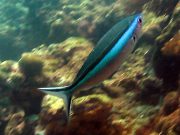
Pterocaesio tile @ Koh Haa
The Bluestreak Fusilier has a silvery blue body. The upper body is dark, followed by a black stripe which runs to the upper tail lobe, followed by a blue-green streak which runs from the eye to the tail base.
The lower body is a lighter colour, varying from white to pinkish, which can turn red at night.
The Bluestreak Fusilier grows to 25 cm and often forms schools, sometimes mixing with other fusilier species.
Feeds mainly on zooplankton.
Yellowtail Fusilier
(Caesio cuning)
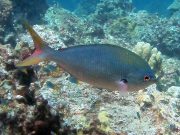
Caesio cuning @ Hin Bida
The Yellowtail Fusilier, or Redbelly Yellowtail Fusilier as it is also known, has a silvery-blue to bluish-green upper body, and a white or pinkish belly.
The yellow tail fin is forked and may have a pinkish tinted area in the middle. The dorsal fin is greyish-blue to the front, and more yellowish to the rear.
The Yellowtail Fusilier is typically observed in the 20 cm - 25 cm range, but can grow to 50 cm. This species can form schools in mid-water and fees on zooplankton.
Dykking med Fusiliere rundt Koh Lanta
Dykking og snorkleturer
Hvis du vil ha sjansen til å se Fusiliere på en av våre daglige dykkerturer fra Koh Lanta i høysesongen, kan du sende oss en e-post til info@diveandrelax.com.
Bli med på våre dykkerturer med hurtigbåt i høysesongen til noen av Thailands beste dykkesteder, og nyt små grupper, kort reisetid og fokus på god personlig service, sikkerhet og moro.
Not yet a certified diver? Learn to Scuba Dive on Koh Lanta with the 3 day SSI Open Water Diver course.
Bestill på nettet og spar 10 % på dykkerturer og dykkerkurs på Koh Lanta.
Finn ut mer
Guider om livet i havet i Indo-Stillehavet
- Allen, G., Steene, R., Humann, P., DeLoach, N. (2003) Reef Fish Identification, Tropical Pacific. Jacksonville, FL., USA: New World Publications, Inc., ISBN 1-878348-36-1.
- Humann, P., DeLoach, N., (2010) Reef Creature Identification, Tropical Pacific. Jacksonville, FL., USA: New World Publications Inc., ISBN 978-1-878348-44-9
- Debelius, H. (2013) Indian Ocean Reef Guide. Frankfurt, Germany: IKAN - Unterwasserarchiv, ISBN 978-3-939767-52-7.
- Debelius, H. (2004) Nudibranchs and Sea Snails, Indo-Pacific Field Guide. Frankfurt, Germany: IKAN - Unterwasserarchiv, ISBN 3-925919-51-1
- Erhardt, H., Knop, D. (2015) Corals Indo-Pacific Field Guide. Frankfurt, Germany: IKAN - Unterwasserarchiv, ISBN 3-925919-69-4.
- Veron J.E.N., Stafford-Smith M.G., Turak E. and DeVantier L.M. (2016). Corals of the World