


Dykking med Engelfisker
Lantas marine liv | Pomacanthidae
De 96 artene av keiserfisk er blant de mest fargerike og iøynefallende fiskene man finner på et korallrev, og flere av artene ses jevnlig på dykkerturer til Koh Lanta.
Denne familien består av avlange eller ovale, dype og svært komprimerte fisker, og har også korte snuter, små munner og børstelignende tenner.
Denne familien har avrundede haler og en sammenhengende ryggfinne, med grove skjell som dekker hodet og kroppen.
Engelfisker ligner sterkt på sommerfuglfisker, og nesten alle artene har svært sterke farger med komplekse og varierte fargemønstre. En veldig tydelig forskjell mellom sommerfuglfisk og engelfisk er at alle arter av engelfisk har en fremtredende og sterk ryggrad nederst på gjelledekselet.
De fleste artene spiser svamper og andre marine virvelløse dyr, mens noen spiser plankton.
6 arter funnet på denne siden:
Semicircular Angelfish
(Pomacanthus semicirculatus)
The Semi-circular Angelfish is a larger species of angelfish, reaching up to 40 cm in length. This species has a mostly greenish-brown body with scales edged in blue creating a blue speckling over the body and tail. The lips are pale yellow. There are bright blue margins on the cheek, spine, and gill cover, together with narrow blue margins on the rear dorsal, anal, and tail fins.
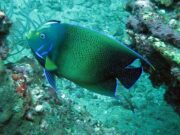
Pomacanthus semicirculatus @ Koh Haa
The ‘Semicircular’ name derives from the juveniles, which have half-circles in black, blue and white.
Juveniles inhabit shallow protected areas, while adults prefer coastal reefs with heavy coral growth providing plenty of hiding places.
The Semicircular Angelfish is often seen alone, sometimes in pairs. The diet includes sponges, tunicates, and algae.
Blue Ring Angelfish
(Pomacanthus annularis)
The Blue Ring Angelfish is one of the larger angelfishes, reaching up to 45 cm in length. This species has a golden brown to orangish body with many upward curving blue bands. The tail is white, with a yellow margin and there is a blue ring above the pectoral fin. There are numerous blue markings on the head.

Pomacanthus annularis @ Koh Phi Phi
The Blue Ring Angelfish is sometimes seen alone, but often in pairs. The diet of this species includes sponges, sea squirts and zooplankton.


Juvenile Blue Ring Angelfish have a bluish to black under colour, with narrow, closely spaced pale blue and white bars which are slightly arched, or bowed toward the head. Two or three of these bars are usually wider and more intensely coloured than the rest. The tail fin is white or translucent.
Emperor Angelfish
(Pomacanthus imperator)

Pomacanthus imperator @ Koh Bida
The emperor angelfish is very easy to identify from its bright blue and yellow stripes and yellow tail. This species has a black mask with blue margin across the eyes, and a broad black bar behind the head, again with a blue margin.
The emperor angelfish grows to 38 cm and can be solitary, but often seen in pairs along reef edges. Their diet includes sponges, tunicates (e.g. sea-squirts and other invertebrate filter feeders), and other encrusting organisms.
Juvenile emperor angelfish are dark blue with electric blue and white rings, and a white margin on the dorsal fin.
Blacktail Angelfish
(Centropyge eibli)

Centropyge eibli @ Koh Haa
The blacktail angelfish is one of the larger of the dwarf angelfishes, reaching up to 15 cm in length.
This fish is pale grey with thin brownish / reddish / orange stripes, a black tail and tail base. Both the rear end of the dorsal fin and the tail fin have a sapphire-blue margin.
This species is usually solitary, but may occasionally be seen in pairs. The diet includes soft corals and algae.
Indian Yellowtail Angelfish
(Apolemichthys xanthurus)

Apolemichthys xanthurus @ Koh Haa
The Indian Yellowtail Angelfish has a whitish to cream body colour and a dark margin around the entire body. The face is dark and the body scales have dark tips which gives a spotted effect.
The rear dorsal and anal fins are black with a white margin and the tail fin is yellow.
This species can occasionally be found with the Indian Vagabond Butterflyfish which has a similar appearance.
The Indian Yellowtail Angelfish is a medium sized angelfish, growing to around 15 cm, but more often observed around 10 cm - 12 cm.
This is a shy species, found in pairs and rarely seen at the dive sites around Koh Lanta.
Three-Spot Angelfish
(Apolemichthys trimaculatus)
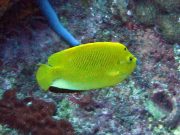
Apolemichthys trimaculatus @ Hin Muang
The Three-Spot Angelfish has a bright yellow body with a dark spot on the forehead and one each side close to the the gills, at eye-level. The mouth and lips are a vivid blue colour.
There is a grey patch between the eyes and the preopercle spine (spine jutting out below the gills) is light bluish grey.
All the fins are yellow, except for the anal fin which is white with a large black margin.
The Three-Spot Angelfish grows to 26 cm, but more likely observed around 10 cm - 15 cm. The diet includes sponges and tunicates such as sea squirts. Rarely seen at the dive sites around Koh Lanta.
Dykking med Engelfisker rundt Koh Lanta
Dykking og snorkleturer
Hvis du vil ha sjansen til å se Engelfisker på en av våre daglige dykkerturer fra Koh Lanta i høysesongen, kan du sende oss en e-post til info@diveandrelax.com.
Bli med på våre dykkerturer med hurtigbåt i høysesongen til noen av Thailands beste dykkesteder, og nyt små grupper, kort reisetid og fokus på god personlig service, sikkerhet og moro.
Not yet a certified diver? Learn to Scuba Dive on Koh Lanta with the 3 day SSI Open Water Diver course.
Bestill på nettet og spar 10 % på dykkerturer og dykkerkurs på Koh Lanta.
Finn ut mer
Guider om livet i havet i Indo-Stillehavet
- Allen, G., Steene, R., Humann, P., DeLoach, N. (2003) Reef Fish Identification, Tropical Pacific. Jacksonville, FL., USA: New World Publications, Inc., ISBN 1-878348-36-1.
- Humann, P., DeLoach, N., (2010) Reef Creature Identification, Tropical Pacific. Jacksonville, FL., USA: New World Publications Inc., ISBN 978-1-878348-44-9
- Debelius, H. (2013) Indian Ocean Reef Guide. Frankfurt, Germany: IKAN - Unterwasserarchiv, ISBN 978-3-939767-52-7.
- Debelius, H. (2004) Nudibranchs and Sea Snails, Indo-Pacific Field Guide. Frankfurt, Germany: IKAN - Unterwasserarchiv, ISBN 3-925919-51-1
- Erhardt, H., Knop, D. (2015) Corals Indo-Pacific Field Guide. Frankfurt, Germany: IKAN - Unterwasserarchiv, ISBN 3-925919-69-4.
- Veron J.E.N., Stafford-Smith M.G., Turak E. and DeVantier L.M. (2016). Corals of the World