


Dykking med Havskilpadder
Lantas marine liv | Chelonioidea
Det finnes fem arter av havskilpadder i thailandske farvann: læderskilpadde, olivskilpadde, karettskilpadde, grønnskilpadde og hawksbillskilpadde. Alle artene er beskyttet i henhold til den thailandske loven om beskyttelse av dyrelivet fra 1992.
Noen arter, som for eksempel hawksbill-skilpadden, er kritisk truet, og kan sees ved de fleste korallrev mens man dykker ved Koh Lanta.
De fem artene som finnes i thailandske farvann kan identifiseres som følger:
- Mønster på ryggskjoldet
- Lærskilpadde – 5 tydelige ryggribber, ingen skjoldplater
- Grønn skilpadde, karettskilpadde, urokse-skilpadde, oliven-skilpadde – ingen sammenhengende ryggribber, skjoldplater
- Sideplater
- Grønn og hawksbill – 4 par sideplater, første sideplate ikke nær nakkeplaten
- Loggerhead – 5 par sideplater, første sideplate nær nakkeplaten
- Olive Ridley – 6 til 8 par sideplater, første sideplate nær nakkeplaten
Hannene har lengre haler enn hunnene, og de fleste skilpaddene vi har registrert rundt Koh Lanta er hunner.
Havskilpadde-klekkeriet og oppdrettsanlegget ved Phang Nga Naval Base ble startet i 1995 og slipper nå ut over 10 000 skilpadder i havet hvert år. Eggene klekkes på Hooyong-øya i Similan-øyene, samles inn umiddelbart etter at de har kommet ut av reiret, og overføres til oppdrettsanlegget.
I verden overlever mindre enn 0,1 % av skilpaddeungene til voksen alder, mens 40 % av ungene fra Royal Thai Navy Sea Turtle Conservation Center ved Phang Nga Naval Base overlever til voksen alder.
Informasjonen på denne siden er hentet fra Sea Turtle Conservation Center, Phang Nga Naval Base, Khao Lak
3 arter funnet på denne siden:
Hawksbill Turtle
(Eretmochelys imbricata)
The hawksbill turtle is easily identified by its sharp hawk-like hooked-beak, and yellowish-brown visibly overlapping scutes on it carapace (shell). The beauty of its scutes has resulted in excessive hunting for accessories production.
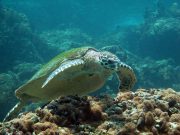
Eretmochelys imbricata @ Koh Bida
Their habitat is coral reefs and they eat bubble corals, sponges, sea snails and various marine animals. This turtle is critically endangered.
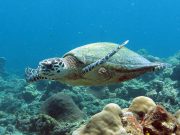

Some of the sponges and small animals that hawksbill turtles eat contain toxic substances. The turtles are not affected by these toxins, however these chemicals are collected in their body fat, and may pose a serious risk to humans who eat turtle meat.
The maximum size of hawksbill turtles is around 95cm and maximum weight around 60kg.
Hatching area in Thailand: Thai Gulf and Andaman Coast.
Green Turtle
(Chelonia mydas)
Green Turtles have a large pair of brown and white paddle-like flippers with maximum size of maturity is 120cm. And maximum weight is 150 kg. Its habitat is coastal areas, sea grass and seaweed are its main food and its spawning sources in Thailand are in beaches of Kram Islands, Similan Islands, Adang-Ravi Islands and Kra Island.
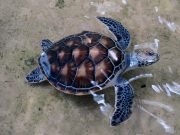
Juvenile Chelonia mydas @ Phang Nga
Green turtles begin their lives eating plants, fish and jellyfish, but become vegetarians as they grow older.

Adult Green Turtles @ Phang Nga

2 week old Green Turtle @ Phang Nga
Green turtles have yellow-brown shells reminiscent of the sky at sunset. They have the hardest shell in the world.
Hatching area in Thailand: multiple locations in both Thai Gulf and Andaman Coast.
Green turtle is named after the colour of their cartilage and fat. Lifespan in the wild up to 80 years.
Females nest at intervals of 2 -4 years, with average of 3 - 5 nests per season. Around 115 eggs are laid in each nest, with incubation period of around 60 days.
Green turtle photos taken at the:
- Sea Turtle Conservation Center, Phang Nga Naval Base, Khao Lak
- Thai Muang Turtle Sanctuary "Turtle Heaven", Phang-nga Coastal Fisheries Research and Development Center, Phang Nga
Olive Ridley Turtle
(Lepidochelys olivacea)
Olive Ridley Turtle is a small sea turtle with an adult carapace length of 75cm and its maximum weight is 50kg. The carapace is grey with 6-9 pairs of lateral scutes, its habitat is coastal area and small marine animals such as shrimp, shellfish, crab and fish are its food.
This turtle lives in the seas around Koh Lanta and all of our dive sites, and can be seen during boat trips to/from dive sites, but it rarely seen on the actual dive sites.
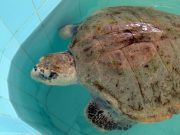
Lepidochelys olivacea @ Phang Nga
Olive Ridley Sea Turtle has spawning behaviour different from other sea turtles. Huge groups of 1,000 - 10,000 female turtles gather together to spawn simultaneously, called the ‘Arribada’ phenomenon in Orissa State in India.
There is no ‘Arribada’ phenomenon in Thailand ,but its spawning source is in the west coast of Phuket and Phangnga provinces.
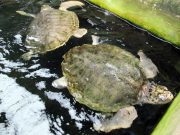
Olive Ridley Turtle @ Phang Nga
The Olive Ridley Turtle has a smooth grey-green shell and a big beak. It is the smallest species of sea turtles.
The diet consists of sea weeds and sea creatures like shrimps and snails.
The hatching area in Thailand is the Andaman Coast, though we don't see them here on Lanta's beaches.
Diet: Omnivore, molluscs and crustacean. Nests 3 times annually with 100 - 110 eggs per nest. Average life expectancy is 50 years.
Olive Ridley Turtle photos taken at the:
- Sea Turtle Conservation Center, Phang Nga Naval Base, Khao Lak
- Thai Muang Turtle Sanctuary "Turtle Heaven", Phang-nga Coastal Fisheries Research and Development Center, Phang Nga
Dykking med Havskilpadder rundt Koh Lanta
Dykking og snorkleturer
Hvis du vil ha sjansen til å se Havskilpadder på en av våre daglige dykkerturer fra Koh Lanta i høysesongen, kan du sende oss en e-post til info@diveandrelax.com.
Bli med på våre dykkerturer med hurtigbåt i høysesongen til noen av Thailands beste dykkesteder, og nyt små grupper, kort reisetid og fokus på god personlig service, sikkerhet og moro.
Not yet a certified diver? Learn to Scuba Dive on Koh Lanta with the 3 day SSI Open Water Diver course.
Bestill på nettet og spar 10 % på dykkerturer og dykkerkurs på Koh Lanta.
Finn ut mer
Guider om livet i havet i Indo-Stillehavet
- Allen, G., Steene, R., Humann, P., DeLoach, N. (2003) Reef Fish Identification, Tropical Pacific. Jacksonville, FL., USA: New World Publications, Inc., ISBN 1-878348-36-1.
- Humann, P., DeLoach, N., (2010) Reef Creature Identification, Tropical Pacific. Jacksonville, FL., USA: New World Publications Inc., ISBN 978-1-878348-44-9
- Debelius, H. (2013) Indian Ocean Reef Guide. Frankfurt, Germany: IKAN - Unterwasserarchiv, ISBN 978-3-939767-52-7.
- Debelius, H. (2004) Nudibranchs and Sea Snails, Indo-Pacific Field Guide. Frankfurt, Germany: IKAN - Unterwasserarchiv, ISBN 3-925919-51-1
- Erhardt, H., Knop, D. (2015) Corals Indo-Pacific Field Guide. Frankfurt, Germany: IKAN - Unterwasserarchiv, ISBN 3-925919-69-4.
- Veron J.E.N., Stafford-Smith M.G., Turak E. and DeVantier L.M. (2016). Corals of the World