


Dykking med Holothuriidae – sjøpølser
Lantas marine liv | Holothuriidae
Familien Holothuriidae består av rundt 185 sjøpølser, hvorav flere finnes i stort antall når man dykker fra Koh Lanta.
Holothuriidae-sjøpølser har tykke, kjøttfulle kropper, som varierer fra små til svært store, og er ofte dekket av små, avrundede utvekster kjent som papiller. Alle arter har mange rørlignende føtter på underkroppen, og flere arter har 15–30 munnføtter.
Når de blir stresset eller angrepet, er mange medlemmer av denne familien i stand til å skyte ut mange fine, klebrige hvite tråder fra anusen, kjent som Cuvierian Tubules. Disse rørene kan vikle seg rundt og uskadeliggjøre et rovdyr. Rørene kan løsne seg internt og deretter vokse ut igjen i løpet av 2–4 uker.
Avhengig av arten kan sjøpølser være skjult under steiner og steinsprut, begravd i sand, ligge eksponert, eller i noen tilfeller bevege seg aktivt rundt i et korallrev med sine rekker av klebrige rørføtter. Noen få arter er aktive om dagen, men de fleste er aktive om natten.
4 arter funnet på denne siden:
Elephant trunkfish
(Holothuria fuscopunctata)
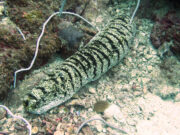
Holothuria fuscopunctata @ Koh Haa
The Elephant trunkfish is a large sea cucumber with a thick body wall, generally golden-brown with dark spots and dark brown wrinkles along its entire body length.
The underside is whitish, the mouth being surrounded by twenty thick brown tentacles and the anus surrounded by a black band.
This sea cucumber can reach up to 70 cm and can weigh up to 4.5kg, though it’s spotted around Lanta more commonly in the 30 - 50 cm range.
This species is normally found down to 30 m, is slow to mature and has a low fertility rate.
Graeffe's Sea Cucumber
(Pearsonothuria graeffei)
The Graeffe's Sea Cucumber is one of the most common sea cucumbers encountered at the dive sites around Koh Lanta. This species of sea cucumber has a white body, with many light, thorny projections surrounded by pale brown blotches. There are many small dark spots all over the body and hundreds of small tube feet on the lower body.
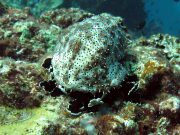
Adult Pearsonothuria graeffei @ Koh Haa
Around the mouth are around 20 - 24 tentacles comprising black stalks with leaf-like ends. The leaves are black on the top and white on the bottom and help to ‘feel’ the way around the coral reef.
This species grows up to 30 cm, are very light-weight and are very thin-walled and ‘floppy’ if picked up (we have rescued some from a fishing trap, but do not recommend touching any marine life in the course of a normal dive).

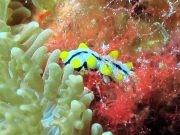
Small juvenile Graeffe's Sea Cucumbers mimic the phyllidiid sea slug Phyllidia varicosa for protection (many nudibranchs are poisonous and distasteful to predators), and as they grow larger than the nudibranch they are impersonating, they start to take on the adult sea cucumber colouration and form. (see photos)
Pinkfish Sea Cucumber
(Holothuria edulis)
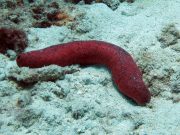
Holothuria edulis @ Koh Rok
The Pinkfish Sea Cucumber has a reddish-pink cylindrical body with rounded ends. There is sometimes a black area on the back/upper body, however this species can also be other colours, such as grey or dark brown.
The lower body has rows of small tube feet which help with movement, and which can be retracted into the body if necessary.
There are around 20 oral tentacles which can help with feeding, movement and also righting itself if it is overturned.
The Pinkfish Sea Cucumber grows to 35 cm and is found over sand and rubble is shallow areas of coral reefs.
Blue Sea Cucumber
(Actinopyga caerulea)
The Blue Sea Cucumber has a loaf-shaped body with some tapering toward each end. The body colour is mostly bluish, with white patches. The bluish areas are covered with small conical 'papillae', which are absent in the white areas.
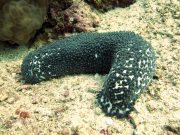
Actinopyga caerulea @ Koh Haa
The mouth of a Blue Sea Cucumber is on the bottom, surrounded by 15 to 18 large bluish-grey tentacles, which in turn are surrounded by a collar of bluish papillae.
The anus of the Blue Sea Cucumber is at the rear end, surrounded by 5 white anal teeth.
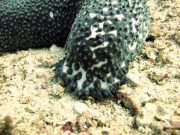
Actinopyga caerulea @ Koh Haa
Unlike many other members of the family Holothuriidae, the Cuvierian organ is absent in Blue Sea Cucumbers and this species is unable to eject Cuvieran tubules if stressed.
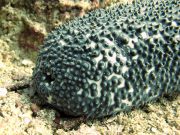
Actinopyga caerulea @ Koh Haa
Dykking med Holothuriidae – sjøpølser rundt Koh Lanta
Dykking og snorkleturer
Hvis du vil ha sjansen til å se Holothuriidae – sjøpølser på en av våre daglige dykkerturer fra Koh Lanta i høysesongen, kan du sende oss en e-post til info@diveandrelax.com.
Bli med på våre dykkerturer med hurtigbåt i høysesongen til noen av Thailands beste dykkesteder, og nyt små grupper, kort reisetid og fokus på god personlig service, sikkerhet og moro.
Not yet a certified diver? Learn to Scuba Dive on Koh Lanta with the 3 day SSI Open Water Diver course.
Bestill på nettet og spar 10 % på dykkerturer og dykkerkurs på Koh Lanta.
Finn ut mer
Guider om livet i havet i Indo-Stillehavet
- Allen, G., Steene, R., Humann, P., DeLoach, N. (2003) Reef Fish Identification, Tropical Pacific. Jacksonville, FL., USA: New World Publications, Inc., ISBN 1-878348-36-1.
- Humann, P., DeLoach, N., (2010) Reef Creature Identification, Tropical Pacific. Jacksonville, FL., USA: New World Publications Inc., ISBN 978-1-878348-44-9
- Debelius, H. (2013) Indian Ocean Reef Guide. Frankfurt, Germany: IKAN - Unterwasserarchiv, ISBN 978-3-939767-52-7.
- Debelius, H. (2004) Nudibranchs and Sea Snails, Indo-Pacific Field Guide. Frankfurt, Germany: IKAN - Unterwasserarchiv, ISBN 3-925919-51-1
- Erhardt, H., Knop, D. (2015) Corals Indo-Pacific Field Guide. Frankfurt, Germany: IKAN - Unterwasserarchiv, ISBN 3-925919-69-4.
- Veron J.E.N., Stafford-Smith M.G., Turak E. and DeVantier L.M. (2016). Corals of the World